Detailed Explanation of Key Techniques for Transplanting Pine Bonsai
People often say an old saying: a person moves and thrives, a tree moves and dies. So, especially for transplanting large trees, extra care is needed, otherwise it is a great pity if they die during the transplanting process. Take pine trees for example, transplanting large-sized pine trees is also particularly important.
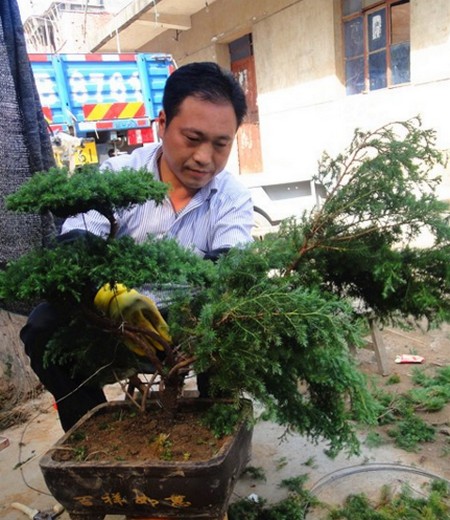
1. Pine tree transplanting is generally carried out in early spring before the pine tree sprouts, but it should not be done during the frozen soil period, as low temperatures will affect the recovery of the root system.
2. When transplanting, first dig the hole at the planting site, then dig up the tree; when digging up the tree, a soil ball must be kept.
3. The size of the soil ball should generally be 5-6 times the diameter of the tree base, and it should be tied firmly with straw rope to prevent the soil ball from falling apart.
4. Larger trees need to be hoisted with a crane, and no more than 2 trees may be loaded per trip; during transplanting, damage to the bark must be avoided, and protective measures must be in place.
5. The time the pine tree stays before being placed into the hole should be shortened as much as possible, to avoid leaf transpiration causing the plant to lose a large amount of water and affecting the survival rate.
6. If the root system is damaged, it should be trimmed smooth with sharp scissors; it must not be left in a torn state.
7. If conditions permit, the root system can be soaked in a rooting powder solution, which can improve the survival rate.
8. When planting, the depth must be controlled, taking the original depth as the standard; it must not be too deep, otherwise the survival rate will be affected; when planting, first fill in half of the soil, firm it down, then fill in the other half of the soil, and firm it down at the end as well.
9. After planting, water thoroughly immediately, and spray and wash the leaves and branches with clean water to increase air humidity, so as to help the plant recover its vitality.
10. Support stakes must be set up to prevent the wind from blowing the tree over and affecting root growth. Generally, three wooden sticks or bamboo poles are used for support. But note that at the points where the wooden sticks or bamboo poles are tied to the pine tree, soft cloth or other materials should be used to protect the bark; otherwise, as the pine tree sways in the wind, the bark will be damaged and the survival rate will be affected.
11. Water thoroughly a second time after an interval of 1—2 days; the third watering should be at an interval of 3—5 days; afterward, follow the principle of not watering until the surface soil is dry, and water thoroughly when watering; and when the temperature is above 20°C, spray water once a day; after one month, the number of sprays can be reduced or spraying can be stopped.
12. Try not to fertilize in the same year; it is not too late to fertilize in the spring of the following year.
After newly planted trees are watered thoroughly for the first time, depending on weather conditions, adopt the principle of "do not water until dry, water when dry and let dry in between." It is strictly forbidden for the tree basin to remain waterlogged for a long time. After entering summer, spray water daily on the trunk wrapped with straw rope, keeping the straw rope in a constantly moist state to ensure the trunk retains moisture and stays cool. For a small number of key locations and important trees, key protection measures should be taken, that is, install shade netting above the crown to lower the temperature of the micro-environment, reduce water evaporation, and create an environment conducive to the recovery and growth of newly planted trees.