Detailed Guide to Planting and Caring for a Distylium Bonsai
The distylium tree has dense branches and leaves, a neat tree shape, and deep green foliage that stays evergreen through winter. In spring it produces small red flowers that are quite beautiful. In addition, it is highly resistant, effective at dust-proofing and sound insulation, and is a greening and ornamental tree species for cities and industrial and mining areas. It is very suitable for planting along roadsides, on lawns in front of courtyards, and under large trees; planting it in clumps or patches as a space divider or as a background for other flowers and trees also works well.
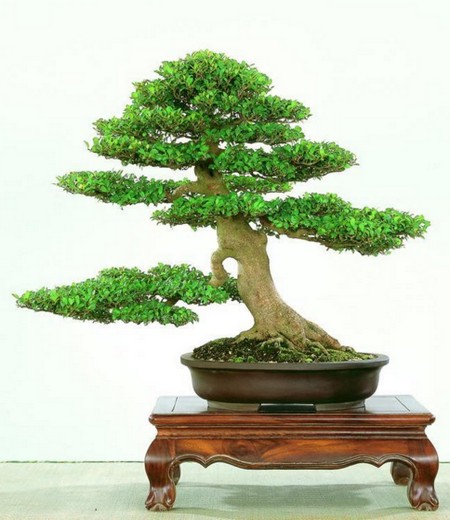
If pruned into a spherical shape, it is suitable for planting in pairs beside a gate or as a foundation planting material. It can also be planted as a hedge and protective forest belt.
Seed collection: Collect seeds from September to October. Because the fruit ripening period is not very uniform, harvest in 2 to 3 batches. After collection, dry them in the sun for 1 to 2 days, then move them indoors and spread them out in a dry, ventilated place at a thickness of 3 cm to 5 cm. After 5 to 7 days the capsules split open, and some seeds can be seen bursting out. Then gently turn and beat them with a wooden stick, and most of the seeds will burst out.
Land preparation: Choose a flat nursery plot with convenient irrigation and good drainage and fertile loam soil. Deep plow 25 cm to 30 cm, then level it and make beds 1 m to 1.2 m wide. When making the beds, quicklime can be broadcast at 20 kg per mu to sterilize and insecticide-treat the soil, preventing damping-off, seedling blight, and damage from underground pests during the seedling stage. At the same time, apply 20 to 30 kg of compound fertilizer or 80 to 100 kg of superphosphate per mu as a base fertilizer. Lightly rake and loosen the surface soil before sowing.
Sowing: The sowing time is in early to mid-October. The sowing rate is about 8 to 10 kg per mu. Broadcast evenly, cover with fine burnt soil ash and yellow subsoil, with a thickness such that the seeds are not visible; it must not be too thick. For early spring sowing, the sowing time is around the Beginning of Spring in late January. Before sowing, soak the seeds in hot water at 50°C to 60°C for 24 hours, which can achieve a certain degree of germination promotion.
Pests and diseases: The distylium tree generally has few pests and diseases, but if planted in a damp, shady, and poorly ventilated place, it is prone to damage by scale insects. After germination, pay attention to preventing rats and birds.
Precautions:
1) Carry out daily care according to its habits, with management involving generous water and fertilizer, high temperature and high humidity, and half shade and half sun;
2) Prune after new leaves turn dark green. It can be shaped 3-4 times a year. Fertilize before pruning and shaping;
3) Never let it lose water, otherwise growth will be poor; in mild cases branches will wither, and in severe cases the trunk will die.