Which peach tree varieties are suitable for bonsai?
Peach bonsai have a small tree body, with rugged, gnarled and twisted branches; the flowers are brilliantly colored and enchantingly lovely; the fruits come in various shapes and bright red colors, giving off wafts of delicate fragrance that are intoxicating.
Peach bonsai symbolize “fortune, longevity and good luck”. If one can place a flat peach bonsai laden with abundant fruits at a birthday banquet to bless relatives and friends, it not only adds a festive birthday atmosphere but also brings a different kind of life enjoyment. They can also be combined with other fruit tree bonsai and displayed in plazas, parks and other places, which not only beautifies the environment but also adds a beautiful scenery to festive occasions. They can also be placed on balconies, in living rooms and meeting halls, beautifying life and cultivating character.
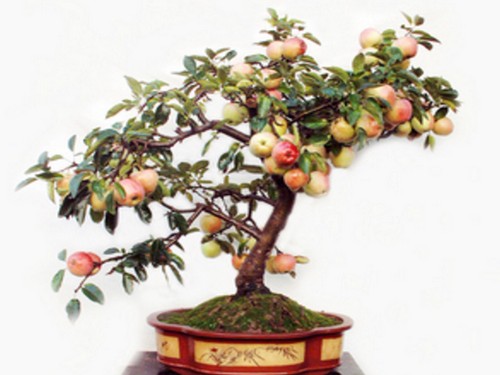
What kinds of peach tree varieties are suitable for bonsai:
1. Zaolu Flat Peach
The tree posture is spreading, with many compound flower buds, and all types of fruiting branches can bear fruit. The fruit-setting rate is high, with a single fruit weight of 100 grams. The fruit shape is flat, the fruit apex is concave, and the suture line is shallow. The base color of the fruit skin is creamy yellow, with a red blush on the sunny side, and the fruit-viewing period is about 75 days. It is one of the excellent varieties for making early-market peach bonsai.
2. Late-maturing Large Flat Peach
The tree vigor is moderate, with many compound flower buds, and all types of fruiting branches can bear fruit. The largest single fruit weighs 240 grams. The fruit skin is greenish-white with bright red patchy blush, and the fruit-viewing period is about 110 days.
3. Chongyang Hong
Young trees have strong bud-breaking rate and branching ability. After fruiting, the tree vigor is moderate, the tree posture is semi-spreading, the fruits are extra-large, with a single fruit weight of about 350 grams and a maximum weight of 700. Nearly round, bright red, and the fruit-viewing period is about 180 days.
4. Zhonghua Shoutao
The fruit is nearly round, with an average single fruit weight of 350 grams, and when planted in pots the largest single fruit weighs up to 1200 grams. The color is bright red. The fruit surface is smooth and it ripens in early October. Around National Day is the best viewing period for bonsai of this variety.
5. Wanmi
The tree vigor is strong, the tree posture is semi-spreading, with rose-shaped flowers. All types of fruiting branches can bear fruit. The fruit is nearly round, with an average single fruit weight of 260 grams, and when planted in pots the largest single fruit can reach 500 grams. After bagging, the fruit turns bright red, and around National Day is the best viewing period.
Suitable rootstocks for peach bonsai
There are not many rootstocks for peach. Generally, in the south, maotao (wild peach) is mostly used, while in the north, shantao (mountain peach, shanmaotao) is mostly used. Maotao is drought-tolerant, highly cold-resistant, has a developed root system, strong adaptability, strong grafting compatibility, and a long lifespan. Shantao is drought-tolerant, cold-tolerant, and alkali-tolerant but not moisture-tolerant, with strong compatibility with peach, though its lifespan is not as long as that of maotao.
There are also those that use plants of other genera as rootstocks, such as plum, apricot and Nanking cherry, etc. According to observations, peach varieties grafted onto rootstocks such as apricot rootstock, plum rootstock, Mayday cherry and Shouxing Tao all showed the characteristics of moderate growth vigor, smaller growth amount and early flower formation. However, the graft union often shows unbalanced growth, demonstrating a state of incomplete compatibility.