How to grow potted Cleome hassleriana (spider flower)? A detailed guide to growing techniques
The flower stalks of Cleome hassleriana (spider flower) are long and sturdy, and the raceme forms a lush flower ball. The flower shape is elegant and distinctive, with petals rounded like a fan and stamens protruding like claws, resembling butterflies in flight. The flower colors are delicate and vivid, first pinkish-white, then turning pink, and finally purplish-red. One flower bears multiple colors and also has nectar glands, often intoxicating flying butterflies, hence the name. When planted in the ground, it can be placed beside courtyard walls or under trees; when potted, it can be displayed on a windowsill or desk.
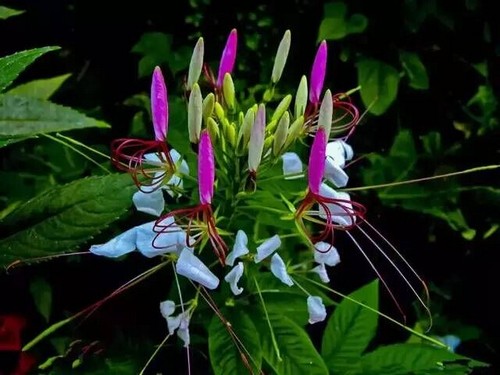
For propagation by sowing, sow in spring from March to April by broadcasting. Because the seeds germinate uniformly, the sowing density should be low. After sowing, cover with 0.2 cm of soil. At 15°C, they germinate in 7-10 days. After emergence, thin the seedlings and apply fertilizer. When there are 2-3 true leaves, they can be transplanted. If sown in autumn in a greenhouse, they bloom in spring. The seedlings grow slowly, so fertilizer and water management should be strengthened during the growing period, fertilizing once every half month, and controlling nitrogen fertilizer. When flower spikes begin to emerge, a 0.4% daminozide solution can be applied to control growth height, which benefits plant shape and flowering.
Cleome hassleriana is commonly propagated by sowing. It can be sown in open-ground seedbeds in spring from March to April, or sown earlier in pots in a greenhouse in February. After germination from open-ground sowing, thinning should be done promptly. When the seedlings grow 2 true leaves, they need to be transplanted once at a spacing of about 10 cm. When the seedlings reach about 5 cm, they are planted out in the garden at a spacing of 30 cm to 40 cm between plants and rows.
Because Cleome hassleriana is a taproot plant with relatively few fibrous roots and is not tolerant of transplanting, it must be transplanted while still a seedling to improve the survival rate. After transplanting or planting out, careful management is needed, watering promptly and covering with reed blinds or similar materials to protect from sun and wind. In addition, when used in gardens, to reduce labor intensity, the seeds can also be sown directly in the garden area where they are to be grown. Generally, spring-sown plants bloom in summer and autumn, while autumn-sown plants bloom indoors in winter and spring.
Cleome hassleriana is native to the tropical regions of South America, so it is not cold-tolerant, but it is heat-tolerant and drought-tolerant. It prefers a warm, dry, sunny and well-ventilated growing environment and can also tolerate partial shade. It has relatively low soil requirements and grows best in loose, fertile, well-drained sandy loam. Its optimum growing temperature is 15°C-25°C. In summer, water at least once a day. In high-temperature weather, watering should avoid the period of direct midday sunlight. Because Cleome hassleriana has a long flowering period, apply a dilute liquid fertilizer once every half month to promote good growth. When planted in flowerbeds for ornamental display, remove spent flowers promptly so that they do not set seed, thereby extending the flowering period. The capsules of Cleome hassleriana split open on their own when mature, and the seeds scatter easily, so seeds should be collected when the capsules turn from green to yellow.
The petals of Cleome hassleriana are light and graceful, and when in full bloom they seem like butterflies dancing, which is quite interesting. It can be used to arrange flowerbeds and flower borders in summer and autumn, and can also be dwarf-cultivated as a potted ornamental. In garden applications, because of its tolerance of partial shade, it can be planted under trees or on the shady side of buildings for viewing. It is worth mentioning that Cleome hassleriana has good resistance to sulfur dioxide and chlorine gas, making it an excellent pollution-resistant flower that can also grow well in heavily polluted factories and mines.
Key cultivation points:
Sowing: There are about 600-900 seeds per gram. Generally, 128-cell or 288-cell plug trays are used for sowing. The sowing medium is generally imported seedling peat moss. After sowing, a thin layer of vermiculite should be covered. The pH value is 5.5-5.8. The Gem series does not require special treatment before sowing to promote germination and growth.
Transplanting and potting up: Once 3-4 true leaves have developed, they can be potted up. Generally, a 15 cm nutrition pot or a larger flower pot is used for transplanting. The potting medium should be loose, well-drained garden soil plus organic fertilizer and compound fertilizer, with the pH controlled at 5.6-6.0.
Temperature: During the growing period, 22-27°C during the day and 16-18°C at night. The combination of high temperature and low light will cause spindly growth, while growth stops at low temperatures.
Fertilizer: It is a fertilizer-loving plant. Continuously apply a 20-10-20 nitrogen-phosphorus-potassium balanced fertilizer at about 1000 times dilution, and after every 3 fertilizer applications, water once with clear water.
Light: It prefers abundant sunlight and also tolerates partial shade.