A Detailed Guide to Soilless Culture Techniques for Household Flowers and Bonsai
The soilless culture technique for flowers and bonsai is a new technique in which perlite, vermiculite or other lightweight gravel (do not use decaying plant matter, such as sawdust, cottonseed hulls and other organic humus, as the growing medium) is placed in a flower pot, and then an inorganic salt nutrient solution is added to grow flowers. The nutrient solution contains a variety of disinfecting agents, and the medium in the pot is also an inorganic mineral, so it does not breed insects, ants or bacteria; it also contains all the elements needed for plant growth, which can make plants grow quickly, with robust plants, more and earlier flowers, larger and more fragrant blooms, and resistance to cold and heat, with few pests and diseases.
Nowadays, only soilless-cultured flowers and bonsai can be exported and enter advanced countries; soilless-cultured indoor plants are even more suitable for display in high-grade hotels, restaurants, shopping malls, office buildings and modern homes. Soilless-cultured flowers and bonsai have good market sales prospects. In addition, fresh cut flowers and vegetables grown in greenhouses with nutrient solution can increase yield and quality, and can supply the market in all four seasons.
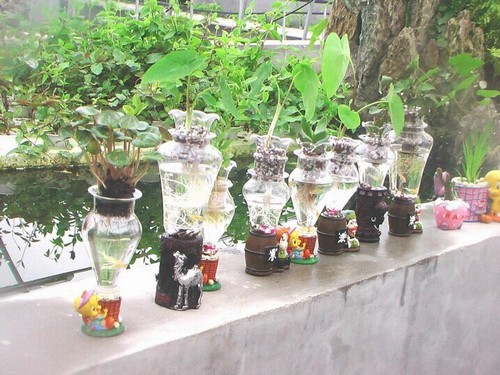
Flowers and bonsai can be converted from soil culture to soilless culture in any season.
The specific steps are as follows:
1. Prepare the nutrient solution: dilute the soilless culture nutrient solution sold on the market with water according to the specified multiple. You can also prepare the nutrient solution yourself using the following formula:
① Macroelements: potassium nitrate 3 grams, calcium nitrate 5 grams, magnesium sulfate 3 grams, ammonium phosphate 2 grams, potassium sulfate 1 gram, potassium dihydrogen phosphate 1 gram;
② Microelements: (use chemical reagents) disodium edetate 100 mg, ferrous sulfate 75 mg, boric acid 30 mg, manganese sulfate 20 mg, zinc sulfate 5 mg, copper sulfate 1 mg, ammonium molybdate 2 mg;
③ Tap water 5000 milliliters (that is, 5 kg). Prepare the macroelements and microelements separately into solutions, then mix them together to make the nutrient solution. The amount of microelements used is very small and difficult to weigh, so they can be prepared at an increased multiple, and then the required amount can be drawn out by reducing it by the same multiple. For example, the microelements can be weighed out at 100 times the amount and made into a solution, then 1% of that solution is drawn out, which is the required amount. The nutrient solution is non-toxic, odorless, clean and hygienic, and can be stored for a long time.
2. Remove from the pot: use your fingers to push the root system together with the soil out through the hole at the bottom of the pot.
3. Wash the roots: soak the soil-covered root system in water close to the ambient temperature, and wash the soil from around the roots.
4. Soak in solution: place the washed roots in the prepared nutrient solution and soak for 10 minutes to allow them to fully absorb nutrients.
5. Potting and pouring in the solution: wash the flower pot, place a tile piece or plug with plastic gauze at the hole at the bottom of the pot, then put a small amount of perlite and vermiculite into the pot, then place the plant into the pot and hold it upright, then fill perlite, vermiculite and other lightweight minerals around the root system, and gently shake the flower pot so that the minerals closely contact the root system. Then pour in the prepared nutrient solution until liquid flows out from the hole at the bottom of the pot.
6. Reinforce the root system: place broken pieces such as English stone and ax-split stone on top of the root system to reinforce the roots and prevent lodging. At the same time, spray some clean water on the leaves.