Detailed Explanation of the Types and Characteristics of Buds on Fruit Tree Bonsai
In recent years, with the improvement of people's living standards and the continuous improvement of office and residential conditions, the beautification of the environment has become rich and colorful. Potted fruit trees and fruit tree bonsai have become a major landscape and fashion in indoor and outdoor greening decorations for homes, balconies, hotels, restaurants, parks, courtyards, etc.
Generally speaking, potted fruit trees are a cultivation method in which fruit trees are planted in pots so that they bloom and bear fruit, while fruit tree bonsai, building on potted fruit trees, inherits and carries forward the shaping art of China's traditional stump bonsai. Through artistic processing, they are formed into artworks of high ornamental value. Both are a rare gem in the flower and bonsai industry.
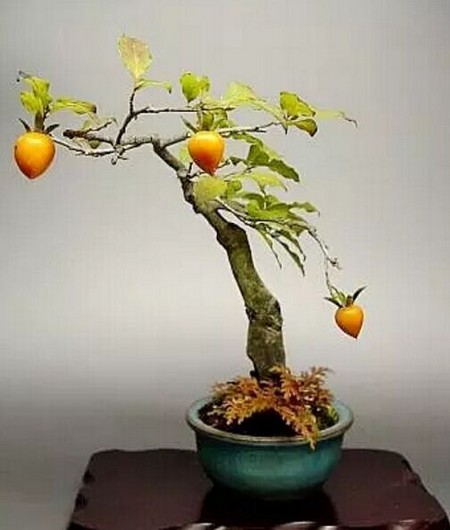
Because of the unique beautifying effect of potted fruit trees and fruit tree bonsai, they can decorate large hotels and restaurants, and can also be made into aerial orchards, miniature orchards, etc., and are even more loved by flower and bonsai enthusiasts. With their unique charm of graceful spring blossoms, verdant summer leaves, brilliantly colored autumn fruit, and sturdy, vigorous winter branches, they have a distinctive appeal and are praised by garden experts as living art that blends "novelty, uniqueness, and wonder into one."
All branches, leaves, flowers, and fruits develop from buds. Buds are the primordial bodies that form these organs. When propagating, grafted buds can form new plants. Buds have the following types:
According to the position where buds are borne on the branch, they can be divided into terminal buds and lateral buds. Terminal buds are borne at the tip of the branch and have strong sprouting ability, generally able to sprout in the second year. Lateral buds are borne in the leaf axils of the branch, also called axillary buds, and have weaker sprouting ability, often not all able to sprout in the second year.
According to the number of buds borne at the same node, they can be divided into single buds and multiple buds. A node with only one bud is called a single bud, as in apple, pear, and persimmon. A node with two or more buds is called a multiple bud; for example, the multiple buds of peach, plum, and apricot often consist of 2-4 buds. In addition, on the side or base of the lateral buds of apple, pear, jujube, hawthorn, etc., there is a lateral bud with a very small bud body that is not easy to find, mostly in a dormant state, which can sprout when the main bud is damaged.
According to the nature of the buds, they can be divided into flower buds and leaf buds. Leaf buds can only produce branches and leaves, while flower buds can bloom and bear fruit. In external morphology, flower buds are generally larger and plumper, with tighter bud scales. Different tree species and cultivars also have different characteristics of flower buds and lateral buds. Bonsai growers must identify them accurately.
Some fruit trees, such as grape, peach, apricot, plum, etc., have buds formed in the same year that can sprout, called precocious buds. They can cause branches to grow multiple times and increase the branching order of the whole tree, so fruit trees with precocious buds generally bear fruit earlier.
Due to differences in environmental conditions and nutritional status during the formation and development of buds, differences arise in bud quality, growth vigor, and external characteristics. For example, buds formed at the base of branches in early spring, when temperatures are low and the tree has few leaves, have a low degree of development and become shriveled buds, and the base of the branch appears in a "ring scar" state. Afterward, as temperatures rise and leaf area increases, the buds formed in the middle of the branch become better in quality, with larger and plumper bud bodies. Similarly, at the junction of spring and autumn shoots, the buds formed when the autumn shoot has just begun to grow are also in an unfilled state, and this part is commonly called a "blind node."
The quality and plumpness of buds noticeably affect the growth vigor of new shoots. Plump strong buds and large buds produce strong branches and long branches; weak buds and small buds produce weak branches and short branches. In shaping and pruning, this characteristic of buds is often used to change the branch length and the ratio of long to short branches in the tree, promoting formation and earlier fruiting.