What are the characteristics of the root system of fruit tree bonsai? A detailed explanation
Potted fruits and vegetables have a long flowering and fruiting period and beautiful shapes. They can not only green the space but also add more interest than ordinary greenery. Placed indoors, they allow you to enjoy the entire process of flowering and fruiting over a long period. Potted fruits and vegetables include both summer varieties planted in the open air and winter varieties grown in greenhouses and plastic tunnels, so people can enjoy and taste fresh fruits and vegetables indoors all year round.
The root system is not only the organ that anchors the fruit tree and absorbs nutrients and water, but also the organ that stores and synthesizes organic nutrients. A healthy root system is the foundation for the normal growth and fruiting of bonsai fruit trees.
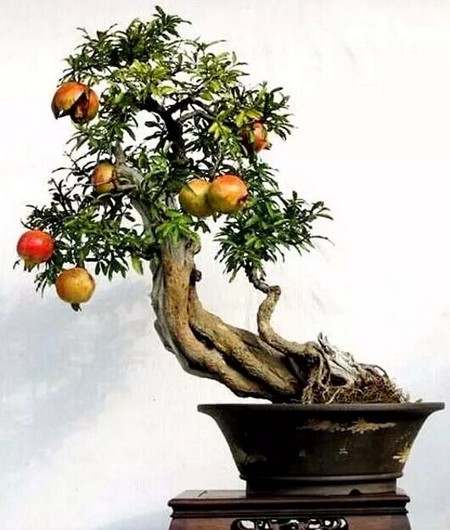
Under potted conditions, due to the centrifugal growth habit of roots and the superior soil aeration near the pot wall, roots mostly grow in a circle along the pot wall and pot bottom, forming a root mat and root ball. After 2-3 years, as the roots elongate and root mass increases, the root ball fills the pot. This aged root ball reduces the proportion of soil in the pot, directly affecting the absorption and transport of nutrients. Therefore, it is necessary to repot in time, prune the roots, and replace with new growing medium. The interval between repotting should be flexibly determined according to the growth of the root system and the aboveground parts, generally 2-3 years.
Compared with the deep and extensive root distribution of field-grown fruit trees, the root ball of potted trees has greatly reduced adaptability and resistance to changes in the external environment such as temperature and humidity, soil aeration, fertilizer concentration, harmful substances, and pests and diseases. Poor environmental conditions and improper management often cause root damage, weakening, and even death. When potted trees grow weakly, leaves become dull, yellow, and lose their luster, and fruits develop poorly or even drop, you should first check whether the roots are damaged and take timely remedial measures.
If the conditions required by the fruit tree root system are met, it can grow continuously throughout the year. Its growth peaks often alternate with the growth peaks of the canopy, that is, before each new shoot emerges or before the rapid growth period of new shoots, there is a peak period of root growth. The condition of roots produced during this period has a direct influence on the growth of new shoots that appear afterward. Fruit tree roots all have strong regenerative ability; after cutting, a large number of new roots tend to grow near the wound. The factors affecting root growth and absorption are as follows.
1. Temperature. Generally, fruit tree roots begin activity above 0°C, and the optimum temperature for growth is 15-25°C. When soil temperature exceeds 30°C, growth is inhibited. Different tree species also differ in their temperature requirements for roots. For example, apple roots begin to grow at 1-2°C, with 14-21°C being the optimum temperature for growth; while citrus roots begin to grow at around 12°C, with an optimum temperature of around 26°C and a maximum growth temperature of 37°C. After the soil thaws in early spring, the roots of potted apple, pear, peach, hawthorn, and other trees begin to grow, and large numbers of new roots emerge before the rapid growth period of new shoots. Citrus, persimmon, jujube, and some southern fruit trees produce new roots later in spring, and root growth is more gradual. In winter, the roots of northern deciduous fruit trees are in a dormant state, maintaining only minimal physiological activity. Likewise, for southern evergreen fruit trees overwintering in greenhouses, root activity in winter is also relatively weak. The cold resistance of roots is related to the genetic characteristics of the tree species. Within the same tree species, it is related to the level of stored nutrients. Vigorous perennial roots have strong cold resistance. Under the same overwintering conditions, newly potted young trees are prone to twig shriveling and even freezing to death, so special protection should be given during cultivation. For potted trees placed in summer on concrete surfaces such as balconies, rooftops, and front steps, due to the scorching local high temperatures and heat conduction from the concrete ground, the pot soil temperature is often too high and damages the roots, especially when the canopy is small, shading of the potted tree is poor, or soil moisture is low. This situation can be adjusted by spraying water on the ground and adding moisture pads under the pots.
2. Water. The pot soil moisture content most suitable for root growth is about 60%-80% of the maximum water-holding capacity of the soil. The drought resistance of roots is much lower than that of leaves. Under drought conditions, leaves draw large amounts of water from the roots, causing root damage and even death. Due to the limited volume of pot soil and the relatively large surface area for loss, the rate of water loss in pots is 4-5 times higher than that of surface soil in field orchards. With careless management, water loss occurs very easily. The smaller the pot, the larger the canopy, the higher the temperature, and the clearer and drier the climate, especially during dry hot wind seasons, the faster the water loss, and the more attention should be paid to timely replenishment of water in the pot.
3. Aeration. The physical structure of pot soil is composed of soil particles and pores. Small capillary pores are occupied by water, while large non-capillary pores are occupied by air. The respiration, growth, and other physiological activities of fruit tree roots all require an adequate supply of oxygen in the pot soil. Under oxygen-deficient conditions in the pot soil, normal respiration and physiological activities of fruit trees are hindered, and growth stops. At the same time, the accumulation of carbon dioxide and other harmful gases causes root poisoning and root death. The most suitable soil composition for fruit tree growth is that soil pores account for about 50% of the total soil volume, with water and air in the pores each accounting for about half.
The aeration and water permeability of potted nutrient soil (referred to as permeability) indicates the proportion of soil pores. When mixing, materials can be obtained according to local conditions and appropriately adjusted according to tree species and different pots. For example, peach roots have strong respiration and high oxygen consumption, and require high permeability of pot soil, while jujube roots are not very demanding for oxygen and can also adapt to heavy clay nutrient soil with poor aeration. The permeability of purple clay or glazed bonsai pots is far inferior to that of unglazed clay pots, so the permeability of the pot soil should be increased. In addition, raw materials differ from place to place, and when preparing nutrient soil, it should be flexibly adjusted according to the physical properties of the materials.
4. Nutrition. The growth and development of the root system are related to the supply of soil nutrients and the supply of photosynthetic products from the aboveground parts. "Deep roots" and "luxuriant leaves" have a mutually causal and mutually promoting relationship. For example, when a potted tree bears too much fruit and the supply of photosynthetic products falls short of demand, root growth is markedly weakened, but adopting reasonable fruit-thinning measures to reduce nutrient consumption in the aboveground parts can significantly promote root growth. Similarly, for diseased and weak trees, taking leaf-preservation measures and spraying fertilizer on the leaves to promote leaf function can also promote strong root growth.
5. Pot soil pH. Soil acidity and alkalinity, expressed as pH value, directly affect root growth and absorption. In pot soil with higher acidity, the root system's ability to absorb elements such as phosphorus, calcium, and magnesium decreases. In strongly alkaline pot soil, the absorption of manganese, iron, and zinc by the root system is hindered. Most fruit trees prefer a slightly acidic-neutral-slightly alkaline environment (pH 6.5-7.5). If the pot soil is too acidic or too alkaline, deficiency symptoms may occur, affecting the growth and fruiting of fruit trees. However, different tree species also have different requirements for pot soil pH, which should be noted when preparing soil.