5 major characteristics of fruit tree bonsai, explained in one article
Fruit tree bonsai is a product of combining modern fruit tree cultivation techniques with traditional bonsai art, integrating flower appreciation, fruit viewing and scenery appreciation into one, so that beauty of form and beauty of abundance are displayed at the same time. In spring, the flowering branches are delicate and beautiful, gorgeous as brocade; in summer, full of vitality, crisp and ready to drip, the fruit grows from small to large, changing with each passing day; in golden autumn, the abundant fruit is a riot of color. An excellent fruit tree bonsai has both the beauty of a bountiful harvest from fruit tree cultivation and the artistic beauty of traditional Chinese bonsai, with a distinct style and character of its own.
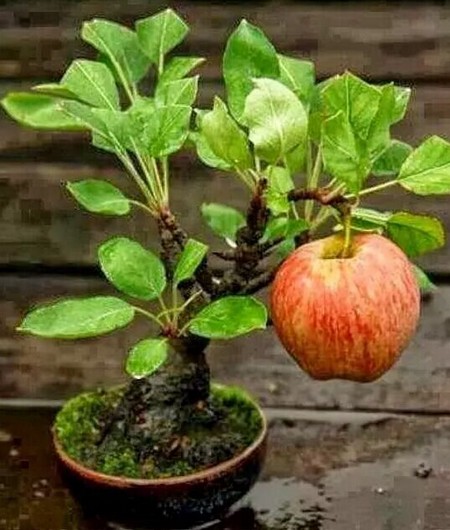
The 5 major characteristics of fruit tree bonsai:
1. Both form and fruit, dazzling and radiant
Fruit tree bonsai equals styling plus abundant fruit. That is to say, it must have the plastic arts of roots, trunk, form and spirit, and must also have a sufficient number of fruit; neither can be missing. In fruit tree bonsai, fruit is an important part of the form; the number, layout, size and color of the fruit are an important part of the art of fruit tree bonsai. Especially the large-fruit bonsai developed in recent years, such as apple, pear, peach, persimmon, hawthorn and local fruit trees such as citrus, carry fruit with form and form with fruit, combining form and fruit, full of delightful charm.
2. Rich in the joy of life
The roots, trunk, branches, leaves, flowers, fruit and form of fruit tree bonsai make up an ornamental whole. Especially the northern fruit tree bonsai developed in recent years: in spring its flowers are exquisite and graceful; in autumn the fruit is abundant and colorful; in winter the sparse branches are firm and upright, elegant and vigorous; while summer is exactly the period when the fruit develops and the branches and leaves are lush, and within ten days the green branches and emerald fruit take on a new look, extremely rich in the joy of life and the breath of nature.
3. Abundant resources, convenient for production
China has extremely rich fruit tree resources. Rootstocks, nursery stock and discarded trees from fruit tree production can all be used; the various wild fruit trees and their rootstock resources in the mountains and wilds are rarely developed and utilized, and they can especially make up for the deficiency of poor bonsai resources in northern China, developing local bonsai with local characteristics according to local conditions. There are many types and varieties of fruit trees; the fruit form, size, color and ripening period of different tree species and varieties are all inconsistent, and they can suit many kinds of styling. Because materials are obtained locally, each tree species adapts to the local ecological conditions, requires no special maintenance facilities, and is simple to manage, convenient for production, and can be turned into an enterprise without much investment.
4. Bold and natural styling style
Another difference from ordinary foliage bonsai is that, in cultivating fruit tree bonsai, in addition to studying styling, attention must also be paid to cultivating flowers and fruit. The cultivation of flowers and fruit, however, requires branches with a certain growth vigor and a certain leaf area, that is, certain nutritional conditions. In addition, the flowers and fruit of some fruit trees are exactly at the tips of the branches. All of this determines that fruit tree bonsai cannot, like ordinary foliage bonsai, be meticulously wired and pruned at will with regard to branches and leaves. The inherent laws of fruit tree bonsai determine a bold and natural style in styling and pruning. In terms of specifications, it can be miniaturized, but it is difficult to make it micro-sized; in the treatment of branches and leaves, it can be layered, but it is difficult to make it into “sheets”; in overall styling, its basic shape can be freely created, but the fine details are difficult to wire and coil meticulously; the number of fruit set by fruit tree bonsai changes every year, and the fruiting position changes every year, so flowers must be cultivated and fruit nurtured anew every year, and it cannot be done once and for all. Cultivating fruit tree bonsai requires certain skills, and this is precisely where its charm lies.
5. Unique techniques
Fruit tree bonsai techniques are different from ordinary foliage bonsai, and also different from ordinary fruit tree cultivation techniques. In principle, it is a fusion of the two; in technique, it is a development of the two. Different tree species all have their own laws of growth and development. In fruit tree bonsai techniques, the use of wild tree stumps and trees discarded in production, the techniques of transplanting old fruit trees (stumps) into pots to improve cultivation, overwintering techniques, and the promotion and control of growth and development through comprehensive measures such as nutrient management, the early formation and fruiting through measures such as grafting and pruning, and the expansion of cultivation areas through the control of environmental factors, all greatly enrich the content of fruit tree cultivation and traditional bonsai art.