How to transplant a black pine bonsai? Detailed methods and steps
"A hundred-zhang pine in the forest, its gray scales wrinkled with age" - this is a line from a poem by the Song Dynasty writer Su Dongpo praising the posture of the pine tree. The black pine bonsai has strong adaptability to the environment and can be grown in courtyards or on balconies. Its branches spread horizontally, its crown is like a canopy, its needles are deep green, its winter buds are silvery white, it stays green all year round, and its tree form is ancient and elegant, making it enjoyable throughout the year. During the growing period, it is best placed outdoors in a spot with plenty of sunlight and good air circulation, and should not be kept indoors for long periods.
A black pine stump specimen cultivated for many years has old trunks that are vigorous and twisted, with gnarled roots, displaying the wondrous posture of a soaring dragon and the indomitable vitality of life, making it an excellent choice for home ornamental cultivation. The black pine is a sun-loving tree and requires ample light; during the growing period, especially when buds are sprouting and needles are emerging, it should not be kept indoors for viewing for long periods. So, how is a black pine bonsai transplanted?
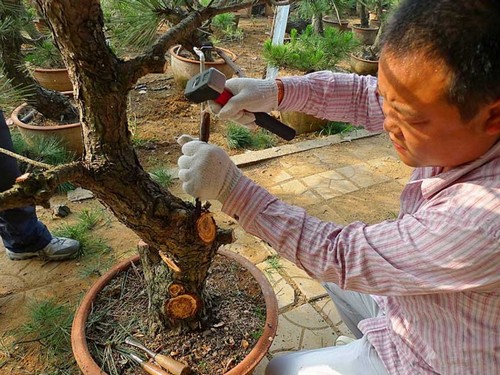
The black pine generally grows on barren hills and wasteland below an altitude of 600 m; its root system is well developed, and it is tolerant of drought and poor soil. The pine bark is grayish black and splits into scale-like plates, often giving people an impression of "vigorous and upright, ancient and peculiar." But when dug up by people and planted in a shallow pot only a foot wide, its growing conditions are restricted, so it is very difficult to keep alive. According to the experience of some black pine growing experts: whether the black pine survives or not depends on the digging and the care and management.
After a black pine stump to be dug up has been decided on, do not start digging immediately. First hollow out the soil around the stump from 60 cm to 80 cm away from the roots, cut off some of the main roots, and make the cuts smooth to help the wounds heal and promote the growth of fibrous roots; also select branches, shorten them, and remove buds on the black pine to prevent water loss and the outflow of pine resin. Fine soil can be smeared on the cut surfaces, or wax or glue can be used to seal them. Then fill the soil back, water it, and carry out care and management during the growing season. Only in the second year can it be dug up at the proper time.
1. The most suitable period for digging depends on the differences between the northern and southern regions. The temperature is generally around 2°C to 7°C; at this time the black pine is in its dormant period, the flow of pine resin is slow, and even if the root system is injured, the survival rate is still very high.
2. When digging, the root ball should be large, the root system should be damaged as little as possible, and the cut surfaces should be sealed at once with fine soil or wax. After digging, wrap it tightly with plastic film and transport it back for planting.
3. Potting and care management must be done properly:
After digging, the pine stump should generally be potted in a purple clay ceramic pot. Before potting, first remove about one-half of the mountain soil, cut off dead and rotten roots, shorten some of the long roots, and at the same time cut away excess branches and pine needles to reduce the burden on the injured root system. It is best, when digging, to collect more of the local mountain soil, which helps the black pine adapt to the soil.
Use overlapping turtle-back tiles to cover the drainage hole of the pot, place coarse-grained mountain soil at the bottom of the pot, then place the pine stump in the middle, and add soil until the lower half of the pot is filled, making sure all the roots are covered, then press it firm, and use a bamboo stick to fill soil into the gaps between the roots and tamp it down, then add more soil. Be sure to avoid leaving the roots suspended with empty cavities. After potting, water the black pine stump specimen thoroughly with pond water or settled water, and place it in a sunny, humid, and well-ventilated environment. Do not water too much; it is best to water only after the soil has dried completely. But every day, persist in using a spray bottle with clean water to spray the pine needles and branches several times to keep them moist, which is beneficial to growth.
For a black pine stump specimen that has survived, water should be appropriately withheld in spring and summer, which can keep the new branches low and the needles short. Pruning of the black pine is mainly by bud removal. A newly potted black pine stump specimen generally does not have its buds removed within the first year; only when the branches are lush and the root system is well developed should this be done. It is done between March and April of the second year, when the new buds have elongated but have not yet produced needles. Generally, about one-half of the length of each terminal bud is removed; if the stump specimen does not need to grow more branches, all the terminal buds can be removed.
For branches that affect the beauty of the stump specimen's posture, they can be cut off during the winter dormant period, and the cuts sealed with wax or glue. The black pine does not like fertilizer; after it survives, in the vigorous spring growth period each year, apply thin, well-rotted cake fertilizer water twice, and then apply it once more in autumn.
To meet the needs of bonsai creation, when grown in the open ground, choose a spot with ample sunlight and relatively poor soil, and control the supply of water and nutrients so that the main root is thick and short, the lateral roots are well developed, the trunk is short and twisted, and the branches and leaves are dense and clustered, with a simple, ancient, and elegant posture. Once the form is good, it can be potted and worked on. If the trunk of the stump is relatively thick, it can be appropriately carved and shaped, and then the retained lateral branches can be bent and tied into a horizontal or drooping form. When selecting and keeping lateral branches, care should be taken not to keep parallel branches or symmetrical branches; it is best to have layered, staggered arrangement.
The shaping and working of the black pine should be done during the dormant period, when the sap flows slowly, so that pruning branches will not risk the outflow of pine resin. During the growing period, only bending and tying for shaping, or bud removal to control growth, may be done; pruning and shaping must not be done.