Detailed Explanation of Key Cultivation Techniques for Azalea Bonsai
Yingshanhong, also known as azalea, belongs to the genus Rhododendron in the family Ericaceae. It is an evergreen, semi-evergreen, or deciduous tree or shrub, and is one of China's top ten famous flowers. When spring returns to the earth and orioles call while cuckoos sing, it is precisely the time when azaleas bloom in profusion, full of spring vitality and delighting the eye.
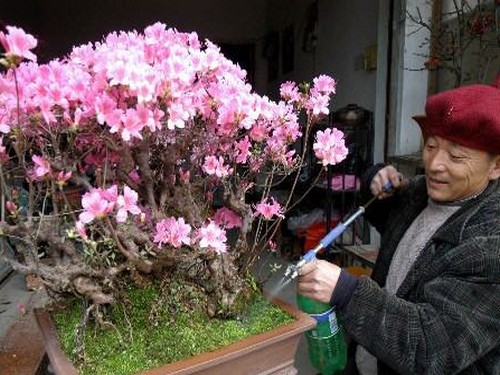
Cultivation key points:
1 Collecting stumps: Although Yingshanhong is a common variety, good stumps mostly grow in places that are relatively difficult to access, so excavation must be done carefully, the root system must be protected, the root ball should be slightly larger, and native soil (symbiotic fungi) should be retained. Dig around the flowering period.
2 Trimming the stump: Trim the slightly larger root ball down to the size needed for cultivation, and cut the branches and trunk to the final desired length in one go. The root ends and branch ends must be sealed to prevent shrinkage.
3 Planting: Disinfect the soil in advance, plant in loose, plain soil, preferably in the ground; after the root system is well developed (about one year), prepare soil according to its habits and plant it; place it according to its habits. The first year is to keep it alive, the second year to develop roots, the third year to develop the tree, and the fourth year to pot it.
4 Fertilizer and water: No fertilizer in the first year, use less fertilizer in the second year depending on the situation, and fertilize normally in the third year, applying light fertilizer frequently. Maintain moisture management throughout.
Whether cultivation is done well or poorly is the key to whether the azalea can survive.
1. Use plain pots to grow the stock: It is best to use unglazed clay pots to grow the stock. Azaleas are shallow-rooted trees, so the pot should not be too deep, and pots with poor air permeability should not be used. Simple containers such as wooden boxes can be used to grow the stock. Try not to use cement pots with high alkalinity to grow the stock.
2. Acidic soil:
(1) The quality of the soil used for azalea cultivation is very important. Azaleas are acid-loving plants, so slightly acidic soil should be used for cultivation.
Five points should be noted:
First, it is best to plant with the loose, breathable yellow leaf mold soil from where azaleas grow naturally. Acidic garden soil or a self-mixed potting soil can also be used.
Second, when planting, the soil should be a bit dry. Planting with dry soil makes it less likely for the potting soil to become compacted. It is better if the soil is granular. Soil that is too fine drains poorly and also lacks air permeability, causing the root hairs to have difficulty breathing and to be "smothered to death." It should also not be planted too deep; if planted deep, it will also be "smothered to death" due to insufficient oxygen uptake.
Third, when potting, a small wooden stick can be used to poke the potting soil firm so that the roots of the stump are not left suspended in air. After watering, do not poke the potting soil again, and do not shake the stump, so as to avoid causing the potting soil to become compacted. This point is also very important.
Fourth, after planting, place it in a ventilated and moist place, water thoroughly once to settle the roots, then cover the entire stump and pot with a transparent plastic film bag to retain moisture. Check the potting soil at regular intervals to ensure it stays moist.
Fifth, after the new buds of the stump sprout in spring, wait until the new buds have grown to about one cun in length and all branch tips that need to grow buds have new buds. Then choose a period of several consecutive rainy days and uncover the plastic bag to harden the seedlings. If dry sunny days occur, use a shade net for appropriate shading and spray water on the stump to retain moisture. Keep the potting soil moist but not waterlogged.
(2) The stump can also be planted in river sand, because river sand is clean and breathable, so the survival rate is very high. The disadvantage is that when potting later, it is difficult for the plant to retain soil, making potting inconvenient, and because river sand has few nutrients, it must be fertilized frequently after it has fully survived. (3) If conditions permit, it can be planted in the ground in a greenhouse, where the survival rate is also very high and management is convenient.