How to grow Rhododendron simsii bonsai? A full breakdown of cultivation key points
Although small bonsai cannot compare with large bonsai in spectacular momentum or in lavish showiness, when it comes to achieving high realism, delicate maturity, and rugged antique elegance, small bonsai are more than up to the task. Moreover, the difficulty is far higher than that of large bonsai! So the direction set at the very beginning of bonsai, that of using the small to represent the large, is correct. Especially after more than a thousand years of inheritance, it should not degrade and deviate from its original purpose because of market manipulation, otherwise it is no longer bonsai. Call those large-scale works whatever you like, but do not borrow the name of bonsai to confuse newcomers who love this art.
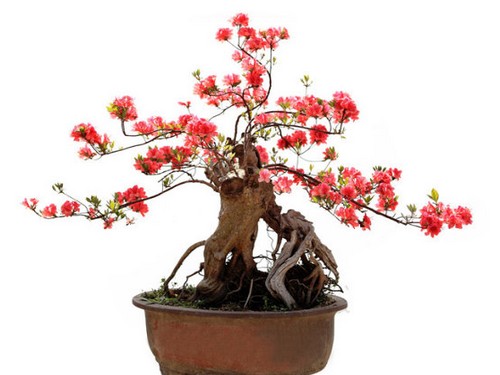
In order to make full use of space and to make management or moving easier, plant the Rhododendron simsii stump directly in a pot. Before potting, first apply a mud-like healing agent to the trimmed wounds of the Rhododendron simsii, then soak it in a rooting solution mixed according to the specified ratio. After two hours, take it out and prepare it for potting.
Rhododendron simsii is a full-sun flowering woody plant. It can tolerate moisture but fears waterlogging, so at the bottom of the pot, first use a mesh piece as a filter over the drainage hole. Then place mountain sand in layers, coarse below and fine above. Finally put the stump into the pot and add fine-grained acidic plain soil. Note that when adding soil and planting, you must fill the soil around the stump with a small bamboo stick, and also press it firm with your hands, to prevent the soil from failing to reach the roots and causing the roots to dangle and wither.
Prepare the growing medium in advance. It must be sterile and low in fertilizer. It can only be used after being sterilized by exposure to blazing sun and then sifted into powder. After planting is completed, soak the Rhododendron simsii pot in a water tank containing a rooting solution even more dilute than the previous one. Once the potting soil is completely moistened, take it out. Wait until no water drips from the bottom hole of the pot, then mix pure yellow clay with water into a thick mud slurry. Remove the main buds to be kept, and wrap the rest together with the base. Although this is a crude method I commonly use.
Years of practice have proven that using this method can maintain humidity, and only then can it resist the cold and heat within a year. Only by long-term control of temperature and humidity will new roots be induced to grow. The stump body wrapped in yellow clay is like a mud wall, able to withstand wind and rain.
After more than a year of cultivation following potting, a small Rhododendron simsii bonsai's newly grown branches have already become woody, so it can be pruned and styled. Because Rhododendron simsii branches are brittle and break easily, only one- or two-year-old branches wrap with good results. Only after several years of styling can it basically take shape. Using natural stumps and human artistry, each pot of Rhododendron simsii bonsai, in the unity of heaven and humanity, is charmingly beautiful.
After a year of careful cultivation, the tiny Rhododendron simsii bonsai has basically survived by this time, and some have already begun to show flower buds beside the branches and leaves. At this point, you can peel off part or all of the yellow clay applied to the stump blank, and it can receive routine management.