A Detailed Guide to Lemon Potted Planting Techniques and Care Methods
I think every office worker probably has a small potted plant next to their desk, whether for protection against radiation or just to cultivate a bit of serenity, it always brings a different kind of mood. But most potted plants are nothing more than cacti, pothos and the like, and there seems to be nothing new about them. In fact, many fruit seeds can become interesting potted plants.
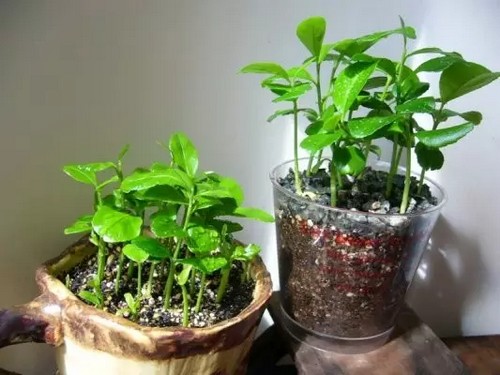
Starting today, don't throw away lemon seeds after you eat a lemon! Place a pot of adorable lemon seedlings on your office desk or writing desk. The tiny lemon seeds take root and sprout in the soil, and life grows before your eyes. All you need to do is give the leftover lemon seeds a super simple treatment, and you can grow a pot of lemon seedlings! When it grows up, you'll have lots and lots of lovely lemons. Here are the specific steps:
1. Soak the seeds of 3 lemons in water for 48 hours to soften them.
2. Use a knife to remove the outer shell, revealing the yellow seed inside.
3. Place the seeds between two paper towels and keep them moist; this will encourage them to sprout.
4. Put the paper towels inside a sealed plastic bag and hang it on a window that gets sunlight.
5. After one or two weeks, they begin to sprout.
6. Once sprouted, just place the seeds in soil.
7. Add some pretty decorations and you're all done.
It's simple to get started, isn't it? But first, you have to finish eating a lemon.
The lemon is an evergreen small tree of the genus Citrus in the family Rutaceae. The leaves are relatively small, long elliptical, with fine serrations along the edges. The flowers are solitary, blooming throughout the year, with a rich fragrance. The fruit is long elliptical or oval, ripening in autumn and winter. The peel is yellow, the flesh is extremely sour and strongly fragrant, the juice contains citric acid, and the peel can be used to extract lemon oil.
The main lemon potted planting techniques are as follows:
Seedling raising and potting: Potting and repotting can be done after autumn or in early spring, and can be flexibly timed according to the local climate.
Light and temperature: The lemon is a light-loving plant, yet if the sunlight is too intense, its growth and development will suffer. Generally, at noon the plant should be moved, and the suitable growing annual average temperature is above 15°C; the optimal growing temperature is 23°C to 29°C; above 35°C it stops growing, and at -2°C it suffers frost damage. In summer, lemons generally do not need cooling; move them indoors before Frost's Descent and move them back outside after Qingming, and they can overwinter safely.
Watering and fertilizing: Lemons need relatively more water during growth and development, but too much water easily causes root rot. Generally speaking, spring is the period of new shoot growth and leaf expansion, flower bud formation and blooming, so water moderately. In summer, with strong light and high temperatures, more water is needed. But it must be timely and moderate, otherwise it will cause fruit drop. Autumn is the period of autumn shoot growth and rapid fruit enlargement, so there must be sufficient water. Late autumn and winter are the flower bud differentiation period, and the potting soil should be on the dry side. Lemons are relatively fond of fertilizer; besides applying enough base fertilizer when potting and repotting, during the growing period you should stick to the principle of light but frequent fertilizing. The number of fertilizing times and the amount applied must be determined according to growth vigor and phenological phase. For liquid fertilizer, fully fermented cake fertilizer water is good, with a cake-to-water ratio of 1:200. In the north, where the soil tends to be alkaline, ferrous sulfate can be added to the fertilizer solution to make a slightly acidic nutrient solution.
Pruning: Pruning is generally divided into winter pruning and summer pruning. Winter pruning should follow the principle of "remove the dense and keep the sparse, remove the weak and keep the strong," cutting off dead branches, shortening weak branches and removing rampant water sprouts with no bearing function. Summer pruning on non-fruiting trees mainly means shortening overly long shoots; on fruiting trees, it means removing summer shoots and shortening declining branches on the middle and upper outer part of the canopy. Promoting flowers and preserving fruit: the lemon is by nature a species that flowers and fruits in all four seasons, while potted ones in the north mostly flower and fruit in spring. Therefore, after the autumn shoots stop growing, water must be controlled. Wait until the two sides of the leaves begin to curl inward, then water moderately, to promote flower bud differentiation. Pay attention to fertilizing in the pot and spraying fertilizer on the leaves, to cultivate strong fruiting mother branches.
The main measures for preserving fruit: first, strengthen the supply of fertilizer and water to accumulate nutrients; second, carry out hand pollination; third, thin flowers and thin fruit. Lemon fruits are large and need a lot of nutrients; the normal leaf-to-fruit ratio is 30 to 40:1. Following the principle of removing the weak and keeping the strong and even distribution, first thin out excessive and overly dense flower buds; then, when the young fruits are 1 cm in size, thin out some of the fruits; finally, after the physiological fruit drop, set the fruit according to the leaf-to-fruit ratio. You can also leave no fruit on weak branches and only 1 fruit on strong branches.