Detailed Explanation of Key Techniques for Growing Potted Phalaenopsis Orchids
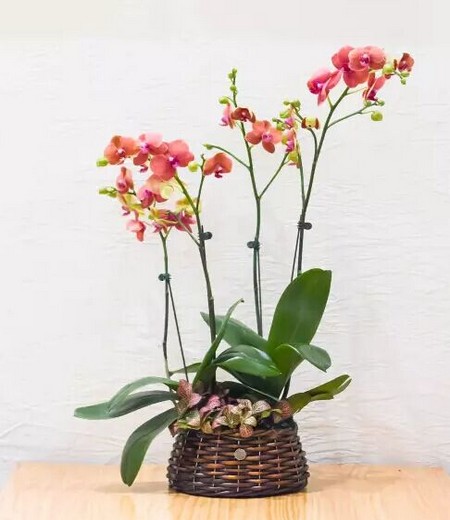
The Phalaenopsis orchid gets its name because its flowers resemble dancing butterflies. Its flower language is "I love you," symbolizing nobility and elegance, and it is widely one of the most popular New Year flowers for the Spring Festival. With its brilliant colors, diverse varieties, and graceful bearing, it has won the favor of people around the world. No festival or high-end banquet is complete without Phalaenopsis orchids as decoration. Phalaenopsis orchids can be displayed in combined pots or as single plants, and both have excellent ornamental value.
For tissue-cultured bottle seedlings brought in for production, place them on a flower rack for about 1 week so the bottle seedlings can adapt to the natural environment for a few days, then remove them from the bottles. First soak them in a 1000-fold carbendazim solution for 2~3 minutes, remove them and rinse clean with water, then use a short soft brush to gently clean off the culture medium attached to the roots, and rinse again with clean water, otherwise they are prone to mildew and rot. After sterilization, plant the seedlings with relatively fine sphagnum moss. The sphagnum moss should first be soaked for 3~4 hours, then washed, squeezed dry, and sterilized. When planting, first wrap the roots of the seedlings with sphagnum moss, then plant them in suitable soft pots. The sphagnum moss should be neither too loose nor too tight. Place them in half-shade, maintain a relative humidity of 70%~80%, and do not water for 2~3 days after planting. Later, attention should be paid to ventilation and regular watering.
When cultivating Phalaenopsis orchids, good root ventilation is required, and the roots of the fern Osmunda japonica are commonly used as a potting medium. Dry the roots, cut them into 5 cm long pieces, then add some leaf mold or peat, along with coarse sand or perlite, and mix together. If Phalaenopsis orchids are planted in ordinary pots, porous pots are generally best. For better air permeability, shallow pots should be used, and the pot height should preferably be less than the pot diameter. They can also be planted in baskets woven from wooden strips or metal wire, tied to tree branches or the stems of tree ferns. Generally, half a pot of broken tiles is placed in the flower pot to aid drainage. If hanging baskets are used, a thin layer of sphagnum moss must be spread on the bottom of the basket to prevent the potting soil from leaking out between the wooden strips or through the mesh holes.
Generally speaking, Phalaenopsis orchids need to be repotted once a year. When the plant's root system begins to grow again (usually in spring), that is the most suitable time for repotting. Whether potting up or repotting, newly potted plants must not be watered immediately. During the first three or four weeks, usually it is enough to spray the leaves once a day.
Phalaenopsis orchids generally need a stable warm and humid environment year-round. The most suitable temperature is 25~28°C during the day and 18~20°C at night. Special attention should be paid to the fact that Phalaenopsis orchids are very sensitive to low temperatures and will stop growing when kept at 15°C for a long time. Generally, the humidity in places where Phalaenopsis orchids are cultivated should be maintained at 70%~80% year-round. You can spray water on the leaf surface once a day. When spraying, it is best to use a fine mist and not let water droplets remain on the leaves of the Phalaenopsis orchid. If water remains on a leaf overnight, black spots will appear at that spot. Phalaenopsis orchids like a well-ventilated environment and are averse to muggy heat; poor ventilation can easily cause rot. Phalaenopsis orchids need bright diffused light year-round, and direct strong light should generally be avoided.