How to Grow Japanese Honeysuckle? A Detailed Guide to Planting Methods and Management Tips
Japanese honeysuckle is both a commonly used medicinal herb and a plant that can be grown for ornamental purposes. Japanese honeysuckle bonsai are also quite beautiful. So what do we need to pay special attention to in Japanese honeysuckle cultivation techniques? First, choosing the site is very important; Japanese honeysuckle has fairly high requirements for its growing environment. In addition, pest and disease control is also a challenge we must overcome.
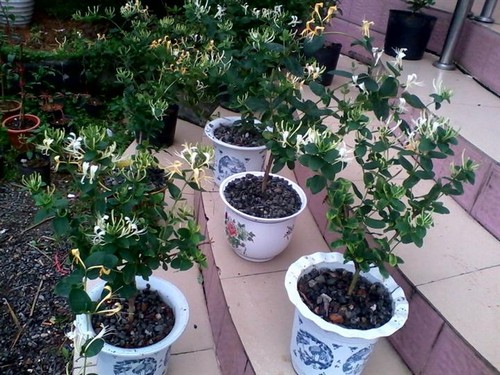
A tiny Japanese honeysuckle can actually be made into a bonsai - you must find that quite incredible! The Japanese honeysuckle vines twine around, the winter leaves turn slightly red, and it does not wither through the winter; yellow and white complement each other, blooming continuously, first white then yellow, with both color and fragrance, beautiful in both flower and leaf, in spring and summer. So what are the cultivation techniques for Japanese honeysuckle?
Japanese honeysuckle cultivation techniques:
1. Timely transplanting: When the seedlings are one year old, they can be lifted and transplanted from the Spring Equinox to Grain Rain. The density depends on the soil quality, generally with a spacing of 2×2.5-3 m per hole. Before transplanting, first dig holes 60-70 cm wide and 40-50 cm deep, and apply enough base fertilizer mainly consisting of farmyard manure, 30-50 kg per hole. For fertile soil, 1-2 plants per hole is suitable; for poor soil, 3 plants per hole, planted in a triangular arrangement, with the number of holes per mu controlled at around 120 to 140.
2. Field management: After transplanting, water promptly to ensure the survival rate. After one month, apply dilute manure urine water or 1:300 nitrogen fertilizer water every 15 days or so. When the new shoots grow to more than 2 nodes, pinch the tips promptly to encourage side branches to develop into clumps early, and set up trellises in good time according to the length of the vines to facilitate the twining growth of new vines. After harvesting flowers, promptly prune diseased, dead and weak branches, and hoe weeds and loosen the soil, and apply additional fertilizer to ensure a bumper harvest the following year.
3. Pest and disease control: Mainly aphids and powdery mildew. The basic control agent can be a colloidal sulfur mixed preparation, namely colloidal sulfur 100 g, trichlorfon 10 g, dimethoate 15 g, plus 30 kg of clean water, mixed and sprayed, generally sprayed once every 15 days.
4. Flower harvesting and processing: Harvest and process the flowers promptly in May-June. Processing methods include drying in the shade, drying in the air, or fumigating with burning sulfur and then sun-drying; they can also be dried with a low fire or an electric oven, but the appropriate temperature should be controlled so that the color and dryness are just right, to prevent blackening. After drying, they should be sealed for storage to prevent moisture and discoloration and to prevent insect damage.
Japanese honeysuckle cultivation tips:
First, choose a fairly good plot of land for tilling the soil and preparing fertilizer. Of course, if conditions do not allow, you can also, as shown in the picture, use scattered plots such as barren slopes, field edges, ditch sides, and in front of and behind the house for planting.
Next is transplanting. Generally, transplanting is chosen before early spring sprouting or during the autumn and winter dormant period. At this time, on the prepared plot, dig holes at a row spacing of 100 cm and a plant spacing of 60 cm, then add 5 kg of soil and miscellaneous fertilizer into these holes, and after mixing evenly with the subsoil, you can transplant the saplings, then begin filling with fine soil, pressing firm and tamping down, and watering thoroughly to settle the roots.
Then comes weeding and topdressing. After the tree-form Japanese honeysuckle survives transplanting, generally carry out intertillage and weeding three or four times each year: the 1st time when new leaves emerge with spring sprouting; the 2nd time in June; the 3rd time from July to August; and the 4th time in late autumn and early winter. And after early spring sprouting each year and after each flower bud harvest, topdressing should be carried out once. In spring and summer, decomposed human and livestock manure water or ammonium sulfate, urea, etc. can be used, while in winter, decomposed stable manure or compost 5 to 10 kg, ammonium sulfate 100 g, and superphosphate 200 g should be used.
Finally comes shaping and pruning. To get a very good tree-form Japanese honeysuckle, pruning and shaping are an indispensable step. It can not only promote the growth of more new branches and the formation of more flower buds, playing a role in increasing yield, but also open up the branches so that they are evenly distributed, ventilated and light-transmitting, which is beneficial to the quality of Japanese honeysuckle.
The main pests and diseases harming the growth of Japanese honeysuckle are the honeysuckle round-tailed aphid and powdery mildew. The control methods are as follows:
1. Honeysuckle round-tailed aphid
Aphids mainly occur in spring and summer. To control aphids, you can ferment rice washing water, filter it, add an equal amount of clean water, and spray it. The effect is very good, and it causes no pollution.
2. Powdery mildew
Powdery mildew mainly occurs in the rainy, hot and humid seasons of summer and autumn. When it occurs, cut off diseased leaves and branches, thin out the covering branches and leaves, and keep the plant ventilated and light-transmitting to control it; generally no pesticide is needed. In severe cases, spray with a 500-fold dilution of 50% wettable carbendazim powder. The cut diseased branches and leaves should be taken out of the garden and burned or deeply buried, and must not be left in the garden to prevent re-infection.