Spider Plant Indoor Growing Techniques and Care Methods
The spider plant is not only an excellent hanging foliage plant for indoor spaces, but also a good indoor air-purifying flower. The spider plant has a very strong ability to absorb toxic gases, so it is also known as a "green purifier." Its most distinctive feature is that mature plants will from time to time produce runners (stolons), with slender flower stems longer than the leaves, bending downward; the raceme is single or branched, and sometimes 2—8 cm strap-shaped leaf clusters also grow in clusters at the upper nodes of the inflorescence. The flowering period is between spring and summer, and it can also bloom indoors in winter. Now let's learn about the spider plant's growing methods together with the editor.
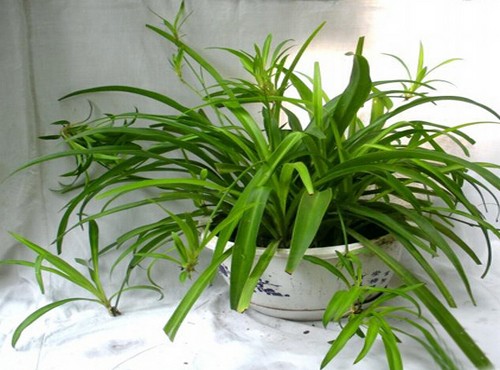
It prefers a warm, humid, semi-shaded environment. It is highly adaptable and relatively tolerant of drought and cold. It is not picky about soil, and grows better in loose sandy loam. It is not strict about light, and is generally suitable for growing under medium light conditions, and also tolerates weak light.
Except in winter when the temperature is too low for division, it can be done in all other seasons. For potted plants that have been grown for 2—3 years, when repotting in spring, remove the old growing medium from the crowded potted seedlings, divide them into two to several clumps, and pot them separately to become new plants. Spider plants can also be propagated using the small plantlets on the runners. During the growing season, cut off the small plantlets on the runners and plant them in growing medium or water; after the plantlets have grown roots, transplant them into pots.
For potting spider plants, a mixture of equal parts leaf mold or peat soil, garden soil, and river sand with a small amount of base fertilizer is commonly used as the substrate. Repot once every 2—3 years, and prepare the growing medium anew. Its fleshy roots have well-developed water-storage tissue and strong drought resistance, but during the peak growth period from March to September it needs a larger amount of water, so it should be watered and misted frequently to increase humidity.
Fertilizer should mainly be nitrogen-based, but for gold-centered and gold-edged varieties, nitrogen fertilizer should not be applied in excess, otherwise the linear markings on the leaves will become less obvious. Spider plants prefer a semi-shaded environment; if the placement location has too much or too little light, the leaves will easily turn pale green or yellow-green, lacking vitality, losing their due ornamental value, and may even wither and die.
When cultivating spider plants indoors, pay attention to the following 8 points:
1. Substrate: The spider plant has strong adaptability to various soils and is easy to cultivate. You can use fertile sandy loam, humus soil, peat soil, or fine sandy soil with a small amount of base fertilizer as potting soil.
2. Propagation: Usually propagated by division; except in winter when the temperature is too low for division, it can be done in other seasons. You can also cut off small plantlets with aerial roots from the flower stems and pot them separately.
3. Light: The spider plant prefers a semi-shaded environment and can be grown indoors in bright conditions year-round. Spider plants grown indoors for a long time should avoid direct strong sunlight and need 50-70% of sunlight to be shaded. Only in this way can they grow luxuriantly with beautiful leaves.
4. Temperature: The spider plant tolerates high temperatures. The suitable growing temperature is between 15-30℃, and the overwintering temperature in winter is best above 10℃.
5. Humidity: It prefers a humid environment. To keep the spider plant fresh and green, you can frequently spray water on the leaves to clean them.
6. Watering: The spider plant prefers a humid environment, and the potting soil should be kept moist frequently. However, the fleshy roots of the spider plant can store a large amount of water, so it has strong drought resistance and will not die of dryness even if not watered for several days. When the temperature is below 5 degrees in winter, water less, and do not let the potting soil become too wet, otherwise the leaves will easily turn yellow.
7. Fertilizing: Apply liquid fertilizer once every 2-3 weeks during the growing season. For variegated varieties, apply less nitrogen fertilizer, otherwise the white or yellow markings on the leaves will become less obvious. Stop fertilizing when the ambient temperature is below 10 degrees.
8. Pruning: At ordinary times, cut off yellow leaves at any time. In March each year, you can repot once, cutting off old roots, rotten roots, and excess fibrous roots. In early to mid-May, cut off some of the old leaves of the spider plant, which will encourage more new leaves and small spider plantlets to sprout.