A detailed guide to growing saffron crocus in pots, easy enough for beginners to get started
Saffron crocus, also known as saffron, is a perennial herbaceous plant in the iris family (Iridaceae), with a plant height of about 15 cm, a flattened round corm, and brown membranous scales on the outer layer. The leaves are linear, with white veins and slightly rolled-back leaf margins; there are 6 petals in a purple-blue color, 3 stamens, 1 pistil, and 3 styles. The styles extend out of the perianth and are deep red, with the tip of the stigma slightly swollen into a trumpet shape, carrying a rich fragrance. Although saffron crocus flowers, it does not produce fruit. Saffron crocus reproduces asexually through corms.
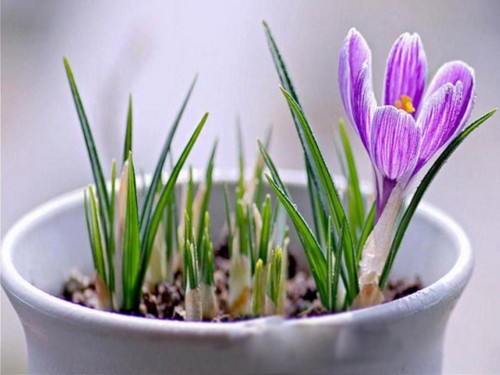
In China, the method of field propagation of corms combined with indoor flower harvesting is mostly used, and the filaments have high active ingredient content and excellent quality. Saffron crocus can be cultivated in most regions.
1. Seed selection and corm storage of saffron crocus
Saffron crocus is triploid, only flowering without setting seed, and relies on corms for propagation. When buying corms for the first time, it is best to do so from June to September, and you need to choose corms that are intact, disease-free, robust, and weigh more than 10 grams each. Corms below 8 grams cannot flower in the same year. Smaller corms need to be planted continuously for 2 to 3 years before they can flower. The Taobao store “Saffron Beauty and Wellness Hall” sells corms.
For saffron crocus that has already been grown for one year, after the aboveground leaves completely wither in May to June, choose a suitable sunny day to dig out the corms, taking care not to damage them when digging. The dug-out corms need to be spread out to dry, and after drying, cut off the residual branches, leaves, and roots, and screen out damaged and diseased corms. Separate the robust, disease-free, and intact corms by size and store them indoors in a ventilated, dry, cool place with little light until September. Saffron crocus can also be left undug and overwinter in the soil directly, but this is not recommended, because in the soil it is more prone to rot and pests and diseases.
2. Planting saffron crocus
Saffron crocus corms can be treated with chemicals before planting, which can effectively prevent and control diseases. The main disease of saffron crocus is rot, and corms are generally treated by soaking in a 500-fold dilution of 25% carbendazim for 20 minutes, then planted.
Saffron crocus is best potted in September. Choose a flower pot with a diameter of about 15 cm, and plant 5 to 6 corms per pot. The growing medium should be loose, fertile, well-drained potting soil, or a mixture of sphagnum peat and sandy loam, with decomposed organic fertilizer plus a small amount of nitrogen-phosphorus-potassium compound fertilizer added. The planting depth for saffron crocus corms is 5 to 6 cm. After planting, water thoroughly once to reach the roots, keep the soil moist, and about ten days later the corms begin to take root and sprout.
3. Potted management of saffron crocus
Saffron crocus grows in the pot from planting in September to June of the following year, about 9 months. During this period it flowers once, with the flowering period in winter (late October to early November) or early spring (January to February), and the flowering period lasts 15 to 20 days. During this time, the following six aspects of work should be done well.
Temperature: Although saffron crocus is a cold-tolerant crop and can withstand low temperatures of -18°C, low temperatures are unfavorable for its growth, and severe cold can easily cause frost damage. Therefore, in winter, saffron crocus should be placed indoors in a place with ample light, and the temperature should be kept above 5°C. In April and May of the following year, when the temperature rises above 20°C, saffron crocus should be moved to a shady place to extend the corm growth period, thereby obtaining larger corms.
Watering: After planting, saffron crocus should be watered sufficiently and the soil kept moist. On rainy days, attention should be paid to drainage to prevent waterlogging. Usually, foliar spraying is used more often to replenish water for saffron crocus.
Fertilizing: Apply sufficient base fertilizer before planting saffron crocus. After the leaves unfold, apply a diluted organic fertilizer or a 1% concentration nitrogen-phosphorus-potassium compound fertilizer about once every 20 days. To make the saffron crocus leaves more emerald green and sturdy, the flower colors more brilliant, and the corms more robust, after the leaves unfold, a potassium dihydrogen phosphate foliar fertilizer can be sprayed once every 15 to 20 days.
Pest and disease control: Throughout the growing period of saffron crocus, temperatures are relatively low and there are fewer pests and diseases. In March, saffron crocus enters the new corm growth period, and spraying carbendazim at the roots can effectively prevent and control rot. If aphids appear on the leaves, dimethoate can be used for control.