Detailed Guide to Planting Techniques and Management Methods for Viola mandshurica (Chinese violet)
After autumn, the stems and leaves of Viola mandshurica remain as green as ever, with small needle-like fruits beside the flowers, and the above-ground parts do not wither until early winter. Therefore, it is an excellent ground cover plant, and can also be planted in gardens to decorate flower borders or nestle into lawns.
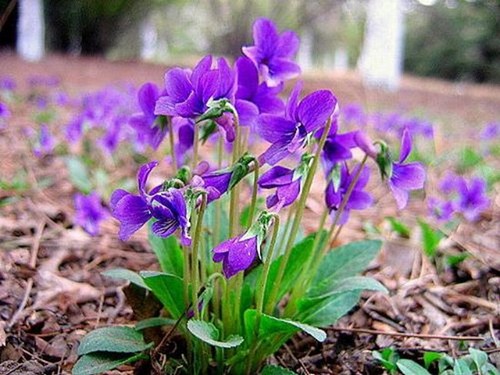
Viola mandshurica is a common ground cover plant, a perennial herb with a plant height of 10—15 cm. Because its flowers are purple and its underground roots are like nails, it is called Viola mandshurica (Chinese violet). It is a plant with medicinal, edible and ornamental value. Viola mandshurica is bitter, pungent and cold in nature, non-toxic, and has the effects of clearing heat and detoxifying, cooling blood and reducing swelling. Therefore, it is deeply loved by gardeners, so its planting methods are very necessary to understand! Below, the editor will briefly introduce the planting methods of Viola mandshurica.
[Habits of Viola mandshurica]
Viola mandshurica, also known as wild violet and smooth-petaled violet, prefers semi-shaded environments and moist soil, but can also grow in sunlight and relatively dry places. It is cold-resistant and drought-resistant, and has no strict requirements for soil. Except for Carex, other herbaceous plants find it difficult to invade. In sunlight, it can coexist with many low-growing herbaceous plants. The flower color is violet or light purple, the flowering period is from April to May, and the full bloom period is about 25 days.
Viola mandshurica grows vigorously and has strong resistance. It requires no special management during the growing period. During its peak growing season, apply organic fertilizer once every 7-10 days. This will make its landscape effect even better. During the growing period, pay attention to pulling out weeds; generally no topdressing is applied; during the rainy season, pay attention to drainage. It prefers semi-shaded environments and moist soil, but can also grow in sunlight and relatively dry places; it is cold-resistant and drought-resistant; it has no strict requirements for soil, can self-sow and reproduce in North China, shows strong competitiveness under semi-shaded conditions, and can coexist with many low-growing herbaceous plants in sunlight.
[Cultivation Techniques]
1. Preparation before sowing. Before sowing Viola mandshurica seeds, it is best to disinfect the soil. Potassium permanganate can be used, generally controlling the solution concentration at 0.1%-0.3%, and spraying it on the seedbed soil. The purpose of soil disinfection is to cultivate strong seedlings and prevent and control seedling-stage pests and diseases.
2. Sowing. When sowing Viola mandshurica seeds, the broadcast sowing method can be used. Use a small-seed seeder or your hands to evenly scatter the seeds on thoroughly moistened seedbed soil. After sowing, cover with fine soil sifted through a fine sieve. After sowing, the indoor temperature should preferably be controlled at 15-25°C.
3. After the Viola mandshurica seedlings emerge completely, management should be strengthened. The temperature should be controlled at 15°C during the day and 8°C-10°C at night, keeping the soil slightly dry.
4. During the growing period, no special management is needed. During its peak growing season, apply organic fertilizer once every 7~10 days. Pay attention to pulling out weeds, and pay attention to drainage during the rainy season.
5. Pest and disease control of Viola mandshurica. Red spiders damage the leaves and can be killed by spraying with lime sulfur mixture.
Viola mandshurica can be planted in lawns as a flower-dotted lawn to increase the ornamental effect of the lawn and provide visitors with a place to enjoy and rest.