Detailed Explanation of Key Points in Pear Tree Planting and Management Techniques
In parks, to highlight its individual beauty, the pear tree can be used as a specimen planting in park landscaping. Generally, an open and spacious location is chosen, such as the edge of a lawn, the center of a flowerbed, a sunny corner, or both sides of an entrance. In spring, snow-white pear blossoms bloom in profusion; in autumn, abundant pear fruits hang heavily on the branches, creating a beautiful scenery in the park. In addition, planting pear trees beside park ponds, along fences, at the foot of rockeries, and beside earth mounds, paired with lawns or groundcover flowers. Using pear trees in combination with other tree species not only enriches the landscape but also attracts fruit-eating birds, adding ornamental pleasure.
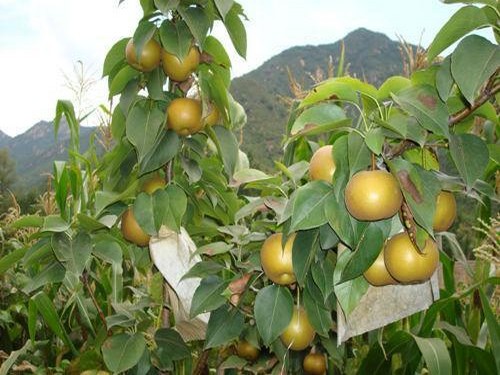
Courtyards The use of pear trees for the greening and beautification of palace gardens and courtyards has a history of more than 2,000 years in our country. In some famous landscape gardens, the planting of fruit trees such as pear, orange, tangerine, peach, plum, and apricot is relatively common. In addition to its sweet fruit and elegantly delicate flowers, the pear tree also has a unique tree form beauty, suitable for viewing around residences and appropriate for courtyard cultivation. Xue Pu Yu Shu says: "In a courtyard full of blossoms, how could one do without this gentleman"; Hua Jing says: "The charm of the pear, the purity of the plum, are suited to a leisurely courtyard and an open garden, in morning light and evening mist." When the pear tree is planted in the courtyard, in spring one can enjoy its flowers, in summer its shade, in autumn its fruit, and in winter its form.
The pear tree is one of the main fruit trees in our country. Besides being eaten fresh, it can also be processed into canned goods, pear wine, dried pears, preserved pears, etc., and is deeply welcomed by the public. Pear trees bear fruit early; generally they begin production in 2-3 years, and by 6 years they can enter the full fruit period. During the full fruit period, 667 sq m can stably yield more than 2000 kg.
I. Establishment of a Pear Orchard
Site Selection and Planning A pear orchard can be developed on flat land, hills, mountainous areas, or riverbanks, but conditions such as transportation and irrigation should be considered. After the orchard site is selected, it should be divided into several plots of 2-10 hectares according to the terrain, topography, roads, channels, and shelterbelts. On hilly slopes, the long side of the plot should, as far as possible, be parallel to the contour lines, which is beneficial for soil and water conservation and convenient for management. Pear trees can be planted from after the seedlings lose their leaves until before budbreak. Planting density should be determined according to different terrain and plots, generally with a spacing of 3 m × 4 m.
II. Planting Techniques
Dig holes at fixed points according to the row and plant spacing. Generally, in sandy soil, the hole should be 80 cm wide and 50-60 cm deep; in paddy field soil, a hole 80 cm wide and 40-50 cm deep is sufficient. First place 30-40 cm of rice straw, branches, or green manure, etc., and add topsoil and press firmly, then apply 50-80 kg of organic fertilizer (pig or cattle manure) or 10 kg of pure chicken manure, which must be decomposed, and add 1-2 kq of calcium magnesium phosphate fertilizer (superphosphate can be used in alkaline soil) and mix with soil to fill in, forming a mound shape. Before planting, the thick roots of the pear seedlings should be cut back by 2-3 cm to promote new root growth, and the film at the graft union should be removed to avoid affecting trunk growth. When planting, the graft union should be exposed 5-10 cm above the ground, the soil around the roots should be firmed, and water should be watered thoroughly immediately. In windy areas, support posts should be set up to prevent lodging.
III. Soil, Fertilizer, and Water Management Techniques
1. Soil Management
Deep plowing and soil maturation is a basic measure in pear tree yield-increasing techniques. The time for deep plowing and soil improvement is generally after fruit harvest in autumn and before leaf fall in winter. Methods include expanding planting holes, deep plowing of the whole orchard, and alternate-row or alternate-tree deep plowing. The depth of deep plowing is generally 30-40 cm. Where conditions permit, alternate-year rotation plowing can be adopted: in years 1, 3, and 5, open deep ditches about 0.8 m deep and wide on both sides of the original hole; in years 2, 4, and 6, open deep ditches on the other two sides, combined with applying base fertilizer. Generally, 100 kg of pear fruit requires at least 100 kg of organic fertilizer (pig or sheep manure), mixed with 2.25 kg of phosphate fertilizer.
2. Fertilizer Management
In addition to base fertilizer, generally four timely topdressings should be applied during the growing period. The first is post-flowering fertilizer, applied in mid-to-late April, to promote branch and leaf growth, flower bud differentiation, and fruit enlargement; 8-10 kg of Jiamei Yinglilai can be applied per mu. The second is fruit enlargement fertilizer, applied twice from mid-May to early June; 15-20 kg of Jiamei Yinglilai can be applied per mu each time. The third is post-harvest fertilizer, applied from late August to mid-September; 10-15 kg of Jiamei Yinglilai can be applied per mu to increase leaf color, prolong leaf lifespan, and restore tree vigor. In addition, 2-3 applications of Jiamei Nao Baijin can be combined with pesticide spraying. Foliar topdressing has a very obvious effect on promptly restoring the tree's nutritional level. Under normal circumstances, the annual fertilizer application rate for pear trees in the full fruit period should not be lower than the standard of one jin of fertilizer per jin of fruit. Package fertilizers should be applied in a balanced manner according to a nitrogen:phosphorus:potassium ratio of 1:0.5-0.7:0.8-1.0, mainly using Jiamei Yinglilai and Neijiade.
3. Water Management
Water is a limiting factor for high-quality and high-yield pear trees. If the water absorbed by the root system is insufficient to supply leaf transpiration, the water in the fruit will be taken away by the leaves, causing the fruit to be small, lusterless, with little juice, dry and mealy flesh, and with gaps and well-developed stone cells. If water is insufficient in June and conditions are too dry, the calyx end will all become hardened, forming iron pears. If water is severely insufficient in July, because some cells of the fruit flesh develop poorly or even die, stone cells in the flesh increase markedly and the membranes of parenchyma cells become suberized, causing the fruit surface to become uneven and form "lumpy" pears.
IV. Provision of Pollinator Trees and the Three-Thinning Technique
Pear trees are cross-pollinated species, and most cultivars are self-unfruitful, so pollinator cultivars with basically overlapping flowering periods must be arranged. The ratio of the main cultivar to the pollinator cultivar is best 2:1 or 1:1, and at minimum 3:1 or 4:1, in order to achieve high and stable yields. The three-thinning technique means correctly mastering the timing and methods of thinning flower buds, thinning flower buds, and thinning fruit.
1. Thinning Flower Buds
Excess flower buds should be thinned in combination with winter pruning. When thinning flower buds in winter, it should be done according to proportion; in principle, flower buds:leaf buds = 1:1, thinning about 1/2 of the total flowers on the tree. However, attention should be paid to how many flower buds the pear tree has formed that year. In actual production, for scaffold branches, a density of 1 flower bud per 15-18 cm is appropriate. Note that only flower buds should be thinned, while leaf buds should be retained.
2. Thinning Flower Buds
If flower bud thinning was not carried out during winter pruning, flower buds can be thinned before flowering as a remedy. The standard for bud thinning is generally to retain one flower bud about every 20 cm. Principles of bud thinning: thin weak ones and keep strong ones, thin small ones and keep large ones, thin dense ones and keep sparse ones, thin axillary flower buds and keep terminal flower buds, thin lower ones and keep upper ones, thin flower buds that sprout too late, and thin secondary flower buds.
3. Fruit Thinning
This should be determined according to cultivar, tree vigor, flowering period, and climate. If there are many flowers, the tree vigor is weak, and the fruit set rate is high, thinning should be done early; for young trees with few flowers and vigorous trees, thinning should be delayed or reduced. In years with normal weather, it is better to thin early; otherwise, it is better to thin late. Generally, each fruit should have 25-30 leaves. In a normal year, one fruit spur can retain 1 fruit; for cultivars with medium-sized fruit, one fruit spur can retain 1-2 fruits.
4. Training and Pruning
According to differences in cultivar and site conditions, the tree form of pear trees generally includes the delayed open-center form, the multi-trunk open-center form, and the multi-scaffold round-headed form, etc. Technical points for training and pruning the delayed open-center form:
(1) Trunk Determination
The trunk is generally determined at a height of 60-70 cm, or it can be 40 cm. When determining the trunk, 7-8 plump buds should be left at the cut. If the height is insufficient for trunk determination, it can be cut back 6-10 cm above the ground so that the trunk can be determined again the next year.
(2) Selection and Training of Scaffold Branches
In the first winter after trunk determination, select the upright shoot at the top as the central leader and train it year by year. If the shoot grows weakly, it can be pruned back appropriately. When the canopy reaches 3.5 m and has 5-7 permanent scaffold branches, the top can be headed and the leader shortened. To promote the growth of the first tier of scaffold branches, when the central leader extends, the method of changing the leader and bending it upward can be adopted, removing strong branches and supporting weak ones as the extension shoot of the central leader. One year after planting the seedling, if there are fewer than 3 shoots selected as scaffold branches at the base, the central leader can be heavily pruned again to promote branching; in the second winter, select shoots with suitable direction and angle as the first tier of scaffold branches. When pruning, in order to maintain balanced growth of the 3 scaffold branches, weak branches should be lightly pruned and left unshortened, and after they become strong, they can be cut back to promote vigorous shoots. At the same time, attention should be paid to the opening angle of the scaffold branches. If the angle is too small, for 2-3-year-old pear trees, methods such as pulling, propping, bending, and hanging can be used; for trees over 4 years old, methods such as "inner bud outward push" and changing the leader can be used.
(3) Training and Pruning of Fruiting Branch Groups
The arrangement of fruiting branch groups should be sparse at the top and dense below, sparse outside and dense inside, large below and small above. Methods for training branch groups: ① First cut back, then leave unshortened: after a branch is left unshortened and pulled flat, it can form flower buds relatively quickly or increase the fruit set rate of water shoots; after fruiting, cut it back and train it into a branch group. For vigorous trees, this can bring early high yield. ② First cut back, then cut back again, then leave unshortened: cut back current-year shoots to below 17-20 cm to promote branching near the scaffold branch, then remove strong branches and keep weak ones, remove upright ones and keep slanted ones, leave the retained branches unshortened or pull strong branches flat and leave them unshortened, then control and cut them back year by year to become medium or large branch groups. ③ Transform auxiliary branches or temporary scaffold branches: as the canopy expands and there are too many large branches, auxiliary branches or temporary scaffold branches can be cut back and controlled to transform them into medium or large branch groups. ④ Spur-type pruning method: heavily cut back growing shoots in winter at the base latent buds; if the shoots that emerge the next year are still too vigorous, then at the part below 30 cm of new shoot growth, use the same method to heavily cut back again until a small or medium branch group is formed. Fine pruning of branch groups on mature trees plays a great role in increasing yield and quality and preventing alternate bearing. The main measure is first to control the number of flower buds so that tree vigor and yield are adapted to each other; the effect is more obvious than flower and fruit thinning.
V. Pest and Disease Control
1. Pear Scab
It mainly occurs on sepals, fruit, leaves, petioles, new shoots, and buds. Symptoms: initially small pale yellow round lesions, later black mold develops. On leaves, it mostly occurs on the underside along the veins, and in severe cases causes early defoliation. On fruit, it mostly occurs in the young fruit stage; affected young fruit stop growing, gradually become suberized and cracked, and cause young fruit deformity. It is most severe in seasons with more rain (April-May).
[Control Methods]
① Eliminate overwintering sources of inoculum. In winter, clear away fallen leaves, fallen fruit, pruned branches, and scraped bark, and burn them in a centralized manner.
② Chemical control. Before budbreak, spray 5. Be lime sulfur mixture; when 3/4 of the flowers have fallen, spray 25% carbendazim 500 times solution; in mid-May during the new shoot growth period and in mid-June during the fruit growth period, spray once each of 75% chlorothalonil 600-800 times solution or other disease-control agents.
2. Pear Rust
It mainly damages leaves, new shoots, and young fruit. On leaves, needle-like yellow lesions first appear, gradually expanding into orange-yellow round spots; later the upper surface of the leaf becomes purplish red and sunken, while the underside bulges and grows a cluster of grayish-yellow hair-like structures. Symptoms on fruit are the same as on leaves. This disease occurs once a year on fruit trees, with the peak incidence from early to mid-April to early May.
[Control Methods] Within 5 km, it is best that there are no cypress, dragon juniper, and other cypress trees. Spray 1:2:200 Bordeaux mixture before flowering, and after flower fall spray 15% triadimefon or 40% Lingfu 1000 times solution; 2-3 consecutive applications give a relatively good effect.
3. Peach Fruit Moth
It damages peach tender shoots, fruit, and pear fruit. It occurs 5 generations a year. Young fruit are bored into from the top of the fruit and near the calyx depression all the way to the fruit core; there is frass in the flesh, and the area around the entrance hole becomes dry-rotted and black. The first generation is in April-May, mainly damaging peach tender shoots; afterward, one generation occurs each month, mainly damaging pear fruit, with the peak of damage to pear fruit in August-September.
[Control Methods] In orchards where peach and pear are cultivated, spray on peach trees in early April and mid-to-late May. In mid-to-late June and mid-July, during the occurrence period of each generation of larvae, spray on pear trees for protection. The pesticides can be 20% Fenghshou Juzhi, 20% hypertonic monocrotophos 800-1000 times solution, or 5% decis 5000 times solution, 20% fenvalerate 4000-5000 times solution; the effects are all relatively good.
4. Pear Aphid
It damages leaves. Affected leaves curl into a tube shape. It is most severe in April-May, and after late May it reproduces in weeds. In October, winged aphids fly to mulberry trees to cause damage, and in winter they overwinter in cracks in pear buds. It occurs more than 20 generations a year.
[Control Methods] Attention should be paid to control after pear flowering. It can be controlled with 70% imidacloprid 1000 times solution or Yibianjing wettable powder 1500 times solution.