Detailed Explanation of Pear Tree Grafting Methods and Technical Key Points
Pear trees are a traditional cultivated fruit tree in China. As far back as 3000 years ago, working people had already domesticated wild pear trees and bred multiple pear varieties. Pear trees not only have economic value but also important ecological and ornamental value, and can be widely used in urban and rural landscaping.
Pear leaves are diverse and colorful. In terms of leaf shape, there are ovate, ovate-round, elliptical, and oblong-elliptical forms, and petiole lengths vary. In terms of leaf color, pear leaves can be divided into spring-colored leaves and autumn-colored leaves. Some varieties have red young leaves that turn green after leaf expansion; some varieties have leaves that turn bright yellow, reddish-brown, or purplish-red in autumn, making them highly ornamental.
Pear flowers are white and fragrant. Pear flowers are corymbose inflorescences with bisexual flowers, and the petals are nearly round or broadly elliptical. In spring, pear flowers cover the branches, dressed in silver and white, and many places hold "Pear Flower Festivals" during the pear flowering season. Countless literati through the ages have composed poems and odes to pear flowers. Li Bai wrote "pear flowers are fragrant like snow," Du Mu wrote "pear flowers alone see off spring," Su Shi wrote "pear flowers pale white, willows deep green," and Lu You wrote "pear flowers bloom everywhere along the post road," among other fine lines.
Pear fruits are plump, sweet, and fragrant. Pear fruit shapes include round, oblate, elliptical, and gourd-shaped, among others; fruit colors include yellow, green, brown, red, and various intervarietal variations. The Ya pear, widely planted in North China, has pointed ovate-round fruit resembling a duck's head, with golden-yellow skin; the Korla fragrant pear has yellow-green fruit color with a red blush on the sunny side, gorgeous and beautiful, and is a precious variety of the Northwest region. The aroma of pear fruits includes strong fragrance, aromatic fragrance, slight fragrance, and delicate fragrance.
For pear tree propagation, Pyrus ussuriensis, Pyrus betulifolia, Pyrus calleryana, Pyrus pyrifolia, and others can be selected as rootstocks, and pear varieties with vigorous growth, excellent quality, and easy fruiting can be used as scions, grafted by budding or stem grafting. Rootstocks can be propagated artificially, or old pear trees culled from orchards can be used, or old stumps of dwarf, oddly shaped, early-branching, quaint and vigorous wild pear varieties can be collected from the mountains and fields. After "nurturing the stock" for rejuvenation, they are allowed to grow new branches before grafting. Tree stumps are generally dug and transplanted after leaf fall in autumn or before sprouting in spring, first planted in the ground or in larger clay pots. Before planting, the plant is shaped, overly long main roots are cut off, lateral roots and fibrous roots are retained as much as possible, and excess branches are also removed. After planting, water thoroughly and place in a wind-sheltered, sunny spot for care to ensure survival.
Pear tree grafting in July to August mainly refers to budding. First, grafting after nursery seedling cultivation and rootstock orchard establishment. Second, grafting when renewing varieties. That is, when renewing inferior variety trees with good branching ability in a one-year-old pear orchard, the high budding method is used to change the top.
1. Preparatory work before budding
(1) Determination of grafting combinations. Before grafting begins, the grafting combination should be determined according to the local fruit tree development plan, and the nursery stock production plan should be set. That is, it is necessary to determine what varieties to cultivate, where the nursery stock will be sold and planted, what rootstock is suitable, and other such issues.
(2) Selection, storage, transportation, and inspection of scions. After the variety is decided, scions should be cut from mother trees that are true to variety, high-yielding, consistently productive, high-quality, and free of inspection targets. The branches selected as scions are best taken from well-lit, fully developed vegetative branches on the outer part of the canopy.
For summer and autumn grafting, current-year new shoots are mostly used as scions.
Scions collected during the growing season are best used immediately after collection. After cutting the branches, the leaves should be removed immediately to reduce water evaporation, and the petioles should be cut to leave 1 cm in length, to facilitate operation and survival inspection during budding. Scions should be stored in a cool place. The lower ends of the scions should be covered with moist sand, and attention should be paid to spraying water to maintain moisture. Scions collected during the dormant period can generally be stored in cellars or buried in moist sand.
When scions need to be shipped elsewhere, variety labels should be attached, and they should be wrapped with moisture-retaining packaging materials and then packed into wooden boxes or bamboo baskets. After arrival, open the package immediately and bury the scions in moist sand in a cool place until use.
When inspecting scions during the growing season, usually check whether the bark is shriveled or discolored, and during budding check whether the bark separates easily. If the scions have already shriveled, soak them in clean water until they have absorbed enough water before use; discolored scions cannot be used; scions whose bark does not separate can be grafted using the chip budding method.
(3) Preparatory work for rootstocks. Before grafting, a comprehensive inspection should be made of the rootstock seedlings. Understand the growth status, thickness, pest and disease conditions, and so on of the rootstock seedlings. For rootstock seedlings used for budding, the lower branches should be cut off before grafting, and an insecticide should preferably be applied to facilitate operation. If there are many weeds in the nursery, hoeing should also be done once; if the weather is dry, irrigate once three to four days before grafting to facilitate bark separation and healing. When grafting two or more varieties, it is necessary to divide the nursery area according to the quantity of each variety, insert labels to distinguish them, and draw a zoning sketch for reference.
2. The best time for grafting
The success or failure of grafting is closely related to temperature and the activity level of the cambium of the rootstock and scion. According to research, in pears, the proliferation of callus tissue accelerates as temperature rises from 5°C to 32°C, while outside this temperature range, whether too low or too high, callus tissue proliferation is very slow. Because forming callus tissue requires a certain amount of nutrients, the higher the degree of lignification of the rootstock and scion, the more stored nutrients there are, and the easier it is for grafting to survive under certain temperature and humidity conditions.
3. Budding
Grafting a single bud piece as a scion onto a rootstock branch is called budding. Budding is simple, easy to master, saves scions, has high work efficiency, heals well, and produces seedlings quickly. The budding methods commonly used in pear tree grafting propagation are as follows:
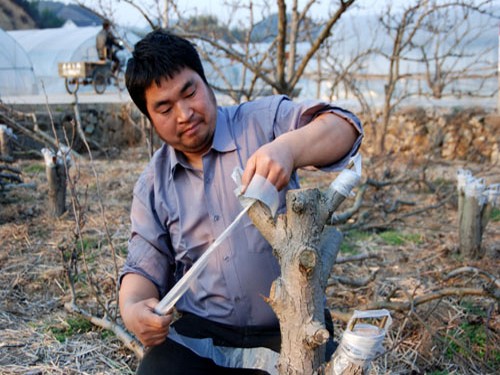
(1) T-shaped budding. T-shaped budding is generally used for 1- to 2-year-old rootstock seedlings; if the rootstock is too large and the bark thickens, grafting is not easy to survive. When grafting, first cut the bud. Hold the scion with the petiole in the left hand and the budding knife in the right hand. First make a cut 0.7-1 cm below the petiole, press the back of the blade with the left thumb, and slant forward with wood, until 0.5-0.7 cm above the bud, then make a horizontal cut about half a circle around 0.5 cm above the bud, deep to the xylem, then pinch the bud with the hand and twist it off to remove the bud piece. On the rootstock seedling, about 20-30 cm above the ground at a smooth, branchless place, cut a "T" shape deep to the xylem (be sure not to cut too deep, which would cause the bud to sprout in the same year). The horizontal cut is about 1 cm wide, and the vertical cut is about 2 cm long. Insert the bud piece into the "T"-shaped wound. When inserting the bud, first use the handle of the budding knife to pry open the incision, gently insert the bud piece from top to bottom, align the upper part of the bud piece with the horizontal cut of the "T" shape, fit it closely, then tie it with plastic strips from top to bottom, tie tightly, leave the bud and petiole exposed, and wrap the bud piece tightly.
(2) Chip budding. Chip budding is mostly used for grafting in spring and autumn when the bark of the rootstock and scion does not separate. In summer budding, if the collected scions do not separate well or do not separate at all, chip budding can also be used. First, on the belly of the rootstock internode about 20-30 cm near the ground, make a slanted cut with a budding knife, about 2 cm long. Slightly above the bottom of the first cut on the rootstock, make a second cut at 30° to the bottom of the first cut, remove the cut bud, and prepare the rootstock incision. When cutting the scion bud, first make a downward slanted cut about 1 cm above the bud on the scion, about 2 cm long, then make a second cut at 30° about 0.7-0.8 cm below the bud down to the bottom of the first cut, remove the bud piece with wood, and finally insert the bud piece into the rootstock incision and tie it.
(3) Ring budding. When pear rootstock seedlings are relatively small and budding must be done earlier in summer, but "T"-shaped budding is inconvenient, ring budding can be used. First make two ring cuts on the rootstock, with a distance of about 2-2.5 cm between the two rings, deep to the xylem, then make a vertical cut between the two rings, and then peel off all the bark of that part of the rootstock (if the rootstock is thicker than the scion, make two vertical cuts between the two rings on the rootstock, leaving one strip of bark). After the rootstock is cut, take a bud piece of the same width from the scion, with the bud centered, immediately place the bud piece into the incision and tie it.
In actual production, different budding methods can be selected according to different situations. However, because chip budding and ring budding require slightly higher operational skill, under normal circumstances, "T"-shaped budding is mostly used.
When renewing varieties in a pear orchard using the high budding method to change the top, the "T"-shaped budding method is also used, grafting one bud piece of a superior variety at the base of each branch, and after grafting, wrapping it tightly with plastic strips. If the original tree's branches grow vigorously, grafting can be done in early to mid-July, and after survival, cut the rootstock the same year to promote the grafted bud to sprout and produce shoots. Otherwise, when the original tree's new shoots grow weakly, the grafting time should be postponed, and the rootstock should be cut before sprouting the following spring.
4. Tying and moisture retention in grafting
At present, plastic strips are mostly used in production as tying material, and substitutes such as Iris lactea can also be used. The width and length of the cut plastic strips can be determined according to the thickness of the rootstock used for budding. Tie with plastic strips from top to bottom, making sure to bind the bud or scion tightly; it is acceptable whether the bud and petiole are exposed or completely covered. In recent years, after 2 years of experiments, the Liaoning Dataishan Fruit Tree Farm proposed a new method of tying for T-shaped budding. This method is simpler and saves labor compared with tying with plastic strips, does not require untying, and has a survival rate above 90%. The specific method is: use a self-made simple fork press to press iron wire (No. 24) into 1 × 2 cm "U"-shaped forks, use a cutter to cut latex film into 2.5 × 2.5 cm small squares, then insert each fork into one third of one end of a film piece, and place them in a small box for later use. After inserting the bud into the rootstock wound, hold the end of the film piece with the fork in one hand and the other end of the film piece in the other hand, wrap the bud tightly in the film, and then use the fork to fasten the film. Because the film rapidly ages in sunlight, it begins to crack after the bud survives, and finally cracks naturally until it falls off, with no need for untying.