How to Grow Corn Poppies? A Detailed Guide to Planting Methods
When will the spring river flowers and moon end? How much of the past do I know? The small building was struck by the east wind again last night, and I cannot bear to look back on my homeland in the bright moonlight. The carved railings and jade steps should still be there, only the rosy faces have changed. I ask you, how much sorrow can one have? Just like a river of spring water flowing east.
I never dared to imagine that the corn poppy appearing in ancient poetry had once been so close to me.
In primary school the weather was very good, with truly blue skies and white clouds. There were many trees and many flowers too. At that time, home had a long courtyard, with a path paved with grey bricks through the middle, and there were always ants in the cracks between the bricks. Along the path was a low wall, and inside the low wall several Sichuan pepper trees were planted. On the pepper trees were large hornet nests, and outside the low wall was a small patch of open ground where some flowers and plants were grown. At that time I did not know what the flowers were called, I just thought they were as beautiful as roses.
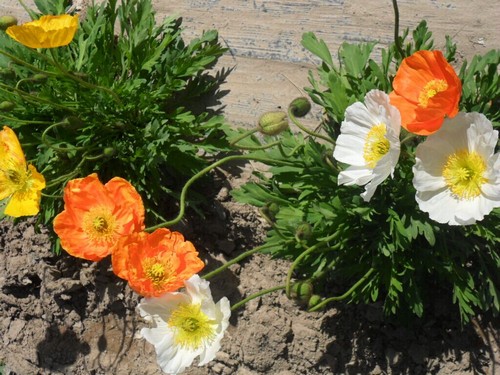
Later I saw them beside the field paths, standing out especially brightly among the wildflowers and weeds, so I moved some home, and they did not survive. I still remember the way those flowers bloomed by the roadside, swaying in the wind. A few days ago when I came to read poetry, I suddenly wanted to know what the corn poppy looked like, so I looked it up, and memories came flooding back. The feeling this flower gives me is one of dreamlike colour.
Before the corn poppy flower opens, the egg-shaped bud is wrapped in two green sepals with white edges, hanging singly on a slender upright flower stalk, very much like a young girl bowing her head in thought.
When the corn poppy bud blooms and the sepals fall off, the corn poppy then stands out: the bent body straightens up, and on the upward-facing flower the 4 thin petals are as thin as satin, smooth and clean as silk, the light corolla like red clouds and coloured silk, seeming to sway even without wind, and when the wind moves it seems even more about to fly away. The originally curved and delicate flower stem now also straightens up to support the flower. It is truly hard to imagine that such a delicate and plain corn poppy plant could produce such rich and gorgeous flowers.
The corn poppy has a lush and elegant posture, graceful and slender, dancing in the wind like a colourful butterfly spreading its wings, very evocative. The corn poppy combines both plain elegance and rich gorgeousness, the two harmoniously united in one body. Its appearance and posture greatly resemble the charm of a beauty in Chinese classical art, and it can be called an exquisite among flowers and plants.
The corn poppy is a deep-rooted plant and does not tolerate transplanting. Because the roots are easily damaged during transplanting, the seedlings grow poorly, affecting normal growth and flowering. If transplanting is necessary, wait until the seedlings have grown 6 leaves and do it on a cloudy day. Before transplanting, water thoroughly, and when lifting the seedlings, carry as much of the original soil as possible and damage the roots as little as possible, but it is still best to grow them by direct sowing.
The corn poppy likes full sunlight and dry, cool air. It is not strict about soil and grows best in loose, fertile sandy soil. During the growing period, watering should be controlled, and keeping the soil moist is best. At the budding and flowering stage, apply 2~3 times a quick-acting fertiliser mainly of phosphorus and potassium to promote large flowers and bright colours and prolong the flowering period. After the flowers fade, promptly cut off the faded flower stems as well as diseased, weak and dead branches, so that the remaining flowers on the plant bloom better. When growing corn poppies, crop rotation should be practised as much as possible, because continuous cropping easily leads to various diseases.
Planting methods for the corn poppy:
1. Propagation by sowing:
Sow in September-October in a seedbed prepared in advance. The suitable germination temperature is 20°C. Because the seeds are very small, the seedbed soil must be finely prepared. After sowing, do not cover with soil; cover with grass to keep moist, and remove the cover after the seedlings emerge. Corn poppy seeds scatter easily, so after one year of growing, the area need not be sown again; countless small seedlings will grow on their own in the same spot.
2. Planting:
After sowing and emergence, if not transplanting, thin and set the plants at a spacing of 20 cm × 30 cm between plants and rows. The planting time should not be later than 110-120 days before the date you want them to bloom. If transplanting is desired, do it on a cloudy day when the seedlings have grown 3-4 true leaves. Before transplanting, water thoroughly, and when lifting the seedlings, keep soil around the roots and do not damage the roots.
3. Light:
It likes cool conditions and dislikes high temperatures. Warm winters and cool summers suit its growth best. During the growing period it requires sufficient light, with at least 4 hours of direct sunlight each day. If the growing environment is shady and light is insufficient, the plant grows thin and weak, and the flower colours are dull.
4. Temperature:
The corn poppy is cold-resistant and afraid of summer heat. The suitable growing temperature is 12-20°C. When the summer temperature rises, the corn poppy's growth weakens, and the above-ground part turns yellow and dies. Low temperatures at night are favourable for growth and flowering, and it grows well in high-altitude mountain areas.
5. Watering:
When sowing, apply enough base fertiliser. During the growing period it likes moist soil, so water in good time. Watering should follow the principle of "dry then wet". Just after planting, control watering to promote root growth. After budding, supply plenty of water and keep the soil moist.
6. Fertilising:
Before flowering, apply dilute liquid fertiliser 1-2 times. After budding, spray the leaves with 0.1% potassium dihydrogen phosphate solution once every 3 days to force flowering. After the corn poppy blooms, promptly cut off the withered flowers so the remaining flowers bloom better.