How to grow peace lily (Spathiphyllum) in water? Explaining the causes of not blooming and yellowing, withered leaves
Hydroponic peace lilies not only have the traditional flower-plant functions of enjoying blooms and foliage, but also offer unique advantages such as being clean and eco-friendly, saving labor and time, being easy to care for, having an elegant style, and being highly ornamental. You can enjoy both the beauty of the flowers and the splendor of the roots, which is refreshing and uplifting. Hydroponic peace lilies are very low-maintenance and are called “lazy person’s flowers”, and their daily care is very convenient.
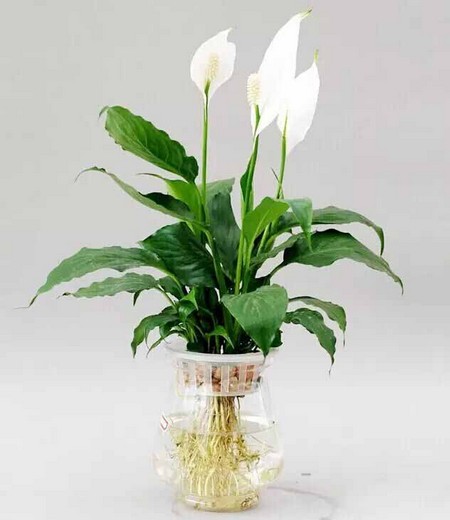
[Steps and Methods]
1. Choosing a container
If you want to grow it hydroponically, buy a vase with a relatively large bottom, or place it in a medium-sized fish tank.
2. Suitable ambient temperature
The growth temperature for hydroponic peace lilies is generally 8°C—30°C; within this range they can grow normally.
3. Suitable light
Hydroponic plants should mainly receive diffused light; they do not necessarily have to be exposed to the sun, and peace lilies are sensitive to light, especially in summer, so direct sunlight should be avoided as much as possible.
4. Changing the water and cleaning the plant roots
For hydroponic peace lilies, change the water about every half month in summer and about once a month in winter, and add a few drops of special nutrient solution for hydroponic flowers (prepare the nutrient solution concentration according to the instructions).
The containers used for growing hydroponic plants are prone to growing moss, which affects the ornamental value of the roots and also consumes oxygen in the water. When changing the water, first wash away the mucus on the plant roots with clean water, and cut off old roots and rotten roots. When growing hydroponically for the first time, wash away the soil from the roots, and scrub the moss off the container and roots. Each time you change the water, the water level should be 1/2—2/3 of the root system, and the remaining root sections should be left exposed to the air.
5. Moisture retention and spraying foliar fertilizer
To prevent the leaves from drying out, during daily care you should spray the leaf surfaces with clean water to retain moisture. It is best to spray foliar fertilizer once a week, which can both provide nutrients to the leaves and increase their gloss, and in winter also help resist low temperatures. Use nutrient solution for foliage plants. At the bud stage, the leaves need to be sprayed 2 to 3 times with a 0.3% potassium dihydrogen phosphate solution, which can promote blooming.
Peace lilies require loose, well-drained, humus-rich sandy loam soil. Peace lilies like a warm, humid, semi-shaded environment and dislike strong direct sunlight. They are not cold-tolerant; the suitable growth temperature is 20°C-28°C, and the overwintering temperature is above 10°C. Even if the above hydroponic method is successful, hydroponic peace lilies may still fail to bloom or develop yellow, withered leaves.
The main causes of peace lilies not blooming and leaves turning yellow and withering are:
1. Unsuitable light
Peace lilies are relatively shade-tolerant; about 60% diffused light is enough to meet their growth needs.
If the light is too dim for a long time, peace lilies will grow weak and be unlikely to bloom. But if the sunlight is too strong and direct, the leaves may turn yellow, affecting growth and being unfavorable for blooming.
2. Improper watering
They require high humidity; when the air is too dry, blooming is unfavorable, so each watering should be thorough to keep the potting soil moist;
Watering too much or too little will both affect the growth of peace lilies. If the potting soil becomes waterlogged, it is prone to causing root rot and the plant to wither and turn yellow, affecting plant growth and preventing blooming. But if the growing environment is too dry, new leaves will become smaller, turn yellow, and even wither. During the growing period, just keep the potting soil moist.
3. Insufficient fertilizer
During the growing period, peace lilies grow rapidly and need a relatively large amount of fertilizer. If no fertilizer is applied for a long time, it is unfavorable for healthy plant growth and they will not bloom. From May to September, during the growing period, apply some granular compound fertilizer each month, which will both promote leaf growth and blooming.
4. Temperature too low or too high
Peace lilies can tolerate relatively high temperatures but are not tolerant of low temperatures. If the temperature is low, they are not easy to bloom. To make them bloom, the temperature must be kept above 20°C, but it must not be too high either; above 35°C will affect the growth of peace lilies.
5. Not repotting for a long time
Peace lilies grow relatively quickly; generally after 1-2 years the plant will fill the pot, the leaves will be crowded, and it will be difficult for them to bloom.
If peace lilies are not repotted for a long time, the soil fertility will decrease, slowing growth; moreover, the soil tends to become compacted and has poor aeration, affecting the respiration of the plant roots. Therefore, they need to be repotted in time; usually after repotting, a semi-shaded location is more suitable;
It is recommended to place peace lilies indoors in a place with ample light and diffused light. In summer, pay attention to shading to avoid direct sunlight; from the 5th to the 9th, provide sufficient water so that the soil is often moist, and frequently spray water on the leaves and the surrounding environment to increase humidity; apply fertilizer once every 10-15 days, especially before the flowering period focusing on phosphorus and potassium fertilizers, and when new leaves sprout focusing on nitrogen fertilizer; repot in a timely manner and apply base fertilizer.