A Detailed Guide to Magnolia Planting Methods and Care Tips
Magnolia is also called lotus magnolia, and comes from the flowers of plants in the Magnolia genus of the Magnoliaceae family. There is another type, the big-flowered magnolia, whose flowers are large and can be used as street trees for ornamental viewing. Magnolia petals are white or have purple stripes. Magnolia is one of the most precious flowering trees in our country and has been loved by people since ancient times.
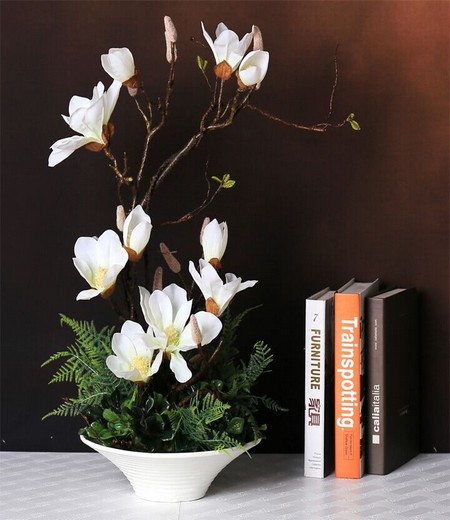
1. Soil: White magnolia prefers acidic soil, with a soil pH requirement of 5.5-6.3. It is best to use fertile, loose, well-drained growing soil. It can be prepared with 5 parts pine needle leaf mold, 2 parts rice husk ash, 2 parts coarse sand, and 1 part thoroughly decomposed barnyard manure. Avoid using fine sandy soil or heavy clay soil with poor air permeability.
2. Sunlight: White magnolia is a sun-loving flowering plant and needs ample sunlight. During the growing period, it should be cared for in a sunny spot with long sunshine hours and strong light, especially during the flowering period. Daily sunlight must not be less than 6 hours. If it is cared for in a shaded place, it will only grow leaves and not bloom, or bloom very little, with slender branches, pale leaves, thin leaves, and no luster, which is unfavorable for growth. However, direct sunlight should be avoided in summer, and shade should be provided from 9 a.m. to 4 p.m. At the same time, water should be sprayed on the leaf surfaces and the ground to increase air humidity.
The growth of magnolia requires sufficient light. During the growing period, it should be placed on a balcony or other sunny spot with long sunshine hours and strong light. During the flowering period, even more attention should be paid to light-related care, and more than 6 hours of light should be ensured every day. Long-term care in a shaded place is not conducive to the normal flowering of magnolia. Only during the "dog days" with long periods of strong direct sunlight should moderate shading be provided, usually between 12:00 and 16:00 each day. At this time, the ground temperature should also be lowered. The specific method is to sprinkle cool water on the ground, which will also increase air humidity and artificially create a suitable environment for magnolia growth.
3. Temperature: White magnolia prefers warmth and fears cold, so special attention should be paid to protecting it so it can overwinter safely. Generally, it should be moved indoors in late October and placed in a sunny spot. The room temperature is best kept at around 10°C and must not be lower than 5°C.
4. Watering: White magnolia has fleshy roots. If the potting soil is too wet, the leaves will turn yellow and fall off, and the roots may even rot and cause death. If it is too dry, the leaf tips will wither and the leaves will curl. It is a flower that fears both waterlogging and drought. During the flowering period, if the petals open outward excessively, it indicates insufficient water; when the water is appropriate, the buds remain in a half-open state. When the surface of the potting soil looks dry and the soil is hard and cracked, water immediately. Watering requires that the water temperature and soil temperature must be consistent, and cold or hot water must not be poured suddenly. In spring and autumn, watering once a day is generally sufficient. In summer, when it is hot, evaporation is high, and growth is vigorous, the frequency and amount of watering can be appropriately increased. When moved indoors for overwintering in winter, watering should be restricted.
The roots of magnolia are fleshy roots, so water control must be done properly. Therefore, from early summer to late autumn, watering should be done once a day to keep the soil moderately moist. Especially during the dry "dog days," it should be watered once in the morning and once in the evening, and air humidity should also be increased by spraying water on the leaves and flowerpot. If tap water is used for watering, care should be taken to prevent the soil from becoming alkaline. If leaves turn yellow, ferrous sulfate solution or acid vinegar water at a concentration of about 0.7% should be applied promptly to the roots. During rainy spring weather, standing water in the flowerpot should be avoided to prevent root rot.
5. Fertilizing: White magnolia has a long flowering period and likes fertilizer. If fertilizer is insufficient, it will bloom less; if fertilizer is not applied at the right time, it will cause excessive growth of branches and leaves and poor flowering. From February to March, before new buds sprout, apply decomposed cake fertilizer as a base fertilizer. During the flowering period, apply dilute human manure, or liquid fertilizer made from fermented and decomposed bean cake, tea seed cake, and fish bones, diluted with 9 parts water, once every 3-4 days. Stop fertilizing half a month before moving indoors for overwintering.
Because magnolia has a long flowering period, large flowers, and abundant blooms, it also needs more nutrients for growth. Moderate fertilizing is needed to provide sufficient nutrients for its growth, thereby ensuring that magnolia can produce lush and beautiful flowers when the normal flowering period arrives. When potting, apply a sufficient amount of base fertilizer. During the flowering period from May to July, apply an organic liquid fertilizer mainly based on phosphorus and potassium (decomposed cake fertilizer water) once every 5-7 days. Adhere to the principle of "light fertilizer applied frequently." The fertilizer can be prepared from dilute to concentrated, and raw fertilizer must never be applied to avoid burning the roots. In addition, every 7-10 days, foliar fertilizing should also be carried out once, spraying a plant growth promoter at a concentration of 0.5% and monopotassium phosphate at a concentration of 0.3%.
6. Pruning: During the growth of white magnolia, the plant should be shaped and pruned by cutting off diseased and dead branches and excessively vigorous branches, and removing some lower leaves to suppress the plant's growth vigor and promote more flower buds and blooming. Magnolia branches and trunks have poor wound-healing ability, so pruning is generally not carried out. However, for the sake of a reasonable tree shape, excessively vigorous branches, dead branches, diseased and pest-infested branches, and branches that hinder the beauty of the tree shape should still be cut off in the early leaf-expanding stage. In addition, after the flowers fade, if seeds are not to be kept, the remaining flowers and follicle fruit clusters should also be cut off to avoid consuming nutrients and affecting flowering the following year.
Magnolia is fresh and elegant, and is an important plant for courtyard beautification. In magnolia cultivation, attention should be paid to:
Magnolia is an ornamental flowering tree with both color and fragrance in early spring. When planting, the timing must be grasped well. It should not be too early or too late. The most suitable time is 10 days before budding in early spring or after the flowers fade and before the leaves expand. When transplanting, regardless of the size of the seedling, the roots must be kept with a ball of soil, and care should be taken to damage the root system as little as possible to ensure survival. Before planting, sufficient fully decomposed organic fertilizer should be applied in the hole as base fertilizer. After planting, cover with soil and press firmly, and water thoroughly in time.
The root system of magnolia is fleshy and not tolerant of standing water. During the flowering and growing period, the soil should be kept slightly moist. After autumn, watering should be reduced to delay magnolia root growth, promote branch maturity, and facilitate overwintering. In winter, watering is generally not done; water only once when the soil is too dry.
Magnolia relatively likes fertilizer, but avoids heavy fertilizer. During the growing period, applying fertilizer twice is generally enough to benefit flower bud differentiation and promote growth. One application is in early spring, and the other is from May to June. Fully decomposed organic fertilizer is mostly used. Newly planted saplings do not need fertilizing; fertilize again after leaf fall or in the following spring.