Potted Cultivation Techniques for Leatherleaf Mahonia
Leatherleaf Mahonia (Mahonia bealei) is evergreen year-round, with an elegant tree form, unusual branches and leaves, and beautiful flowers. It bears yellow flowers, and its fruit turns blue-purple when ripe. Its leaves are graceful with sharp spines, and their color is vivid and attractive. It can be used for landscaping and as an indoor potted ornamental. Because of its intricate branches and leaves and its yellow flowers and purple fruit, it looks both distinctive and full of character when used as a landscaping accent. Planted around the front and back of a house, Leatherleaf Mahonia looks especially harmonious in front of a white plastered wall, and it is quite attractive as a foundation planting beneath the walls of courtyards and gardens.
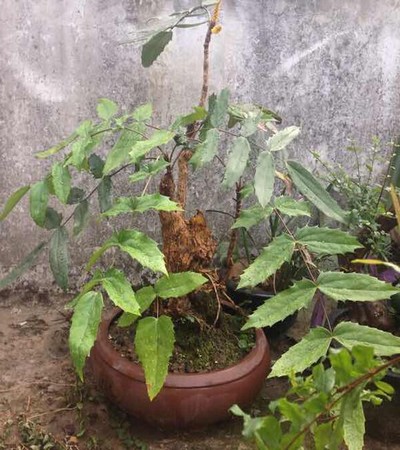
Selecting thick, large plants and truncating the trunks to encourage sprouting can produce stump bonsai with beautiful roots, leaves, flowers and fruit. In gardens it can be planted as a hedge. At the four corners of orchards and vegetable gardens it serves as a boundary planting, and as a potted plant placed at entrance halls, meeting rooms, guesthouses and reception rooms it makes people feel serene and charmed. Planted by ponds, at pond edges and beside rocks, its lush green is exceedingly elegant. As a cut flower it is even more distinctive. In short, Leatherleaf Mahonia attracts viewers with its unique presence; whether leaves, trunks or the whole plant, it draws the eye, and its elegant appearance makes it a prized among ornamental flowering plants. So how do you grow potted Mahonia?
Potting soil:
The potting soil should be fertile, loose, well-aerated, slightly acidic, neutral or calcareous soil. Leaf mold or weathered garden soil mixed with an appropriate amount of sand is commonly used. It is not demanding about soil and grows vigorously in moist, well-drained, fertile sandy loam.
Seedling raising:
Cultivate and weed 3 times each year, in May, July and September. Apply topdressing 2 times, after the cultivations in May and September. After transplanting, cultivate and weed 2-3 times each year and apply topdressing once, with pig manure water being suitable. In the seedling bed, pull weeds as soon as they appear, and water appropriately during dry spells when there is no rain.
Planting:
It is best to pot it after autumn or before sprouting in spring. When digging up seedlings, be sure to protect the lateral roots and fibrous roots; it is difficult to survive with only a taproot, so it is best to transplant with a soil ball. At the same time, appropriately thin the branches and leaves to reduce water loss. Mahonia is relatively easy to manage and is generally transplanted when growth starts in early spring. Apply sufficient base fertilizer at planting, firm the soil after planting, and water thoroughly.
When potting, mix a large amount of sand into the growing medium to prevent water from accumulating in the pot. It can be repotted and given fresh soil once every 2 years. As root suckers emerge and the clump continues to expand, gradually move it into larger pots, up to a maximum of a "three-hoop" pot; do not plant it in a wooden barrel, because old plants have low ornamental value. Overly old plants can still be planted in smaller flowerpots through division and cutting back.
Fertilizer and water:
Pay attention to watering during drought; irrigation is best and can be done by furrow irrigation, sprinkler irrigation or watering. Watering once before winter each year with decomposed cake fertilizer or poultry and livestock manure will keep it growing vigorously. During the growing season, apply a decomposed dilute liquid fertilizer once every 20 days to Mahonia; topdressing 2-3 times a year is sufficient, and in early spring apply an appropriate amount of cake fertilizer. If grown in a pot, keep the potting soil moist but not waterlogged. In winter, move it indoors to a spot with ample sunlight, and the temperature should not be too high.
Main pests and diseases:
Fruit-piercing owlet moth, bagworm moths, Mahonia anthracnose, spot disease, leaf spot disease, rust disease, Japanese wax scale, and white peach scale, etc.
Control methods:
1. For the fruit-piercing owlet moth and the large bagworm moth, spray with a 1000-fold dilution of 90% trichlorfon technical powder.
2. For Mahonia anthracnose, spray with a 1000-fold dilution of 70% thiophanate-methyl wettable powder.
3. During the scale insect stage, spray any one of the pesticides dichlorvos, parathion or carbaryl.
4. Remove diseased fallen leaves and burn them. During the disease period, spray agents such as Bordeaux mixture or chlorothalonil.