What are the planting methods and precautions for apricot trees?
Apricot fruits ripen early and have high nutritional value; they are suitable for processing and for eating fresh, and they hold an important position in the early-spring fruit market. Looking at domestic and international markets over the past ten years, apricot fruits are in short supply, demand exceeds supply, prices are stable with a slight rise, and economic returns are high, making it a tree species with great development prospects.
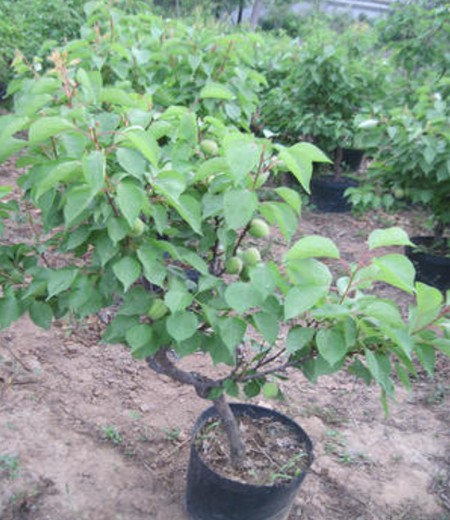
The apricot tree is one of the main fruit tree varieties in the southern Xinjiang region. If apricot trees are not managed properly, problems such as weakened tree vigor, poor quality, and frequent pests and diseases can occur. In the past two years, the apricot varieties in Baozihong Baximaili Village have degenerated, the quality of the harvested apricots has declined, and they cannot fetch a good price, which has distressed local growers. To solve this problem, the reporter interviewed Zhang Ping, director and researcher of the Institute of Agricultural Product Storage and Processing of the Academy of Agricultural Sciences, who introduced the key techniques for high-quality and high-yield apricots.
First, select excellent varieties and pair them with pollinating varieties. "Semaiti apricot," "Mugeyage apricot," "Heiye apricot," "Mingxing apricot," and "Xiaobai apricot" are all excellent apricot varieties in the southern Xinjiang region. If inferior varieties are found in the apricot orchard, top-grafting to replace the canopy should be carried out promptly. To improve the fruit-setting rate, pollinating varieties should also be paired; generally, a ratio of main cultivar to pollinating variety of 1:2 to 1:4 is acceptable, to prevent problems such as a low fruit-setting rate caused by a single variety. The tree shape should be well ventilated and let light through; apricot trees generally use the natural round-headed form. This tree form has no obvious central leader; the trunk height is generally 60 cm to 100 cm, with 4 to 5 main branches retained, arranged alternately on the central leader; on the main branches, one side branch is kept every 40 cm to 60 cm, and branch groups are arranged on the side branches; large branch groups can also be used to replace side branches. The tree height should preferably be controlled at 3.5 m to 4.5 m.
Second, pay attention to soil and fertilizer management. The planting trench is generally about 1 m wide; the trench should be covered with plastic film or frequently cultivated, loosened, and weeded, so that the soil remains loose and free of weeds.
Base fertilizer is mainly farmyard manure, applied after apricot harvest. "The method of applying base fertilizer depends on the different planting conditions of each household locally," said Zhang Ping. For 1-year-old to 3-year-old apricot trees, hole application is used, digging pits of 40 cm × 40 cm × 50 cm between plants in different directions and applying into them, with 2 cubic meters to 3 cubic meters of farmyard manure per mu; for mature trees over 4 years old, trench application is used, digging a continuous trench 50 cm wide and 50 cm deep at the crown projection and applying into it, with 3 cubic meters to 5 cubic meters of farmyard manure per mu. Apricot trees need topdressing four to five times each year: before flowering, apply 10 kg to 20 kg of urea and 5 kg of diammonium phosphate per mu; at the pit-hardening stage, apply 25 kg of diammonium phosphate per mu; at the maturity stage, apply 20 kg of potassium sulfate per mu; after harvest, combine with base fertilizer application and apply 20 kg of diammonium phosphate per mu. "When topdressing, dig pits at different positions outside the crown projection and apply into them, 20 cm to 30 cm deep, and irrigate immediately after fertilizing," Zhang Ping emphasized. Irrigation should be carried out once each at the bud-break or flowering stage, the swelling stage, the pit-hardening stage, after harvest, and for winter irrigation. Foliar spraying should be chosen in the morning or evening during the fruit swelling stage of apricots, commonly using 0.3% urea or 0.5% potassium dihydrogen phosphate, etc., at an interval of 10 days to 15 days, sprayed three times consecutively.
Gummosis, scale insects, aphids, and fruit borers are all pests and diseases that occur frequently in Baozihong Baximaili Village. Trunks and branches affected by gummosis exude transparent gum in spring, mostly caused by weakened tree vigor as well as frost injury and insect injury. Therefore, fertilizer and water management and pruning and shaping of apricot trees should be strengthened. A mixture of 1 kg sulfur powder + 10 kg quicklime + 40 kg water + a small amount of clay or cement can be used to whitewash the trunk and main branches in winter. Before bud break in spring, the whole tree should be evenly sprayed with 5-degree lime sulfur mixture. Scale insects occur for 1 to 2 generations per year; before bud break in early spring, spray 5-degree lime sulfur mixture. In early August, during the peak period of nymph dispersal, spray 1000-fold chlorpyrifos, with a pre-harvest interval of 30 days. Aphids mainly damage young branches and young leaves; after being damaged, the leaves curl toward the back, and in severe cases curl into clumps, causing new shoot growth to stagnate. Combined with pruning, cut off branches bearing eggs. Before leaf curling, spray a 400-fold to 600-fold dilution of 0.5% veratrine alcohol solution. For fruit borer control, the timing should be based on monitoring by the local agriculture or plant protection department, mainly using green environmentally friendly bionic formulations or biological formulations, such as evenly spraying 0.5% veratrine alcohol solution at 400-fold to 600-fold, or evenly spraying 1% matrine soluble liquid at 800-fold to 1200-fold.
Harvesting, as the last step before apricots are sold, is also particularly critical. Harvesting is chosen on a sunny morning after the dew has dried; different varieties should be harvested and transported separately. For apricots used for drying, harvesting when the fruit is 80% to 90% ripe is appropriate. Temperatures in the southern Xinjiang region are slightly higher; for apricots used for fresh eating, after harvest they should be promptly transported to market or refrigerated for fresh-keeping storage and transport. When picking, handle them gently, and it is preferable to cut and leave the fruit stalk with scissors; the harvesting container should be clean, and a capacity of 10 kg to 15 kg is appropriate.
[Precautions]
Planting: Select seedlings with a good root system, robust and plump branches, reaching a certain height and thickness, and free of serious pests, diseases, and mechanical damage. Planting can be done in both spring and autumn. The suitable period for spring planting of apricot trees begins when the soil thaws in early spring and lasts until mid-April; the suitable period for autumn planting runs from apricot leaf fall to before the soil freezes; in high-cold regions, spring planting is preferable.
Fertilizer and water: Irrigate at least once each before bud break, after flowering, in autumn, and before the soil freezes. Irrigation and topdressing can be carried out at the same time. If there is a year with high rainfall, pay attention to drainage and waterlogging prevention in the apricot orchard. Base fertilizer should be applied before leaf fall. Topdressing should be applied before bud break and during the fruit swelling stage with quick-acting nitrogen combined with phosphorus and potassium fertilizers; after fruit harvest, mainly apply phosphorus and potassium fertilizers, with a small amount of nitrogen combined; for aging trees, after fruit harvest, the amount of nitrogen combined can be appropriately increased.
Pruning: For young trees, shaping and pruning. Apricot trees have strong apical dominance, so a multi-main-branch natural open-center tree form is preferable. Pruning in the early fruiting stage. Apricot trees generally can flower and bear fruit 3 years after planting, and at this stage branch growth vigor is still strong. The purpose of pruning is to continue expanding the crown, maintain the necessary tree form, and cultivate as many fruiting branch groups as possible. In the middle and late stages of full fruiting, the fruiting parts move outward and the branches at the lower part of the crown begin to become bare, so the main task of pruning during full fruiting is to regulate the relationship between fruiting and growth, keep the tree vigorous, and extend the years of full fruiting. Pruning in the aging stage. The main task for apricot trees is rejuvenation and renewal and re-cultivating fruiting branch groups. The specific pruning method is to heavily retract weakened perennial branches, stimulate latent buds to sprout vigorous shoots, and select from them to cultivate new scaffold branches, extension branches, and fruiting branch groups.
Harvest: After apricot trees have fruit harvested, young vigorous branches need to be pulled to open the angle, to moderate tree vigor and promote flower formation. Continue secondary pinching of new shoots to promote branching and cultivate branch groups. Promptly cut off water sprouts and diseased and pest-damaged branches. Diseased and pest-damaged branches should be burned in a centralized manner.