What are the key points of red twig dogwood planting techniques?
The red twig dogwood has bright red autumn leaves, small white fruit, and after leaf drop its branches are as brilliantly red as coral. It is a rare stem-ornamental plant and an ideal winter landscape tree species, as well as a good cut flower material. In gardens it is often planted in clumps on lawns or interplanted with evergreen trees, achieving a red-and-green contrasting effect and bringing more surprises to the bleak winter landscape.
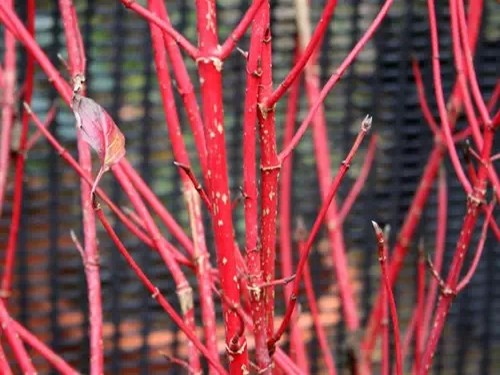
Red twig dogwood is also known as red-stemmed dogwood, Liangzi wood, and pagoda dogwood. It belongs to the Cornaceae family, genus Cornus. The flowers are small and yellow-white. The flowering period is from May to June. The drupe is obliquely ovate, white or slightly blue-purple when mature, and the fruit ripening period is from August to September. The red twig dogwood has a vigorous nature and wide adaptability. Its cultivation and management key points are as follows:
1. It is extremely cold-resistant, drought-resistant, and tolerant of pruning; it prefers light and likes relatively deep, moist but fertile and loose soil.
2. It can be propagated by cuttings, sowing, layering, and other methods:
Cuttings——In late autumn, cut 1- to 2-year-old vigorous branches as cuttings, store them in sand over winter, and insert them into the soil in late March of the following year. After rooting, apply a dilute liquid fertilizer once a month;
Sowing——Note that the seeds should be stratified in sand for 120 days and then sown in spring;
Layering——In early May, girdle the branch and then bury it in the soil. After rooting, separate it from the mother plant and transplant it in the following spring.
3. When planting red twig dogwood, apply 10 to 15 kg of decomposed compost per hole as base fertilizer, and thereafter apply topdressing in trenches every spring or autumn.
4. In early spring when buds sprout, renewal pruning should be carried out, cutting back the previous year's branches to promote the sprouting of new branches and keep the branches brightly red.
5. When old plants grow weak during cultivation, with rough bark and aging flowers, attention should be paid to renewal. Leave 1 to 2 buds at the base, cut off all the rest, and after new branches sprout, thin them appropriately; the plant can recover in the same year.
6. It is prone to stem rot. In March when buds sprout, spray 4 to 5 degrees Baume lime sulfur mixture, and before the rainy season spray 1:1:200 Bordeaux mixture; in autumn, leafhoppers may occur, damaging the branch bark and affecting ornamental value. Spray 1% dimethoate or 0.5 degrees Baume lime sulfur mixture.