Clematis Container Planting Methods and Key Technical Points
Clematis has sparse, graceful branches and leaves; some have large, brightly colored flowers, while others have numerous small flowers clustered into large inflorescences, offering unique charm. It is an indispensable excellent material for climbing greenery. It can be planted by walls and windows, or beside trees and shrubs, or arranged among rockeries and rocks. It can climb on flower pillars, flower arches, and fences; it can also be grown in containers for ornamental purposes. A few species are suitable as ground cover plants. The flowering branches, leafy branches, and fruiting branches of some clematis can also be used for bottle arrangements, cut flowers, and more.
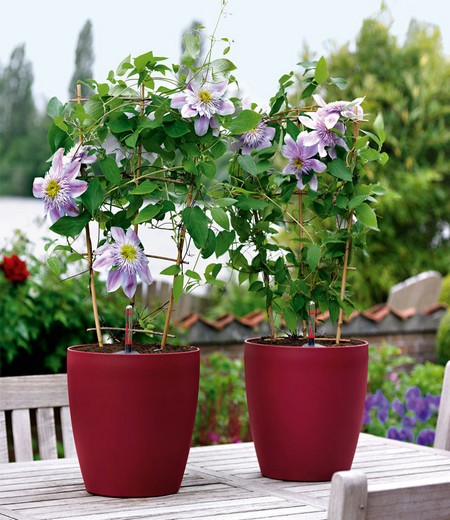
[Seedling Selection]
Choosing clematis seedlings is very important. First, you must choose good varieties. Many varieties have proven to be relatively weak, such as Mianbai, Patricia, Hongxing, Gongzi, Ziziwan, and many other clematis. So beginners must choose carefully. Second, you must choose a good seller.
[Soil Mixing]
The growing medium is the most important thing in container-grown clematis. One major principle is that it must be breathable and moisture-retentive. Based on this principle, and combining the soil mixes of those experts, I believe the best and most economical soil mix method is to use coconut coir 3, peat 1, and perlite 1. Of course, large-particle media such as volcanic stone, kanuma soil, clay pellets, and bark can also be added.
[Planting]
When planting, generally dig a hole 40 cm deep and 60 cm in diameter. After loosening the hard soil at the bottom of the hole, put in a large amount of humus, then add topsoil mixed with bone meal. In poorly drained clay or light sandy soil, after loosening the bottom of the hole, mix in a spadeful of peat soil or humus. In places where water may accumulate, the bottom should be raised with stones or rubble, 25 cm above the surrounding soil surface.
[Watering]
In many cases, clematis is killed by water damage. Clematis has fleshy roots and is very afraid of waterlogging. But it also likes to stay moist. So generally in winter, water should be controlled, basically once every half month. In summer, watering should be more frequent, generally once every 3 days. In summer, because the weather is too hot, it is best to supply water from the tray in the morning. Do not water directly at noon, otherwise the roots will rot. The principle of watering is to water when dry, not to water every day. In spring and autumn, watering can be more flexible, because clematis is in its vigorous period and uses water quickly. The so-called "water thoroughly when dry" does not mean it needs a lot of water; seeing water flow out is enough, and it is not necessary to repeatedly irrigate with a lot of water.
[Fertilizing]
Put some fermented organic fertilizer at the bottom of the new pot, remember it is a small amount. Then put a layer of new medium before placing the clematis. For newly planted or transplanted clematis, it is recommended to apply basal fertilizer, generally using organic fertilizer or humus. The basal fertilizer should be at least 5 cm away from the root system. Generally, a 1-year-old small pot should not be casually switched to a large pot. Be sure to remember not to switch to a large pot, do not put organic fertilizer, and you can add an appropriate amount of mixed fertilizer.
[Pruning]
There are no absolute rules for pruning clematis. But in general, after flowering, if you do not need to keep seeds, you can cut the 3 nodes of branches below the flower for cuttings. In autumn and winter, when clematis enters dormancy, pruning should be done immediately. Small seedlings can generally be cut flush with the soil, while large seedlings can keep strong branches. In particular, double-flowered ones such as Dani, Arctic, Josephine, and Crystal should keep old branches.