A Step-by-Step Guide to Growing Blue Plumbago (Plumbago auriculata) in Pots
Among the many flowers and plants, I really love blue plumbago. I love its color - so blue it feels like a cool breeze blowing through spring or autumn. It always blooms so diligently, on and on. I think that perhaps among such blue blossoms, I might have a dream - a dream of my grandmother's embrace, and in that moment laughter would rise and fall, right?! I must plant another blue plumbago. The longing that lingers in my heart is like a flower - it too is beautiful.
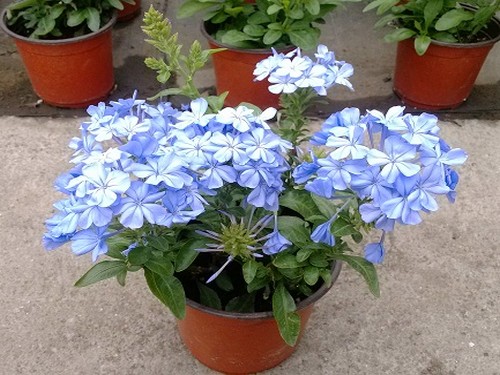
Blue plumbago belongs to the genus Plumbago in the family Plumbaginaceae. Its flowering period is from June to November. It is a perennial upright clump-forming herbaceous plant, usually about 30-60 cm tall. Each year, several renewal shoots emerge from the nodes near the ground at the upper end of the underground stem, becoming above-ground stems. The leaves are emerald green, and the flowers are elegant and subtle in color, mostly sky blue, occasionally white, giving a refreshing feeling in the hot summer. It is commonly cultivated in South China, East China, Southwest China and Beijing in China. It is native to southern South Africa and has been widely introduced as an ornamental plant in many countries.
[Substrate]
Blue plumbago grows better in peat-based growing media; plants grown in garden soil clearly grow more slowly. Just mix in some perlite.
[Flower Pot]
Blue plumbago prefers a wider pot; it does not need to be too deep. Blue plumbago is a shrub and will send out roots underground and produce new shoots laterally. Choose a large flower pot; it grows rapidly and needs plenty of water and fertilizer. A small flower pot restricts its growth. Generally speaking, seedlings I took cuttings of in autumn are planted in an Elho No. 10 round pot by the following summer.
[Watering]
Blue plumbago prefers a fairly moist growing medium. If it lacks water and is watered immediately, it can recover. If it lacks water for a long time, the leaves tend to turn yellow and the plant becomes weak. In summer, for the ones I grow in No. 14 pots, I water at least twice a day, and often add another watering at noon.
[Fertilizer]
Blue plumbago loves fertilizer. For base fertilizer, you can use long-acting slow-release fertilizers such as Osmocote or hoof and horn meal. For regular top-dressing there is nothing too particular; basically any fertilizer can be used. I habitually use Peter's Professional for root drenching, and for solid top-dressing fertilizer I use Leili Haifusheng. Foliar feeding has a very good effect - Peter's Professional plus seaweed extract.
[Pruning]
Blue plumbago is not afraid of pruning. After flowering, cut off the spent flowers, and it can bloom again in about 20-30 days. Old branches should not be more than two years old. I generally do hard pruning each year when I move it indoors in autumn, cutting away black branches and keeping only the thick, strong green branches that grew that year.
[Pests and Diseases]
The main pest and disease problem of blue plumbago is the larvae of noctuid moths - small green fleshy worms. Use abamectin or Leili 609, or Xiangshan Plant Insecticide King. White powder on the underside of the leaves is a normal phenomenon, and curling of old leaves is not a disease either.
[Other]
If it rains during the peak flowering period, the flowers are easily damaged, which affects their ornamental value. It likes strong sunlight, and flowering is still decent in semi-shade. In winter, you can force dormancy by cutting off water at low temperatures, but you must ensure a certain amount of light. According to my experience, the low-temperature limit is about zero degrees. Some flower growers in Shanghai have successfully overwintered it outdoors, but it needs to regrow its branches.
Blue plumbago has vigorous growth, is relatively tolerant of high temperature and high humidity, and is not very cold-hardy. North of the Yangtze River it cannot survive winter outdoors; in the Jiangsu-Zhejiang area it needs protective measures to overwinter. It has few pests and diseases. It loves light and tolerates shade to a certain extent, but the amount of flowering will decrease. It prefers sandy, well-drained, fertile soil. It is easy to manage and has a long ornamental period. When short of water, the leaves will wither and turn yellow. The flowers are fairly sticky and do not tolerate rain.
Blue plumbago is relatively simple to care for and is suitable for light, frequent fertilization. Timely pruning is very important. Prune at the end of March and the beginning of April, and water thoroughly before pruning to ensure a sufficient water supply for growth.