A Detailed Guide to Growing Lobelia (Trailing Lobelia)
I remember looking at pictures of the Aegean Sea online, where every household's yard, walls, and even the walkways and alleys were hung with pots of trailing little flowers, forming a flower ball along each pot. The deep and light blues, the reds and greens climbing all over the walls, and the azure sea in the distance created a huge visual impact. So the all-knowing Baidu once again gave me the answer: those pots of deep and light blue had a strange name called liubeili (lobelia), and the first time I heard this name, I directly thought of ancient pawnshops. Well, the name isn't pleasant to hear, but as long as the flowers are pretty, that's fine. About seven years ago, I began my journey of growing lobelia.
Lobelia seeds are very tiny, only slightly larger than succulent seeds. When sowing, do not cover with soil. In the south, it is best to sow in autumn, so the seedlings do not have to endure the scorching summer; in the north, where indoor heating is available in winter, you can sow in spring or autumn as you like. When temperature and humidity are suitable, the seeds sprout in about 5 days. The optimal growing temperature is 15°—25°. From sprouting to blooming is a long six-month process, during which you go through a series of early tasks such as transplanting seedlings, pinching, and fertilizing, and then it is just routine care while waiting quietly for the flowers.
I remember the first time I grew lobelia, I wasn't really sure what to expect. After sprouting and transplanting, there were seven or eight pots, large and small, and the seedlings went through a long period of just being leafy. A friend came to ask for some flowers, and I recommended lobelia. When she saw the pots full of green leaves, she immediately turned up her nose and said this looks like the bean sprouts at my house, I'll pass. Not long after, and really not long after, they bloomed, bursting into a full pot. I took a photo to show my friend, and she immediately regretted it.
Lobelia doesn't have many flower colors: white, pink, and various shades of blue. I always thought the name liubeili was a bit vulgar. After growing lobelia once, my understanding of the name became this: six months from sprouting to blooming, and as long as you take careful care of it, it will give you double the surprises. In fact, the scientific name of lobelia is: Lobelia erinus, and its name is a transliteration.
I see many flower lovers have some questions about growing this small-flowered herbaceous plant. I happened to have grown it before, so I'll share my experience with everyone. If you need it, you can listen to what I have to say.
First, whether the flowers can become very beautiful depends on sowing at the right time. From first encountering lobelia to growing the effect I was satisfied with, it took me 3 years:
The first year, trial growing of varieties.
The purpose was to understand this herbaceous flower variety's habits, such as temperature, humidity, fertilizer, medium, containers, and pinching control.
The second year, sowing and pinching experiments.
The purpose was to understand the most suitable sowing period for this herbaceous flower and the effects of different pinching on flower growth.
The third year, harvesting finished flowers.
Through trial and exploration, I concluded that the best sowing period for the Yangtze River basin (I myself am in Wuhan) is September 10 to September 20. Do not sow later than the National Day holiday, and do not sow earlier than September 1.
In the second year, I tried sowing in August, September, and October, and what I learned was:
When sown in August, the seedlings take shape very early, and they can bloom around late February to early March. However, due to climate conditions, it is hard to guarantee the sunlight and temperature for flowering, so the flowering effect is not ideal and is rather sparse. As the temperature rises, the internodes of the branches become longer, and the bloom comes out loose and cannot achieve a very full goal. Of course, if you like a very airy, trailing effect, then it is very ideal.
Sowing in September is the most suitable, especially the climate conditions in mid-September. Look back at the pictures to understand what I mean.
When sown in October, the temperature drops relatively quickly, the seedling stage is long, and growth is slow throughout the winter, so it tests the patience of flower lovers. As spring temperatures rise, the seedlings gradually grow, leaving relatively little time for pinching control, and it will be difficult to achieve a very good effect.
So mastering the right sowing time is the key to success. Look at the seedlings sown in August; they were already quite large very early, and by the end of March they were already blooming quite a lot.
The downside is that light and temperature are insufficient, so the blooming is not dense enough. As temperatures rise later, the branches become very long and tend to scatter easily, which affects ornamental value, making it only suitable for hanging display.
Of course, some flower lovers like this kind, while I prefer lots and lots of flowers.
Of course, sowing early like this also has a certain advantage, which is a longer flowering period.
I will reply to some questions one by one when I have time. First, I will talk about the general direction.
Flowers sown in September will definitely bloom later than those sown in August. I did a lot of pinching control, so blooming also did not happen until late April. At that time, it happened to coincide with the blooming of campanula, so I gave it much fewer resources and did not take many photos either. Because it was experimental research, my goal was to understand what I needed.
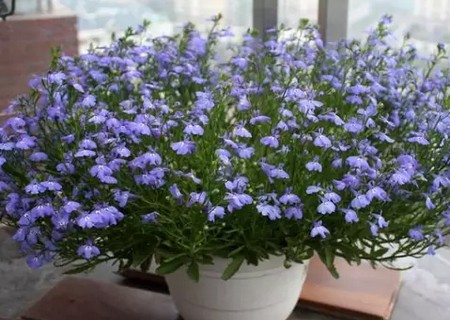
Take a look at this one, sown in September. The density of the flowers is definitely much better, and the shape does not fall apart when it blooms. Obviously, when the flowers are dense, it looks much better.
Seedlings sown in October can also be raised to maturity and can also bloom, but because the temperature is already relatively high during the season that is just right for growth, the internodes will be relatively long, and the density of blooming will also be greatly reduced.
Because this flower is relatively intolerant of heat, the flowering period is limited in many places. You also wouldn't want something you worked hard to raise for more than half a year to suddenly be gone, haha. This one is from October sowing and blooming.
Because I used the same variety and grew it in the same year, it has relatively good reference value.
After the first exploratory growing and the completion of the second year's experiments, all the data was summarized, providing a good foundation for successful growing in the next season.
In the third season of growing, I chose mid-September sowing for all of them, gave suitable fertilizer according to the growth needs at different stages, and after a long winter of growth and care, I could harvest the most beautiful moment in the spring of the following year.
First, let's look at a detail of the flower.
Here's a close-up. The leaves have become fewer and fewer, and this is exactly the effect I wanted.