Detailed Explanation of Grafting Techniques for Red Flowered Loropetalum (Red Zhimu)
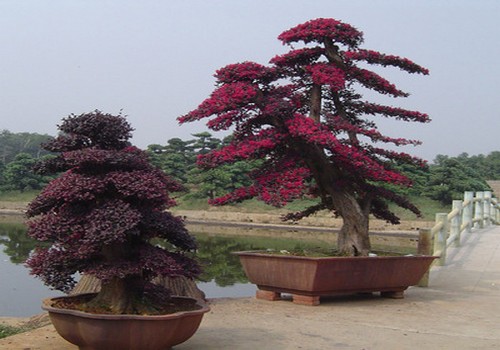
There are many kinds of grafting. The commonly used methods include "T"-shaped budding, square budding, "I"-shaped budding, ring budding, groove budding, budding with wood, and chip budding, etc. The affinity between red flowered Loropetalum and Loropetalum is particularly strong, so grafting is mostly used to make red flowered Loropetalum bonsai and large-specification red flowered Loropetalum landscaping seedlings. The commonly used methods are:
1. Cut grafting:
Grafting in spring and autumn is preferable. From the middle and upper parts of a vigorous mother tree, select one-year-old or current-year shoots with plump, full buds and a certain thickness. Generally, depending on the internode length, each scion should preferably have 2 to 3 buds, with a total length of 2 to 2.5 cm. Choose the flat side as the long cut surface, and cut away the cortex with a slight bit of wood, with a length of 1.5 to 1.6 cm, at an angle of about 15 degrees. The short cut surface is on the opposite side of the long cut surface, with a length of one third of the long cut surface, at an angle of about 60 degrees.
The rootstock branch should be cut with a smooth cut surface, slightly inclined to one side. First make an angle cut upward on the lower inclined side, then make a vertical cut along the wood, 1.5 to 1.6 cm long, and then insert the prepared scion with the long cut surface facing inward and aligned with the cambium. If the size difference between rootstock and scion is relatively large, it must be aligned with the cambium on one side. Then wrap and tie it with a strip of film, and put a film bag over the upper part of the scion.
When the rootstock is many times larger than the scion, the mud-ball method can be used to seal the opening. That is, after grafting, wrap and bind it with a film strip, but do not seal the top. Then at the junction of rootstock and scion, knead moist fine loess into a long oval mud ball, wrap it tightly with a 5-cun long and 4-cun wide film, and tie string around it, exposing only a few leaves outside the mud ball. This isolates the scion in the mud ball from the outside hot and dry climate, improves the survival rate, and prolongs the grafting period.
2. Budding:
This method is often carried out in summer and autumn. Common budding methods include t-shaped and h-shaped. At the selected bud position, cut a t-shape or h-shape deep to the wood, gently lift open the cortex to separate it from the wood, then on the scion branch cut off the leaf below that bud, leaving only the petiole, cut the bud into a shield-shaped bud piece with a slight bit of wood, about 1 to 1.2 cm long, then insert it into the t-shaped or h-shaped cut on the rootstock, and when wrapping, leave the petiole outside. After 7 to 8 days, lightly touch the petiole with a finger; if it falls off immediately, it indicates that the grafting has survived.
Management of grafted seedlings:
After survival, untie the wrapping film, promptly remove sprouts and cut off the rootstock, strengthen management by loosening the soil and removing weeds, pay attention to drainage and irrigation during dry seasons, apply fertilizer at the appropriate time and in the appropriate amount, and carry out preliminary pinching and shaping as needed.
Red flowered Loropetalum grafting can be carried out from February to October. Cut grafting is best done before spring germination, while budding is suitable in September to October.
Generally, red flowered Loropetalum is not grafted, unless it is a red flowered Loropetalum stump. According to our horticultural method, red flowered Loropetalum branches are cut for cuttings, and small seedlings grow. Grafting techniques require professional personnel, a knife (a grafting knife), strips of plastic film, red flowered Loropetalum branch buds, and timely management according to the weather is all that is needed!