What are the planting methods for creeping phlox?
Creeping phlox has a long green period and a long flowering period, especially in the peak bloom of early spring, when it is a profusion of flowers shaped like a colorful carpet. Creeping phlox is planted once and enjoyed for many years; in its early-spring peak bloom it looks like a colorful carpet, very gorgeous and festive, and in landscaping it is suitable for planting in carpet flower beds, using its different flower colors to form decorative words or patterns; it can be used as a low ground cover planted over large areas on flat ground or small slopes, can be planted hanging or trailing, or used in rock gardens, and can also serve as a cut flower accent.
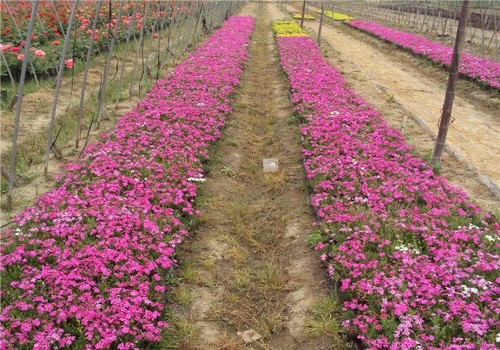
Creeping phlox can be widely used in gardens, for example dotted in lawns or at the edges of green belts, planted among rock crevices, or combined with flowers such as French marigold, tulips, and dwarf daylily as a mixed flower border; it can also be planted on slope sections to beautify sloping land and reduce soil erosion. Hanging it for trailing display is another kind of landscape.
Transplanting/potting:
Phlox seedlings do not tolerate transplanting, so it is better to do it early rather than late, and keep the seedling roots as intact as possible. They are usually transplanted into pots within 4 weeks after emergence; for the variety “Palona”, use a small pot of about 10 cm, along with a potting medium that drains well and is loose and airy.
Temperature regulation:
The temperature at seedling emergence is relatively high and can be 22 degrees; in the initial period after transplanting into pots it is best to maintain 18°C, and once the roots extend, it can be grown at about 15°C, so that it can bloom in about 9-10 weeks. Maintaining a lower temperature can form a good plant shape; phlox can tolerate a low temperature of about 0°C, but its growth period is relatively longer.
Management:
Phlox should be grown in an environment with sufficient sunlight and a cool climate, so there is no need to use chlormequat to control plant shape. When environmental conditions are not ideal, spraying chlormequat 1-2 times can prevent leggy growth. During cultivation, a good spacing between plants and rows must be maintained to prevent crowding from affecting plant shape and causing pests and diseases. The plants are dwarf, and the branches and leaves are hairy, so when watering and fertilizing, avoid contaminating the leaf surface to prevent the branches and leaves from rotting. The entire growth and development period is 10-14 weeks, related to pot size, light conditions, and seedling time.
In the actual application of creeping phlox, several issues also need attention:
(1) When selecting and setting out seedlings for a project, do not choose only large seedlings with a good flowering effect at the time, because creeping phlox does not tolerate transplanting and larger plants are not easy to survive transplanting; small seedlings should be chosen for planting, and after a period of growth the landscape effect will be good.
(2) Creeping phlox prefers a relatively dry growing environment and dislikes waterlogging; in landscaping, the site conditions must be fully considered, and the soil preparation work must be done well.
(3) Creeping phlox is more suitable for cultivation in the vast areas north of the Yangtze River in China; in the Yangtze River basin and to the south, the adverse effects of humid and stuffy summer weather on the growth of creeping phlox must be considered.
In dry seasons, creeping phlox is susceptible to red spider mite damage, with symptoms of yellowing leaf clusters, and chemical control should be carried out promptly. You can spray 5% bifenazate and 20% hexythiazox wettable powder at 4000 times dilution, once a week, for two or three consecutive sprays.