A Detailed Guide to Mucuna Birdwoodiana Planting Techniques and Management Methods
On weekends since the start of spring, you have seen the golden rapeseed flowers, photographed the delicate pink cherry blossoms, plum blossoms and more - do you feel that nothing surprises you anymore? If you want something special, why not go and admire the Mucuna birdwoodiana flowers, hanging in clusters from vines, loved by all - a spectacular “fine spring scene” that perhaps can only be seen in Guangdong.
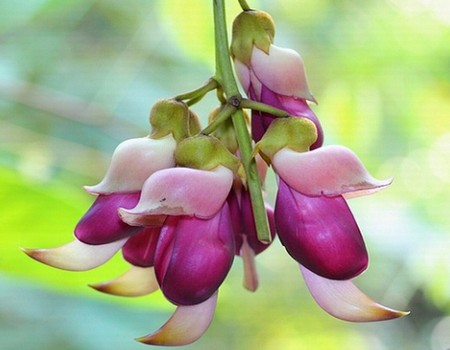
Also known as sparrow flower and Mucuna birdwoodiana, it is a national second-class protected plant. The flower spikes grow in clustered strings directly on the vines, named for their shape that closely resembles sparrows. Its place of origin is the subtropical region, in provinces and autonomous regions including Guangdong, Jiangxi, Fujian, Guangxi, Guizhou and Sichuan, with Guangdong Province being especially concentrated and renowned for it. Because Mucuna birdwoodiana stays evergreen all year round, around every Qingming Festival when the spring rain falls continuously, whether in the countryside or in courtyards, the Mucuna birdwoodiana flowers growing along the vines bloom profusely, hanging in strings, with as many as 20—30 flowers per string, like sparrows dancing in flight, with considerable ornamental value.
Some days ago, in several parks in Shenzhen, many strangely shaped flowers attracted the attention of numerous citizens. These flowers were either purple, yellow or white, with drooping blooms and spreading petals, like a great many birds lined up in neat rows with wings spread, poised to dance - the visitors were delighted and took photos as souvenirs one after another. It turns out these flowers are Mucuna birdwoodiana, blooming during spring. Friends who want to grow Mucuna birdwoodiana can read on to learn more.
[When Does Mucuna Birdwoodiana Bloom]
The flowering period of Mucuna birdwoodiana is relatively short, from March to April, lasting two weeks. When it blooms, it is as if countless sparrows have stopped here - some whispering, some returning to the nest after a hundred years, some spreading their wings to peck at food, and so on. They all compete in splendor, each wanting to show its most beautiful side, making Mucuna birdwoodiana bloom across the fields and become a sea of Mucuna birdwoodiana flowers.
When cultivating Mucuna birdwoodiana, it can be propagated by cuttings or layering. Cuttings are taken in spring, using thick, sturdy branches as cuttings, which root in about one month. For outdoor cuttings in summer, a shade frame needs to be built. When propagating by layering, mainly use vines that have fallen on the ground, notch the lower part between the nodes, then press them into the soil and keep the soil moist; after rooting, cut off the new shoots. When used for ground planting or vertical greening, pond mud mixed with peat soil or slow-release fertilizers such as compost soil can be used, and plant growth should be properly controlled. After autumn begins, overly dense vines and aged branches should be pruned once, to increase light penetration and better promote the growth of Mucuna birdwoodiana.
[Propagation and Cultivation]
Seed selection: Before sowing, the seeds must first be selected. Whether the seeds are well chosen directly affects whether sowing will succeed.
1. It is best to use seeds harvested in the current year. The longer the seeds are stored, the lower their germination rate.
2. Choose seeds that are plump and free of damage or deformity.
3. Choose seeds free of pests and diseases.
Planting preparation:
1. Disinfection
Disinfection includes two concepts: one refers to disinfecting the seeds, and the other refers to disinfecting the sowing substrate. For household seed disinfection, it is common to soak the seeds in hot water at about 60°C for a quarter of an hour, then use warm hot water to promote germination for 12~24 hours. To disinfect the sowing substrate, the best method is to put it in a pot and heat it by stirring until hot, so that any pests and diseases are killed by the heat.
2. Germination promotion
Soak the seeds in warm hot water (at a temperature similar to face-washing water) for 12~24 hours, until the seeds absorb water and swell. For very common seeds that germinate easily, this step can be skipped.
3. Sowing
For tiny seeds that are difficult to pick up with hands or other tools, you can moisten one end of a toothpick with water and stick the seeds one by one onto the surface of the substrate, then cover with substrate 1 cm thick, and then place the sowing pot into water, with the water depth at 1/2~2/3 of the pot's height, allowing the water to slowly soak upward (this method is called the “pot soaking method”);
For larger seeds that can be picked up with hands or other tools, place the seeds directly into the substrate and sow them in spots at a spacing of 3×5 cm. After sowing, cover with substrate to a thickness of 2~3 times the size of the seeds. After sowing, use a sprayer or a fine-holed watering can to moisten the sowing substrate; later, when the pot soil is slightly dry, water again, still taking care that the force of watering is not too strong, so as not to wash the seeds out;
4. Cuttings
Softwood cuttings are often taken in late spring and early autumn using branches of the current year, or hardwood cuttings are taken in early spring using branches from the previous year.
Cutting substrate: this refers to nutrient soil, river sand, peat soil and other materials used for cuttings. For household cuttings, ideal cutting substrate is hard to obtain due to limited conditions; medium-coarse river sand can also be used, but it must be rinsed several times with clean water before use. Do not use sea sand or river sand from saline-alkali areas, as they are not suitable for the growth of flowers and plants.
Cutting branches: When taking softwood cuttings, from late spring to early autumn when the plant is growing vigorously, choose sturdy branches of the current year as cuttings. After cutting the branches off, select the robust parts and cut them into sections 5~15 cm long, each section carrying more than 3 leaf nodes. When cutting the cuttings, note that the upper cut should be made flat about 1 cm above the topmost leaf node, and the lower cut should be made at an angle about 0.5 cm below the bottommost leaf node, with both upper and lower cuts smooth and even (the knife must be sharp). When taking hardwood cuttings, after temperatures rise in early spring, choose robust branches from the previous year as cuttings. Each cutting usually retains 3~4 nodes, and the cutting method is the same as for softwood cuttings.
Mucuna birdwoodiana blooms with particular liveliness and clamor; seen from afar, hundreds and thousands of blossoms are truly spectacular and abundant. Planting it at home instantly makes the household atmosphere lively, as if bringing many birds to accompany spring, calling friends and gathering companions, full of vitality. Friends who want to add more life to their home may consider planting a Mucuna birdwoodiana, so that a quiet, deserted home, even in the peaceful and serene spring, can radiate the infinite vitality of life.