Detailed Explanation of Key Cultivation Techniques for Potted Primroses
The primrose is a symbol of spring; when primroses bloom, it signals that spring has arrived. The leaves of the primrose grow in clusters, with oval-shaped blades, and the flowers are brightly colored, arranged in umbrella-like clusters, making them truly beautiful. Primroses are widely cultivated and have become an important garden flower. The primrose is a flowering plant that blooms in early spring, with colorful flowers in red, pink, yellow, white, purple and more that are truly beautiful. The floral form of compact, low-growing small potted plants is delicate and lovely, making them ideal flowers for decorating the home. Below is an introduction to the cultivation techniques for primroses:
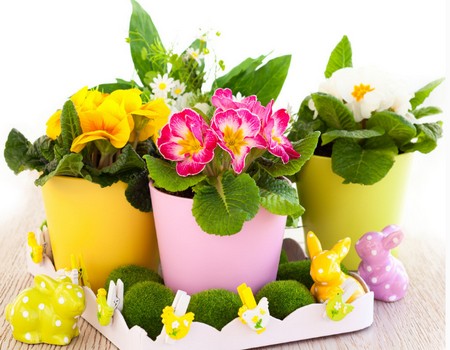
Primrose cultivation and management are not difficult. For varieties used as greenhouse potted flowers, it takes about 160 days from sowing to reaching the market in 12 cm pots. If sown in July, they can bloom at the beginning of the year. To avoid hot weather, sowing in August can also result in blooming in January. The first transplanting is done in shallow pots or wooden boxes, with a plant spacing of about 2 cm, or directly into 8 cm small pots. The potting soil must not be acidic, then they are directly moved into 12 cm pots. Planting depth should be moderate; too deep easily causes root rot, too shallow easily causes lodging, and regular fertilization is required. The causes of leaf chlorosis, aside from acidic potting soil, may be excessive moisture or poor drainage. Not only should shade be provided in summer, but also during strong winter sunlight, shade should be given to ensure vivid flower colors.
For transplanting seedlings into pots, pots are generally limited to 12 cm to 16 cm. For 2-year-old mature plants, the pots can be appropriately enlarged. During summer, attention should be paid to ventilation, providing partial shade and preventing damage from sudden rainstorms. Measures such as misting, overhead frames and watering the ground can be used to lower the temperature. In winter, the minimum indoor night temperature should be controlled at around 5°C, and should not be too high. However, for potted flowers, if sowing is too late (October), the overwintering temperature needs to be raised to 10°C to accelerate growth and ensure timely blooming the following spring.
[Propagation]
Seed propagation is mostly used. After collecting seeds from March to April in spring, sowing can be done until August to September, but it is mostly done in June to July. They bloom in November, with the peak flowering period in January to February. The seeds are extremely tiny and have a short lifespan. They are usually sown in shallow pots filled with culture soil. The soil at the pot opening is sifted through a fine sieve, then water is absorbed from the bottom hole to moisten the soil. The seeds are evenly scattered on the surface, the pot surface is covered with glass, and it is placed in a shaded area. After 1 to 2 days, once the seeds have absorbed water, a thin layer of sandy soil is covered over them, and moisture is regularly maintained. After one week, they will germinate. When the seedling emergence rate reaches above 03%, the glass can be removed, and they are gradually moved to a location with sufficient light, but not direct sunlight.
[Cultivation]
They are generally grown as greenhouse potted plants. When the seedlings grow 5-6 leaves, they are first transplanted into small pots. When they grow 7-8 leaves, they are moved into slightly larger pots, with a diameter of 15-17 cm being suitable. The potting soil is a mixture of 2 parts leaf mold, 3 parts garden soil, and 1 part river sand, with an appropriate amount of decomposed manure and slaked lime added. Planting should not be too deep, otherwise the stems easily rot; the root collar should be level with the soil surface. After planting, water them and place them in a cool, shaded area for a period of time before entering normal management.
[Light and Temperature]
Preferring cool conditions and avoiding high temperatures is the basic temperature requirement for primroses. The suitable growing temperature is 20°C during the day and 5-10°C at night. They can grow well at 12-22°C. Under conditions of sufficient growth, a low-temperature treatment of 10°C can promote flower bud differentiation, and in a 12°C environment, the flowers remain open for a longer time. In summer and autumn, shade should be provided or they should be placed in a partially shaded area to lower the temperature, avoiding direct sunlight and maintaining good ventilation. In winter, move them into a low-temperature humid room, keeping the temperature above 5°C.
[Watering and Fertilizing]
Newly planted seedlings should have watering controlled to promote root growth and development. During the growing period, attention should be paid to watering, keeping the potting soil in a moist but slightly dry state, and it must not be too wet. During the growing period, apply dilute liquid fertilizer 3-4 times per month. Avoid applying concentrated fertilizer; it is best to apply more phosphorus and potassium fertilizers, which is beneficial for more flowers. When fertilizing, do not splash the liquid fertilizer onto the leaves. If it splashes onto the leaves, rinse them clean with water.
[Shaping and Pruning]
After the flowers fade, promptly cut off the flower stalks and spent flowers, remove dead leaves, and strengthen management to extend the flowering period.