Detailed Explanation of the Key Cultivation Techniques for Potted Blue Sage
The blue sage in the park, native to the southern United States, is also known as "a string of blue." It is precisely because of that deep blue, that expanse of blue, that it is so stunning. If you look at just a single plant, it is merely a spike of blue flowers - when you walk past, it is hard to make people stop. But this expanse of blue is overwhelming in its momentum. Blue and purple are merely a difference in visual perception; standing before that patch of flowers and plants, it is in fact azure, as deep and serene as the ocean. Blue with a resolute firmness, blue with a vast expanse. The flowers of blue sage are nothing particularly unusual; only when they merge into a single expanse do they move people with color, and in the rain there is yet another kind of flavor - on every flower hang crystal-clear water droplets, as noble as sapphires. In that instant, it seems as if ocean waves come sweeping in……
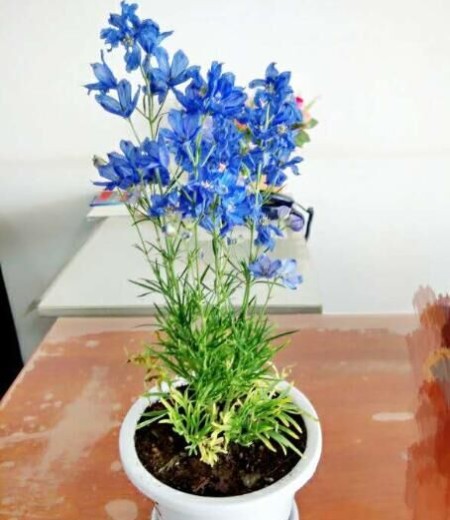
Sage is an ancient medicinal plant of Europe, with a history of more than 1000 years. The ancient Arabs called it the “elixir of immortality.” It has a long flowering period, blooms profusely, is vigorous in growth, and has good adaptability, and is often used for planting in patches in courtyards. It is commonly used in flower beds, flower borders, or at the forest edge, and is suitable for roadsides in parks, courtyards, and similar places. This shows how powerful sage's efficacy and effects are. What the editor wants to introduce to everyone today is blue sage. Let us learn together about the cultivation techniques for potted blue sage!
[Sowing and Raising Seedlings]
There are about 920 seeds per gram. Generally, 200-cell or 288-cell plug trays are chosen for sowing. The medium generally chosen is imported seedling peat soil or sterilized domestic seedling peat soil, and its pH value should be 5.5 to 5.8. After sowing, it is necessary to cover with a thin layer of vermiculite, then cover with plastic film. The suitable germination temperature is 20°C to 23°C, and the germination days are 5 to 8 days.
In the first stage of germination, the radicle appears and the root begins to form. At this stage, no fertilizer is needed, but it is very important to keep the seedling medium moist, and a certain amount of light is required. After the seedlings emerge, gradually remove the film. Use 1000-fold chlorothalonil or thiophanate-methyl weekly to prevent damping-off, spraying continuously 2 to 3 times.
In the second stage of germination, rooting continues, stems appear, and the cotyledons have unfolded. Maintain appropriate humidity and prevent excessive moisture. A water-soluble fertilizer with a nitrogen-phosphorus-potassium ratio of 20-10-20 may be applied appropriately.
In the third stage of germination, the roots can extend into the cells of the plug tray, and several true leaves appear. Increase the fertilizer concentration, control humidity and temperature, and lower the temperature to about 20°C. A certain amount of light is needed to prevent the seedlings from becoming leggy at this stage.
In the fourth stage of germination, the root system forms a mass, with 2 to 3 pairs of true leaves. Continue to increase the fertilizer concentration; temperature and humidity are the same as in the third stage. Appropriately control moisture, strengthen ventilation, and still prevent legginess, in preparation for transplanting.
[Transplanting and Potting Up]
When the plants have 2 to 3 true leaves, begin transplanting and potting up. Generally, 12 cm to 13 cm nutritional pots are chosen for transplanting, and the substrate chosen is loose, well-aerated garden soil plus organic fertilizer and compound fertilizer.
Pinching: when the plant grows 4 pairs of true leaves, leave 2 pairs of true leaves and pinch off the growing tip to promote side branches.
[Key Cultivation Points]
Temperature: after potting up, lower the temperature to 18°C, and after one month it can be lowered to 15°C. If the temperature is below 15°C, the leaves will turn yellow or fall off; if the temperature is above 30°C, the flowers and leaves will be small and the plant will stop growing.
Fertilization: during the growing period, apply 1500-fold diluted ammonium sulfate to change leaf color, with good results. Do not apply urea at low temperatures. To make the plant's root system robust and its branches and leaves lush, continuous fertilization is very important. Apply once every half month a compound fertilizer containing calcium and magnesium at 100 ppm.
Light: it prefers an environment with ample sunlight. In the hot summer, appropriate shading is needed. During the seedling stage, strengthen light to prevent legginess.
[Pest and Disease Management]
Pests: common pests of sage include whiteflies, aphids, and others, which need to be actively controlled.
Diseases: common diseases of sage include downy mildew, leaf spot, and others. When diseases occur, spray 50% thiophanate wettable powder at 500-fold dilution for control.