Detailed Explanation of Polygonum capitatum Planting Techniques and Cultivation Management Methods
Polygonum capitatum——an inconspicuous little flower, with the Miao medicinal name “Dlob dongd xod” (approximate Chinese transliteration: “Sou Dang Suo”). Previously, Polygonum capitatum was just an inconspicuous plant. In the mountainous areas of Guizhou, Polygonum capitatum was generally used to feed livestock, and only some local Miao people skilled in herbal medicine would use it to brew decoctions to treat people's illnesses. Even now, a story still circulates among the Miao people: in 1961, at a rural school in Matou Village, Guiyang City, Guizhou Province, there were two teachers, one of whom was a volunteer university student from a big city. Not long after this young man came to Guizhou, he fell seriously ill. The villagers were very anxious and gathered Polygonum capitatum from the hillside to brew into medicine for him to take, and the young man's illness gradually improved. From then on, Polygonum capitatum became ever more legendary in the Miao villages. Research has found that Polygonum capitatum has a very good curative effect on urinary tract infections, pyelonephritis and other urinary system diseases.
According to a survey by the Southern Pharmaceutical Research Institute, the sales volume of “Weimen · Relinqing Granules”, produced by Weimen Pharmaceutical with Polygonum capitatum as the main material, has now risen to first place in the national hospital medication ranking of traditional Chinese medicines for treating urinary system infections. As the saying goes, “good medicinal materials make good medicine”. In order to control the quality of Relinqing Granules from the source, Weimen Pharmaceutical's Polygonum capitatum planting base has passed the GAP certification of the Certification Center of the State Food and Drug Administration. This base is also currently the only Miao medicine Polygonum capitatum GAP base certified by the State Food and Drug Administration, and Polygonum capitatum medicinal material promotion planting bases have been established in multiple suitable growing areas for Polygonum capitatum in Guizhou. Coupled with refinement through modern processing technology, the quality of the medicinal materials is guaranteed from the source, allowing patients to experience the maximum efficacy of the medicinal materials after taking them.
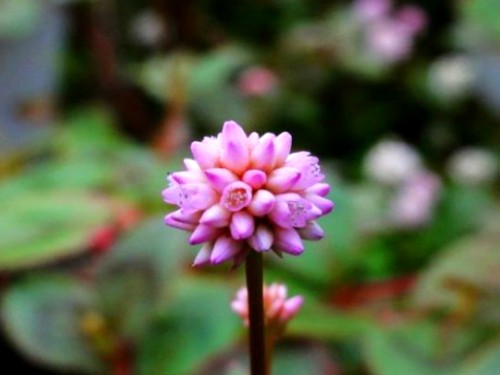
Polygonum capitatum grows in patches, often growing on hillsides, wet valleys and other places, and the scenery after it grows is breathtakingly beautiful. A single little flower is insignificant, but Polygonum capitatum covering mountains and plains is like the people of Weimen holding hands and uniting together, all giving of themselves for people's health. The pale purple stamens of Polygonum capitatum bloom with astonishing beauty, and together with the people of Weimen striving for the health industry, they jointly interpret a new height where career and beauty are closely connected.
[Seedling Cultivation]
1. Seedbed Selection
For the seedling bed land, generally choose a sandy soil plot that is sheltered from the wind and faces the sun, with convenient water sources, relatively fertile soil, and good water permeability and air permeability as the seedling bed soil for Polygonum capitatum. Any place with heavy viscosity, hardening, relatively high water content, thin soil, high groundwater level, prone to water accumulation, or polluted cannot be used as seedling land.
2. Preparation Work for Seedling Bed Soil
Seedling cultivation of Polygonum capitatum is generally carried out from the end of February to the beginning of March each year, but the preparation work for the seedling land should be completed in November to December of the previous year. Specifically: ① Fertilizer preparation: generally referring to farmyard manure. For each standard bed (with an effective seedling cultivation area 10 m long and 1 m wide as 1 standard bed), 200 kg of stable manure should be prepared, covered with plastic film for fermentation treatment, compacted and set aside. ② Deep plowing of bed soil: after clearing debris from the soil to be used as seedling bed land, plow to a depth of 20~25 cm, overwinter, and plow again 15 d before seedling cultivation to fully refine the soil so that there are no longer hardened large clods of mud. ③ Other materials that also need to be prepared: compound fertilizer, ordinary calcium superphosphate, bamboo (used for small arched shed seedling cultivation), pegs, dexon, humus soil, plastic film, agricultural film (used for small arched shed seedling cultivation), Polygonum capitatum seedling seeds, etc.
3. Sowing
Sowing time is February 25 to March 5. Before sowing, plow the land prepared as the seedling bed again, discard impurities, and open beds at a length of 10 m and width of 1 m (after net bed preparation). Bed spacing is 0.5 m. Form ridges with a ridge height of 20~25 cm, then evenly apply the prepared decomposed, fermented stable manure at 200 kg per bed, together with 1 kg of compound fertilizer and 2 kg of ordinary calcium superphosphate, onto the bed surface, fully and evenly mix with 15 cm of soil, level the bed surface, water thoroughly with bottom water, then apply a 0.5 cm thick layer of humus soil, then disinfect with a 2 000-fold diluted dexon solution, water thoroughly with bottom water again, and then sow. When sowing, for each standard bed first mix 20 g of seeds with 500 g of fine soil evenly, then mix evenly with 2 000 g of fine soil, and sow evenly onto the prepared bed surface in 3 batches. Then cover the bed surface with plastic film, insert pegs and small arched shed bamboo strips, cover with agricultural film and press tightly.
4. Management
After sowing, Polygonum capitatum begins to emerge in 7~10 d (at lower altitudes or if encountering long periods of high-temperature sunny days after sowing, emergence occurs in 5~7 d). Usually pay attention to observing the emergence situation, especially on the 7th to 10th d after sowing. When 60% emergence is found, remove the pegs, uncover the plastic film on the bed surface, and observe whether the bed surface lacks water. If it is not extremely short of water, do not water for the time being. Generally, 4~5 d must pass, and watering should be done after most seedlings' root systems are fixed. Otherwise, the seedlings are easily washed down and the seedling roots are difficult to fix. When the seedlings emerge completely and the root systems are fixed, it is only necessary to do a good job in seedbed moisture management and weeding.
[Transplanting]
The transplanting time for Polygonum capitatum is generally from April 20 to May 10. Before that, the Polygonum capitatum planting land should be treated as follows: ① After winter begins, clear straw. Plow the soil, improve soil properties, and eliminate overwintering sources of pests and diseases. ② Prepare farmyard manure. Undecomposed farmyard manure should be subjected to decomposition treatment. ③ Carry out land preparation, pick out stones, tree roots and other debris from the field, and evenly apply 30000 kg of decomposed farmyard manure and 300 kg of compound fertilizer per hectare into the soil. Open beds at a width of 1 m, with a bed spacing of 45 cm. Crush and level the bed surface and wait for transplanting.
Determine the specific transplanting time according to the growth condition of the seedlings. Generally, when the seedlings reach 6 leaves, take seedlings and transplant immediately. On the day before transplanting, water the seedbed thoroughly. Do not keep seedlings overnight. When transplanting, first stretch a rope down the middle of the bed surface, plant one plant under the rope, then extend to the left and right sides at a plant-row spacing of 20 cm ×20 cm, planting 5 rows per bed. After planting, water with root-setting water promptly on the same day, and after 7 d pay attention to checking for gaps and filling in seedlings.
[Management]
After transplanting is completed, it is required to do a good job in intertillage, weeding and pest and disease control. In case of drought or flooding, attention should also be paid to watering and drainage treatment.
1. Field management. After Polygonum capitatum is transplanted in mid-May and missing seedlings are filled in, it enters the field management stage. Polygonum capitatum generally closes its rows in June. After row closure, hoe weeds once every 10 d, then water once with 1:1 biogas slurry and apply 150 kg of compound fertilizer per hectare. If there are relatively few weeds, the number of hoeing times can also be reduced accordingly. At the same time, do a good job in drought resistance and drainage.
2. Pest and disease control. After transplanting Polygonum capitatum, observe frequently and pull out weeds. Strengthen pest and disease control. Especially just after transplanting, the harm from black cutworms, flea beetles, etc. is particularly serious, and measures should be taken promptly for control. Black cutworms can be controlled by manual capture, or with 1 500-2 000-fold diluted zinc phoxim solution; flea beetles can be controlled by foliar spraying with 1 500-2 000-fold diluted dichlorvos. Other pests and diseases occur relatively rarely on Polygonum capitatum.
[Harvesting]
In late August, choose a sunny day for the first harvest of Polygonum capitatum, leaving about 10 cm of stems and branches, removing weeds and soil, and drying promptly. For the second harvest, cut everything flush with the ground, leaving no stems or branches.