How to grow purslane (moss rose) seeds? A detailed guide to planting methods
Moss rose also has aliases such as pine-leaf peony and purslane, belongs to the Portulacaceae family, and its scientific name is Portulaca grandiflora. It is a herbaceous plant that grows close to the ground, with seedlings no more than 10 cm tall, so it is very suitable for home growing as a garden flower, and in recent years it has also been widely grown as a small potted plant.
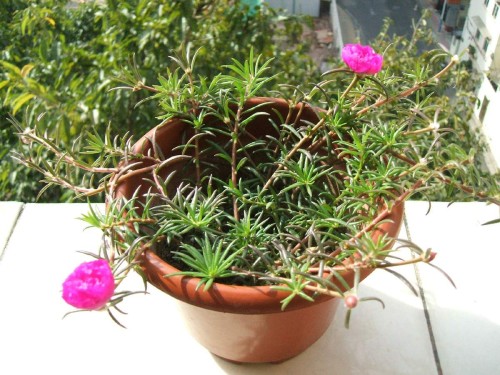
1. Preparing pots and soil
Although "tolerates poor soil" is one of the characteristics of moss rose, and its growth does not depend on whether the soil is good or bad, as a flower grower you always hope the flowers can grow with strong roots, abundant leaves and bright blooms, so it is still best to prepare a loose, breathable soil with good fertility.
During this period, you can collect expired oily foods from home, such as sesame powder, the leftover okara from homemade soy milk (let it ferment), or fish intestines (fermented in advance) to use as base fertilizer.
2. Sowing
At the end of April and the beginning of May, the climate conditions in the Jiangnan area are most suitable for sowing. With a growth period of about 1.5 months before and after, it can be called fast-growing and fast-developing, and the secret lies in the sowing step.
To make the seeds closely contact the soil, when sowing moss rose seeds you only need to evenly scatter the seeds on the surface layer of fine-grained potting soil, and then cover them with a very thin layer of fine soil.
3. Raising seedlings
To ensure the seedlings pass through this critical period safe and sound, the seedling-raising stage is very important. You must have enough patience to care for and tend them, just like treating a baby in swaddling clothes; with the slightest carelessness, the seedlings die, which greatly reduces the survival rate of seedlings.
4. Thinning and transplanting seedlings
Thinning, also called pulling seedlings, means keeping a certain spacing between seedlings. For the thinning tool, choose a pair of pointed-tip tweezers. When the flower seedlings grow a few millimeters tall, you can begin thinning. Adopt the method of thinning in batches and at intervals, always pulling out the relatively weak ones and keeping the sturdy ones, until there is still a gap of 3 or 4 cm between seedlings.
5. Pinching off tips
When the young seedlings grow to 3 or 4 cm tall, branches also grow from the roots. At this time, pinch off the tip of the main stem, and soon a cluster of shoots will sprout again from the break. When the branches at the roots grow to a certain length, you can also pinch the tips of the branches. After such treatment, the moss rose is dwarfed and the plant shape also becomes more attractive.
6. Watering
During the seedling stage, the weather is not yet very hot and water evaporates slowly, so it is not suitable to water too much. The flowering period is in the dog days of summer, when it needs to be watered thoroughly so it can fully absorb water.
7. Collecting seeds
Mature moss rose seeds are silvery gray, but it is very difficult to harvest them at exactly the right moment; either the seed pods have split open, or the seeds have already flown away. So you should often touch those yellow seed shells with your hands; the shells that fall off at a touch are the best; if they do not fall off when touched but the outer shell has already turned yellow and whitish, pick them too, pinch them with two fingers, and what is revealed is black seed, because it is still a bit damp; after a little while, the black seeds turn into silvery gray seeds.