How to graft Magnolia grandiflora? Detailed explanation of Southern magnolia grafting techniques
Magnolia grandiflora is called Guangyulan (Cantonese magnolia) because it was first introduced to Guangdong Province in China. Magnolia grandiflora, also known as "lotus magnolia" or "Zeyulan", is an evergreen tree with a tall stature, lotus-like flowers, and a fragrant scent. It has the ability to absorb dust from the air and has a certain resistance to toxic gases, making it an excellent tree species for urban street and residential area landscaping. Magnolia denudata (white magnolia), Magnolia liliiflora (purple magnolia) and others can be used as rootstock. Branch grafting or root grafting is done in spring, cut grafting in autumn, with a very high survival rate. Approach grafting can also be done in spring.
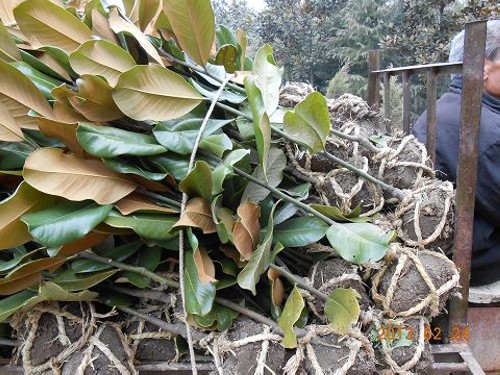
1. Rootstock seedling selection:
The rootstock seedlings mainly used for grafting Magnolia grandiflora are Magnolia denudata (white magnolia), Magnolia liliiflora (purple magnolia), Magnolia officinalis (houpo), etc. Seeds purchased in late autumn should be washed, disinfected, and stored by the sand storage method in a clay pot or wooden basin. Pay attention to regularly checking whether the seeds have become moldy, keep them moist, and wait for spring sowing the following year. Sowing period: field sowing is from late March to early April. Before sowing, the seedbed should be deeply plowed and fully fertilized. After sowing, cover with about 1 cm of sieved plant ash and fine soil. Then cover with rice straw and regularly remove weeds from the seedbed.
2. Grafting methods:
The suitable grafting period is from mid-March to early April, when the rootstock has begun to sprout but the scion has not yet sprouted. Use vigorous Magnolia grandiflora branches from the previous year or the current year with plump buds as scions. It is best to collect the scion on the same day as grafting. The scion should have its leaves removed, leaving only a bit of the petiole, and be covered with a damp towel or rice straw to prevent drying from wind. When grafting, cut the rootstock off 4-5 cm above the root collar, wipe clean the soil around the roots, cut one side of the cut surface into a slanted angle, then make a slightly angled vertical downward cut with a little wood included, 2-3 cm long.
Scion selection: According to the thickness of the rootstock, select a scion of the same thickness, 4-8 cm long, robust with plump axillary buds. It is best to use the first node as the scion; if using the second node as the scion, retain 2-3 buds. After selecting the scion, use a sharp grafting knife without nicks to cut the lower part of the scion into a 45-degree angle. Then, with the second cut taking little wood, make a straight smooth cut from top to bottom, 2-2.5 cm long. The cut surfaces on both the scion and rootstock must be smooth, not rough.
3. Management after grafting:
After grafting, Magnolia grandiflora's wound heals in about 20-25 days, and then the axillary buds sprout and grow. After sprouting, when 2-3 leaves have grown, pay attention to timely weeding and remove the sprouted rootstock shoots, and be careful never to bump the scion. Thereafter, regularly weed, fertilize and water. Also regularly spray Bordeaux mixture to prevent and control diseases. Bordeaux mixture is prepared with copper sulfate, quicklime and water. The ratio is: copper sulfate to quicklime to water equals 1 to 1 to 100-200.
Magnolia grandiflora seeds easily lose their germination ability, and the seedlings grow very slowly, so Magnolia grandiflora is generally propagated by grafting, with Magnolia denudata (white magnolia), Magnolia liliiflora (purple magnolia) and others used as rootstock. Magnolia grandiflora grows well in light and is slightly shade-tolerant when young. It likes a warm and humid climate and has a certain cold resistance. It is suitable for growing in dry, fertile, moist, well-drained slightly acidic or neutral soil. When planted in alkaline soil, it is prone to yellowing. It dislikes waterlogging and poor drainage. It has strong resistance to smoke, dust and sulfur dioxide gas, and has few pests and diseases. Its root system is deep and extensive, with strong wind resistance. Therefore, we should carry out care and management according to its growth characteristics.