How to grow black-eyed Susan
At the entrance of the Cormorant Cottage at the hometown of Xi Shi, a large patch of black-eyed Susan is in bloom. Such a beautiful flower, just because its center is black, has been given such a name. Every time I walk past them, I feel wronged on behalf of these flowers, and even somewhat resent the person who named them. They say the face reflects the heart. This black-eyed Susan grows so beautifully, its soul must be beautiful too, still blooming passionately in the scorching summer days, offering us a spread of fragrance and beauty.
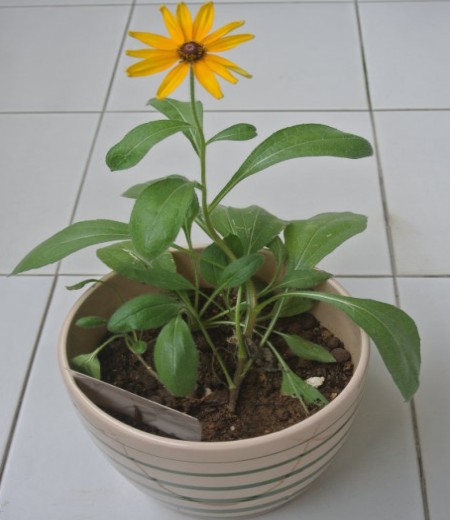
I observed the black-eyed Susan carefully, and in fact its center is not black, but purple-brown, with a raised center, and the small petals around it are golden yellow, very similar to a sunflower. The color of the center is actually quite complex, carrying a faint hint of blue, yet also a hint of green, and it is called the “Irish eye”; that color is very bewitching. This flower also has double-flowered and semi-double-flowered types, though all the ones blooming here are single-flowered.
[Seedling cultivation methods]
In production, division and tissue culture are mostly used to propagate seedlings.
① Division is usually done once every 3 years. Generally, from April to May, old plants from greenhouse forcing cultivation are dug up and split, with each plant retaining 4-5 leaves, and then replanted separately.
② Tissue culture is a method of rapidly propagating seedlings using biotechnology. Ordinary growers do not have the conditions for tissue propagation, so they can directly buy tissue-cultured commercial seedlings for planting. However, because these tissue-cultured seedlings are often small, they need to be grown into large seedlings before being planted out in the greenhouse. Preparation before planting out
① Land preparation: When preparing the land, deep plowing is needed, with a depth of more than 25cm. Along with land preparation, apply sufficient base fertilizer. The amount of fertilizer is preferably 200kg of barnyard manure or 100kg of oil residue plus 10kg of superphosphate and 100kg of plant ash per 100 sq m.
② Soil: Loose, well-aerated sandy loam is best, with a pH of around 6.5. If it is too alkaline, it should be adjusted appropriately, otherwise the leaves will turn yellow and growth will be weak.
③ Ridging: For greenhouse cultivation, ridging is best. Make the planting beds in the form of one ridge and one furrow, generally with a ridge width of 40cm and a furrow width of 30cm.
[Planting out method]
Plant the seedlings on the ridges in double rows in a staggered arrangement, with a plant spacing of 25cm. When planting, it is better to plant shallowly rather than deeply, with the root crown exposed at the soil surface as the standard. Planting too deeply can easily cause root crown rot. After planting out, water only in the furrows.
[Field management]
① Temperature and light management: Black-eyed Susan prefers a warm cultivation environment with ample sunlight and good air circulation. The optimum temperature during the plant's growth period is 20--25°C, not exceeding 26°C during the day, and above 10--15°C at night. Under suitable temperatures, the plant can continue growing and blooming without going dormant. In winter, because light is insufficient, light should be increased; in summer, because light is too strong, appropriate shading should be used, and cooling should be achieved through shading to prevent dormancy caused by high temperatures.
② Water and fertilizer management: Newly planted small seedlings should have water appropriately controlled to promote root establishment. After the seedling stage, supply sufficient water to promote growth. When watering during the flowering period, never let water get into the center of the leaf rosette, which would cause flower buds to rot. Black-eyed Susan has large flowers and many leaves, and consumes much nutrients during the growth period, so topdressing should be applied in time to replenish them. The required ratio of nitrogen, phosphorus and potassium is about 15:8:25. Especially during the flowering period, the application rates of phosphorus and potassium fertilizer should be increased: use 0.4kg of potassium nitrate, 0.2kg of ammonium nitrate or 0.2kg of ammonium phosphate per 100 sq m each time, once every 10 days.
③ Removing old leaves: When the leaves are too dense, the outer old leaves and diseased leaves of the plant should be removed in time to improve light and ventilation conditions, reduce pests and diseases, and help the development and growth of new leaves and flower buds, thereby increasing yield.
④ Harvesting: The best harvest period is when the outermost ligulate flowers of the flower head are perpendicular to the flower stem. The method is to pull sideways by hand from the base where the flower stem connects to the leaf cluster, place it in clean water, and bag it to facilitate transport.
[Care methods]
Soil: Black-eyed Susan is highly adaptable and has no special requirements for soil, though it is suitable for cultivation in well-drained, breathable, loose and fertile sandy loam. Black-eyed Susan is often grown in the ground.
Temperature: The optimum germination temperature for black-eyed Susan is 21°C-30°C, and it can be sown in spring, summer and autumn at this temperature. The optimum growth temperature for black-eyed Susan is 10°C-30°C, not exceeding 26°C during the day, and it should remain at 10-15°C at night. Only at suitable temperatures can black-eyed Susan continue growing and blooming without going dormant.
Light: Black-eyed Susan likes a growing environment with ample sunlight. During its growth period, there should be sufficient light. In summer, when light is strong, black-eyed Susan should be shaded and cooled to avoid dormancy caused by high temperatures. In winter, because temperatures are low and sunlight is scarce, in order to prevent insufficient light and low temperatures from affecting the growth of black-eyed Susan, it should be placed in a sunny spot indoors for care, and attention should be paid to keeping it warm.
Water and fertilizer: Black-eyed Susan is not strict about fertilizer and water requirements. When growth is generally good, it only needs appropriate topdressing with nitrogen, phosphorus and potassium fertilizer. When watering black-eyed Susan, the principle of watering when dry and withholding when wet should be followed, so that the flowers become even more beautiful and vivid.