Potted French Marigold Planting Methods and Precautions
French marigold (Tagetes patula), also known as yellow chrysanthemum and satin flower, generally grows on mountains at higher altitudes. When it blooms, its flowers are brightly and richly colored, as gorgeous as a peacock spreading its tail, which is why it is called French marigold. The common colors of French marigold flowers are red, yellow, orange and so on. It can be harvested in summer and autumn and has extremely high medicinal value. At present, French marigold has gradually become a main flower for flowerbeds and courtyards.
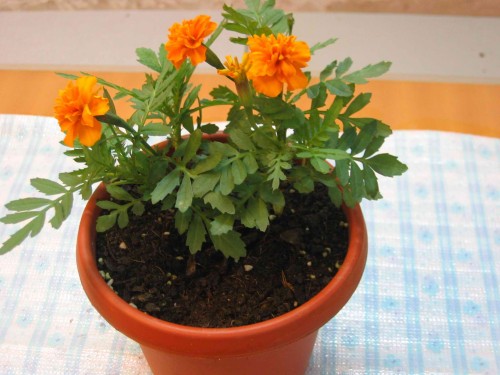
French marigold is an annual herbaceous plant of the Asteraceae family, also known as bayberry chrysanthemum. It prefers a warm environment with plenty of sunlight. Its growing temperature is 10°C to 38°C, and the optimum temperature is 15°C to 30°C. French marigold is relatively sensitive to temperature and day length, so direct sunlight should be avoided, and shading and cooling are needed around noon. The key to water management is to use a well-drained medium. Although keeping the medium moist is important, proper drying before each watering is necessary. Do not let the medium become too dry and cause the plant to wither.
1. Soil: French marigold does not have very high requirements for soil. As long as the soil's air permeability and drainage performance are ensured, it is fine.
2. Propagation: French marigold can be propagated by both sowing and cuttings. Sowing is carried out from November to March. Winter and spring sowings bloom from March to May. Sowing can be done directly in the courtyard or in pots. For potted plants, about 1 month after sowing, the seedlings can be dug out and planted in pots. For cutting propagation, from June to August, cut tender branches about 10 cm long and insert them directly into the courtyard, with shading and covering, and they grow quickly. They can also be inserted directly into flower pots. Cuttings made in summer and autumn bloom from August to December. Whether inserted in the ground or in a bed (pot), cuttings can survive.
3. Light: French marigold is relatively fond of sunlight by nature, but it can also bloom in a semi-shady environment. The temperature suitable for the growth of its seedlings is about 22 to 24°C. However, in summer, some shading measures can be taken for French marigold to prevent sunlight from scorching the leaves.
4. Temperature: When French marigold is potted, the temperature for seedlings can drop from 22°C to 18°C. At the same time, after a few weeks it can drop to 15°C. The temperature before and after flowering is generally suitable at 12-14°C. Its suitable growing temperature is within 10-30°C. At the same time, the winter temperature must not be lower than 5°C, otherwise French marigold will suffer frost damage.
5. Watering: It does not have high requirements for watering. As long as the soil becomes dry, it can be watered, and it can be watered thoroughly.
6. Fertilizing: During the growing period, French marigold can be given some water-soluble fertilizer appropriately. Because some artificial medium fertilizer can be added as base fertilizer when preparing the soil for French marigold, during its growing period a water-soluble fertilizer can be applied once every 7-10 days. In winter, fertilizer use can be reduced.
7. Pruning: About 1 week after cutting, French marigold can take root and be potted. After the weather cools in autumn, it can grow rapidly into shape and continuously produce bright flowers.
To achieve a high germination rate when sowing French marigold, two things must first be ensured: a room temperature above 18° and breathable potting soil. With these two points ensured, French marigold is very easy to keep alive. I generally sow in pots, then transplant the seedlings to a flowerbed for growing.
Precautions for growing French marigold:
1. Light regulation
French marigold is a sun-loving plant. Both growth and flowering require sufficient sunlight, and sufficient light also helps prevent the plant from becoming leggy. In high-temperature seasons, direct sunlight should be avoided, and shading and cooling are needed around noon.
2. Temperature control
After potting, the temperature can be reduced to 18°C, and after a few weeks it can drop to 15°C. Before and after flowering, it can be as low as 12-14°C. This temperature is ideal for forming a good plant shape, but in actual production it may be difficult to reach this condition. Therefore, generally speaking, as long as it is above 5°C, it will not suffer frost damage, and it can grow well between 10-30°C.
3. Water and fertilizer management
The key to water management is to use a well-drained medium. Although keeping the medium moist is important, proper drying before each watering is necessary. Of course, the medium must not be too dry and cause the plant to wither. For those grown entirely in an artificial medium, fertilizer can be applied alternately once every 7-10 days. When the winter temperature is relatively low, fertilizer use should be reduced. If ordinary soil is used as the medium, compound fertilizer can be mixed in an appropriate amount as base fertilizer before potting the medium. When fertility is insufficient, apply additional fertilizer.