Detailed Explanation of Grafting Techniques and Operation Methods for Flowering Almond (Prunus triloba)
Flowering almond (Prunus triloba) has a cultivation history of several hundred years in China, and it is planted in most parks across the country. This species blooms early and is mainly grown for ornamental purposes. Common cultivated types include the double-flowered flowering almond (double flowers, pink; sepals usually 10) and 'Luanzhi' (10 petals and 10 sepals, pink flowers; leaf undersides hairless).
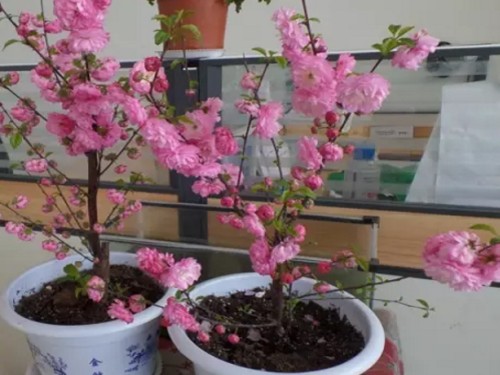
Since the double-flowered flowering almond does not easily set fruit, seed sources are a major headache if propagation is done by sowing. Propagation by division, on the other hand, yields too few plants. After comprehensive comparison, grafting is generally used to propagate the double-flowered flowering almond, and the grafting methods are as follows:
1. Selection of rootstock and scion: For the rootstock, it is best to use vigorous 1- to 2-year-old wild peach (Prunus davidiana) seedlings; 3- to 4-year-old plants can also be grafted. Choose plants with upright trunks and smooth bark as rootstock, and before grafting cut off small side branches around the roots and useless branches. For the scion, choose 1-year-old branches that are well developed, have plump leaf buds and uniform thickness. The tip portion and the base portion with non-plump buds should be removed, and each scion should retain 2-3 buds.
2. Graft at the right time: The best time for grafting is when sap begins to flow but before budbreak. In the Yulin area, this is from late March to early April. Use the cut grafting or cleft grafting method.
3. Operation method: Use a sharp knife to cut both sides of the scion into a 3 cm long slope. If the rootstock is thicker than the scion, cut it into an offset wedge shape, and the cut surface should be smooth and flat. Cut off the rootstock 3-5 cm above the ground, split a 2.5 cm cleft downward from 1/2 of the cross-section, quickly insert the scion into the rootstock slit, leave 0-3 cm of the scion exposed, and make the rootstock and scion fit tightly together. If the scion is thinner than the rootstock, ensure that the cambium layers align on one side, then bind the union tightly from top to bottom with plastic film strips, and do not let the scion move while wrapping.
4. Management after grafting: After grafting, frequently remove sprouts on the rootstock; otherwise, nutrient consumption will affect the survival of the scion. After about 2 months, when the scion sprouts and produces leaves, the binding tape can be removed. If it is removed too late, it will affect the growth of the grafted plant. Do not remove the binding too early, to prevent spring drought, dryness, wind breakage and bruising of the scion, and water promptly, loosen the soil and weed in time to promote sprouting and growth of the scion. Using grafting to propagate the double-flowered flowering almond is fast, has a high survival rate, is simple to perform, and the plant can bloom in the same year. Moreover, grafted plants grow faster, are taller, have a larger crown, and produce more petals with deeper flower color than ungrafted plants.
Flowering almond can be propagated by grafting, sowing, layering and other methods, but grafting gives the best results, and it takes only two to three years of cultivation to become a mature plant that flowers and fruits. The main grafting methods are cut grafting and bud grafting. Wild peach, flowering almond seedlings and apricot can be used as rootstock. The rootstock generally needs to be cultivated for more than two years, and the basal diameter should be about 1.5 cm. Before grafting, it should be cut in advance, leaving a stump 5 to 7 cm above the ground.
1. Bud grafting: From late August to mid-September, determine the bud position in advance on branches selected as scions. The grafted bud should be thick, plump, and free of dried tips and pests or diseases. Use a sterilized budding knife to make an upward 30-degree angled cut into the xylem 2 cm below the bud position, until 1 cm above the bud position, then make a horizontal cut 1 cm above the bud position, gently remove the grafted bud, and at 3 cm above the ground on the rootstock, use the knife to cut a "T" shape in the bark, with length × width of 3 cm × 2 cm. Gently lift the bark, insert the grafted bud into the "T" shaped cut, make the grafted bud and rootstock fit tightly together, then cut the plastic strip into narrow bands and tie it well. After grafting, if the grafted bud does not wilt within about 7 days, it indicates that it has survived, and the plastic band can be removed after about 20 days.
2. Branch grafting: In mid-to-early March of spring, take 1-year-old double-flowered flowering almond branches as scions, about 8 cm long, retaining 3 or 4 buds. On one side of the rootstock cross-section, use a knife to cut vertically down about 4 cm between the xylem and bark, cut the lower end of the scion into a duck-bill shape about 3.5 cm long, then insert the scion vertically into the cut on the rootstock, leaving it slightly "exposed", then wrap it tightly with a plastic band. To retain moisture, immediately mound soil around it. It can survive in about 20 days. After one month, gently open the soil and remove the plastic band.