A Detailed Guide to Growing Potted Rainbow Dianthus Flowers
Rainbow dianthus, also known as bearded pink, sweet William, and ten-variety brocade, is a perennial herb 30-60 cm tall. The plant is cold-tolerant but not tolerant of severe heat, and can be planted from late spring to mid-autumn (any time temperatures reach above 10 degrees, regardless of season). In gardens it can be used in flower beds, flower borders, raised flower platforms, or as potted plants, and can also be used in rock gardens and as edging for lawns. When planted in large masses, it can serve as a landscape groundcover material. In addition, dianthus has the ability to absorb sulfur dioxide and chlorine gas, so it can be planted in large numbers wherever there are toxic gases, and it is also excellent for cut flowers.
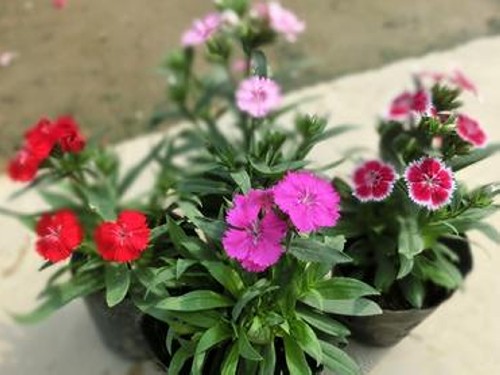
Although dianthus is not a rare or precious flower, it is brilliantly colorful. This flower with jagged petals gives off a delicate fragrance and is deeply loved. Wang Anshi of the Song Dynasty admired the beauty of dianthus and pitied it for not being appreciated by people, so he wrote "Two Poems on Dianthus," one of which reads: “When spring returns to the secluded valley it first forms clumps, on the ground it spreads a pale red. No carriages or horses come, who will admire it? Pitiful, yet it still knows how to enjoy the spring breeze.” How do you grow such a charming dianthus flower? Today let us take a look at the methods for growing dianthus.
Sowing:
Hybrid dianthus has light-avoiding seeds, so after sowing, gently cover with a layer of fine soil about 0.5 cm thick. Use seedbed drilling, seedling trays, or plug trays for spot sowing. Keep the temperature at 20-25°C during the seedling stage; germination occurs in 5-7 days. After emergence, let the seedlings gradually receive light until full sun. During the seedling period, keep the seedbed soil slightly moist and maintain the medium pH at 6.5-7.0. After the cotyledons have fully unfolded, apply a 2000-fold solution of “Leaf Green Essence” once. Once true leaves begin to grow, increase the concentration to 1500-fold, once a week.
Transplanting:
Once the cotyledons have fully unfolded, the seedlings can be transplanted. When they have grown 3-4 pairs of true leaves and the plant height is 4-5 cm, they can be potted up for final planting. Use flower pots 10-15 cm in diameter, or plant them into connected pots.
Light:
Dianthus needs full sunlight to grow well. When sunlight is insufficient, the leaf color is paler, the internodes are longer, branching is poor, and the flowers are small and weak. Therefore, after transplanting and potting, the plants need ample sunlight Miao Yubin, and there is no need to shade them.
Temperature:
After the seedlings are planted out, maintain a temperature of 15-20°C so the plants grow vigorously and branch well. It is cold-tolerant; generally, when the temperature is not below 5°C, growth is normal, though at lower temperatures growth is relatively slower and the time needed to flower is longer. When the temperature is above 30°C, growth will rapidly weaken and may even die. Hybrid dianthus can withstand a certain amount of low temperature, but care should still be taken to prevent frost damage.
Water:
During the growing period, keep the medium semi-dry to moist, and the plants will grow well. Do not overwater, otherwise the plants will often show root rot.
Fertilizer:
Dianthus grows quickly. Five days after planting out, apply a 1500-fold solution of “Leaf Green Essence,” or apply a 800-1000-fold solution of 15:10:15 compound fertilizer, so the plants grow well. When the plant height is 8-10 cm, the plants enter the mid-growth stage; apply a 1500-fold solution of “Bloom Essence” once every 10 days, which helps flower bud differentiation and the rapid growth of flower buds.
Pinching:
Dianthus branches readily, so pinching is not necessary during the growing period. Only for cut-flower varieties, after planting out, when the plant height reaches about 8 cm, can one pinching be done to make the side branches grow vigorously, so as to achieve uniform cut flowers.
Rainbow dianthus can be used for ornament, beautifying the environment, and purifying the air, and can also be used medicinally. It has many uses, among which the effect of decorating and accenting the home is the best. If you like rainbow dianthus, do not miss out.
Editor's note:
Rainbow dianthus, with its pale red flowers edged in white, always gives people a delicate, pitiable feeling no matter when. The white edging looks just like a ring of exquisite, lovely lace, like a cute young girl. Long, long ago, when people saw dianthus growing in mountain fields and by rivers, they must have stroked the lovely, delicate little flowers while thinking of the person they secretly loved.