How to grow nasturtium in pots? See this illustrated planting guide
Nasturtium has trailing stems, so a support frame is generally necessary for reinforcement. If allowed to grow naturally, the stems will inevitably become too long and detract from its ornamental value. To control the unlimited growth of its stems, when the nasturtium enters the initial flowering stage and its stems have grown to 30-40 cm, spray the leaves with a 100 PPM paclobutrazol solution to encourage dwarfing. Results appear three days after spraying: the main stem thickens, the leading stem extends more slowly, and flowers on the side stems open one after another, looking quite beautiful.
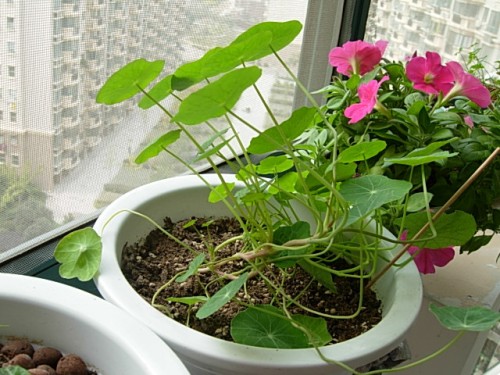
For gardening enthusiasts who want to grow nasturtium, an illustrated nasturtium planting guide is just what they need. This article is an illustrated guide to growing nasturtium from seed, summarized by a gardening enthusiast based on their own growing experience. We hope it will help fellow gardeners grow nasturtium.
Although nasturtium is a perennial plant, because it does not tolerate high temperatures, it is often grown as an annual or biennial. Over the years I have tried spring sowing, autumn sowing, and winter sowing, and the results each time were somewhat different, as follows:
Spring sowing: short growth cycle, thin and weak stems, and few small seeds;
Autumn sowing: suitable for most regions. Although sown in September and October, you have to wait until February or March of the following year to see flowers, but the growing process is relatively smooth and care is relatively easy;
Winter sowing: the flowering period is basically similar to spring sowing, but because raising seedlings sown in winter is somewhat difficult, those in warm southern regions and northern regions with heating can give it a try.
The following uses Zhejiang as an example to illustrate the whole process:
1. Early October, when the temperature is basically between 22-24°C, with clear autumn skies and crisp air, this is the most suitable time for sowing.
2. Nasturtium seeds remain viable for only 5 years, and old seeds have a low germination rate, so when sowing, try to choose fresh seeds.
3. Before sowing, soak the seeds in warm or cold water for 24 hours, gently peel off the outer skin, then use a paper towel to germinate them.
4. For germination, you must use unscented paper towels and purified water (cooled boiled water also works). Generally, the sprout tip appears in about 2-7 days (germination time varies with variety and temperature).
5. For raising seedlings, clear plastic disposable cups are highly recommended. Wrap the outside of the cup with thick paper to prevent direct sunlight on the roots (recommended because it makes water and fertilizer management easy and lets you directly observe growth).
6. When the roots have basically filled the cup, the seedlings can be transplanted and planted out. For planting out, an 18-20 cm pot can be used.
7. When the plant has 4 true leaves, carry out the first pinching, removing 2 true leaves and leaving 2, and let it continue growing. If the plant branches well, only one more pinching is needed. However, some varieties have weak branching ability and need multiple pinchings to achieve the ideal shape, so you can wait until the side branches grow 4 true leaves and carry out a second pinching.
8. Nasturtium has a relatively low demand for nitrogen fertilizer during growth. To make it bloom early and bloom more, during the growing period use a diluted potassium dihydrogen phosphate solution every 10 days to water the roots or spray the leaves, or alternate between the two.
9. After flowering, if you do not want to save seeds, promptly remove spent flowers to help new flower buds form.
10. When grown outdoors in warm spring weather, it easily sets seed. Indoor growing requires hand pollination. Hand pollination is best done on a sunny morning. When the stamens release pollen and the pistil is shaped like the character "", dab some pollen and apply it to the pistil. Pollination can be done between the same flower or different flowers. After pollination, the flower will quickly wither, and when the flower stalk bends into a spiral shape, it means pollination was successful.
11. Mature seeds will fall off on their own. At this point, dry the seeds in the sun and store them in a cool place.
Nasturtium likes a warm, humid environment with plenty of sunlight. The suitable growing temperature is 18-24°C, and it does not bloom easily in high summer temperatures. It does not tolerate waterlogging or cold. It likes fertile, well-drained soil. Based on these growth habits, when you put in hard work, nasturtium will surely show you its most beautiful side. And at that moment, the joy of your success cannot be expressed in words.