A Detailed Guide to the Planting Methods and Care Techniques of the Shasta Daisy
Under the trees along both sides of the road, small flowers of the Asteraceae family are blooming everywhere, and the line "wild flowers bloom and give off a subtle fragrance" automatically pops into my head (I can still remember it, so it seems those high school Chinese classes were not wasted O(∩_∩)O~). Today's star is the Shasta daisy. The Shasta daisy has a long flowering period, roughly from April to June, so friends in Hangzhou can go for a walk in Jiangyangfan, where a large stretch has been planted along the paths; it is now in full bloom and very beautiful.
The Shasta daisy is a perennial herbaceous flower, introduced from Europe, which is why it is also called the Western Shasta daisy. Like most flowers of the Asteraceae family, the Shasta daisy forms a capitulum made up of ray florets and disc florets; what we see as "one Shasta daisy" is actually not a single flower, but an inflorescence composed of many white ray florets and yellow disc florets.
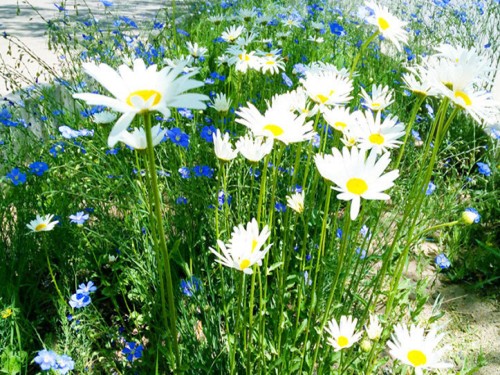
The Shasta daisy not only has high ornamental value and a long flowering period, but, like most Asteraceae flowers, it is easy to manage and belongs to the kind that grows well on its own with just a bit of casual care, so it is used quite a lot in garden flower borders. On an early summer evening, walking along a quiet path lined with flowers on both sides, being with the flowers and being with yourself, temporarily setting aside your worries and stealing a half day of leisure from a busy life. Below, I will introduce the planting methods for the Shasta daisy.
Propagation: The Shasta daisy is mostly propagated by division, sowing and cuttings, with division and cuttings being the main methods. Sow seeds and raise seedlings in autumn or early spring; at 15-18°C they germinate in about 7 days.
Soil: The Shasta daisy has strong adaptability and is not particular about soil; it can grow in garden soil, sandy loam, and slightly alkaline or slightly acidic soil. For cultivation, a loose, fertile, well-drained sandy loam is best, and the pH value can be adjusted between 6.5 and 7.0.
Light: The Shasta daisy likes sunlight and is suitable for placement in a sunny environment. It has fairly strong cold tolerance; in the Yangtze River basin of China, its basal leaves often remain evergreen in winter. It tolerates partial shade.
Temperature: The suitable growing temperature for the Shasta daisy is 15 to 30°C. During the seedling stage, the temperature should not be too high, otherwise leggy growth is likely to occur, and thinning should be done in time.
Fertilizer and water: For open-field cultivation, choose a location with good drainage. Before planting, deeply plow the soil and apply rotted barnyard manure and sufficient potassium fertilizer. Especially after division and for newly planted seedlings, strengthen water and fertilizer management so that they expand their plant size as much as possible. During the growing period, apply a dilute liquid fertilizer with balanced nitrogen, phosphorus and potassium once a month, and strictly control the amount of nitrogen and water, otherwise flowering will be delayed; consider adding 0.2% potassium dihydrogen phosphate to dilute cake fertilizer water. Control the dosage, as excess will delay flowering.
Pruning: For plants that flower earlier but have smaller flowers, basal branch cutting can be carried out to make them produce more branches and more flowers, so as to expand the plant and increase tillering. Old plants need to be divided and replanted every other autumn, and spent flowers should be cut off promptly after blooming.
Pests and diseases: Leaf spot and stem rot often cause damage, and can be sprayed with a 600-fold dilution of 65% zineb wettable powder. Pests include plant bugs and leafminers, which can be killed by spraying a 500-fold dilution of 25% carbaryl wettable powder.
The reasons for failure to bloom may include the following aspects:
First, the sowing time is not ideal;
Second, the temperature during the seedling stage is too high and the plants did not go through a low-temperature stage;
Third, the amount of nitrogen fertilizer was not properly controlled.