How to plant red wood sorrel? A detailed guide to growing methods
On campus in April, in every corner, especially around the main building, everyone must have noticed the patches of red flowers appearing on the lawns or the mounds of soil by the walls. They break through the soil in the April sunlight, with small red heads held up on fresh green leaves. It is the star of today's feature, red wood sorrel. Yes, that cluster of small red flowers beside the main building is a wild flower whose scientific name is red wood sorrel.
Red wood sorrel is a perennial herbaceous plant of the wood sorrel family, genus Oxalis. The plant is low-growing, generally only about 15 cm tall, and because it has bulbous corms underground it grows in clumps and grows neatly. Both its flowers and leaves are small and quite lovely. Its most distinctive feature is its 3 leaflets. Its leaves are very small, basal, with 3 leaflets, and the leaflets are broadly obcordate, like three little hearts joined at the bottom.
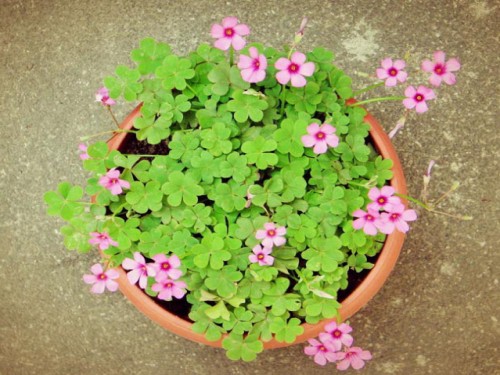
Because of its three obcordate leaflets, red wood sorrel is also called "shamrock" by people, but if you call it that, the real "shamrock" will not be happy. The "shamrock" that first appeared in Western legends and the "four-leaf clover" with magical blessings are both a plant called white clover. Therefore, wood sorrel, which has a similar leaf shape, is also called shamrock by people.
Red wood sorrel is native to Brazil. It prefers shady, moist environments and requires well-drained sandy loam rich in humus. It is not cold-tolerant, and in colder regions it can only be cultivated in a greenhouse.
[Propagation methods] There are division propagation or seed propagation, with division propagation being the main method.
1. Division propagation
Red wood sorrel has very strong rhizome reproductive capacity and divides easily. It can be done throughout the year. One perennial old plant can be separated into more than ten corms. If the divided new plants are planted properly, they can quickly recover their growth and put out new leaves. If divided before autumn, they can bloom the same year.
2. Seed propagation
After the seeds mature, they split open easily and are very difficult to pick, so the timing must be grasped well and they must be harvested promptly. Mature seeds are brown, rather small, with a thousand-grain weight of about 0.07 g. Choose ordinary sowing soil, maintain a high temperature above 25°C, and they will germinate in about 7 days, with a high germination rate. The seedlings grow fairly quickly, tolerate transplanting, and have a relatively high transplant survival rate. With proper management of the seedlings, they can grow into mature plants the same year, develop rhizomes, and bloom the following year.
[Cultivation management]
The best planting time is from late February to early to mid-March, preferably when the leaves have emerged and the petioles are shorter than 1 cm. After planting, green appears. It can be grown in many pots and also in the ground. Besides repotting potted plants every year as the plant size increases, the soil should also be renewed, and overly crowded plants should be combined with division propagation. Be careful to promptly remove yellowed leaves and flower stalks after blooming. Each year when repotting and changing the soil, add a certain amount of base fertilizer, mainly phosphorus and potassium. During the growing season, apply dilute soybean cake water as a top dressing, and after top dressing, be careful to rinse the leaves with clean water. Do not let fertilizer remain on the leaves, otherwise it easily burns the leaves.
For ground planting, the planting method can be full coverage or scattered coverage. After raking the soil level, use a tool to bury red wood sorrel divided into 2 cm pieces into the soil. After all planting is finished, water thoroughly once. Ground-planted plants should also, after several years of growth, be dug up at the underground part for "thinning" or thinning of seedlings. In winter, apply enough freezing water. When the soil is loose, carry out slight compaction.
1. Watering: Because it is shade-tolerant and likes moisture, special attention should be paid to ensuring an adequate water supply. Spray water once every evening, and water thoroughly once a week. From late May, increase spraying to twice, once in the morning and once in the afternoon. After the ground is closed in, the number of sprays can be appropriately reduced. From September, stop spraying and water thoroughly once a week.
2. Fertilizing: After red wood sorrel safely passes the seedling recovery period and enters a certain period of normal growth, fertilization can begin. In the early stage, mainly use urea. After it is fully closed in, compound fertilizer can be applied. From September, stop fertilizing.
3. Weeding: From May, weeds begin to grow vigorously and must be removed promptly, especially in June to August, when the task of pulling weeds is even heavier. The key to management after planting red wood sorrel is in the first year, and in the second year the key is before it closes in. After Frost's Descent, the leaves gradually turn yellow and management stops. After sprouting in the second spring, management begins again. In short, red wood sorrel is an excellent groundcover plant for ornamental lawns.