How to grow sulfur cosmos? Planting methods and care tips
Sulfur cosmos (scientific name Cosmos sulphureus) is an annual herbaceous plant in the genus Cosmos of the family Asteraceae. Native to Mexico, it is also known as yellow cosmos, yellow garden cosmos, yellow-flowered cosmos, sulfur cosmos, sulphur cosmos, and yellow hibiscus. Sulfur cosmos has large flowers and brilliant colors, but its plant form is not very uniform, so it is best planted in clusters or masses of multiple plants. It can also be used, thanks to its ability to self-seed and spread, together with other perennial flowers for flower border planting, or for naturalistic planting on lawns and at forest edges. Dwarf varieties with a low, compact habit and denser flower heads can be used for flower bed arrangements and as cut flowers.
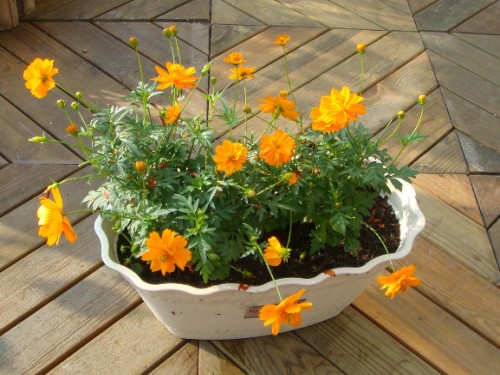
Below we introduce the planting methods for sulfur cosmos. Sulfur cosmos is commonly propagated by sowing and by cuttings. After sowing, be sure to thin the seedlings in time. Sowing propagation takes 7-21 days to germinate, with fast and uniform germination; the optimum temperature for growth is 24°C, and flowering occurs about 2 months after germination. Sulfur cosmos seeds have the ability to self-sow; once planted, a large number of self-sown seedlings will appear afterward; with a little protection, they can flower as usual. For cuttings propagation, use tender shoots as cuttings in early summer, and they will root 15-20 days after insertion. When the seedlings have 4-5 true leaves, pinch out the growing tips and transplant or pot them up.
1. Sowing. In northern China, outdoor sowing is generally from April to June, with flowering successively from June to August; in August to September the weather is hot with frequent rain, so there is less flowering. After the autumn cools, flowering continues until frost. If sown in July to August, plants will flower in October and will be short and uniform. For specific seed-planting methods, please refer to: Main menu—Beginner Growing—Seed germination. Indoor growing allows sowing throughout the year.
2. Soil. Sulfur cosmos prefers loose, fertile loam or semi-sandy loam that drains well and is rich in organic matter; generally, Dewoduo organic nutrient soil can be used.
3. Light. Sulfur cosmos loves light and needs plenty of sunshine. During the growing period, keep enough sunlight exposure; it likes bright, sunny weather, but can also tolerate semi-shade conditions. However, growing it in a dark place for a long time will cause the leaves to turn white and yellow and the plant to become listless and weak.
4. Temperature. Sulfur cosmos has low temperature requirements, and in most areas it can be grown outdoors. The optimum temperature for seed germination is 24°C, which can increase the germination rate. In hot summer midday weather, be careful not to let it lack water, but do not water immediately as soon as you see it lacking water; if conditions permit, move it indoors for 2 hours first and then water, or shade it appropriately and water in the evening.
5. Watering. Sulfur cosmos can tolerate drought, and watering should not be too frequent; water according to the principle of "water thoroughly when dry." For specific methods, please refer to Main menu→Beginner Growing→Watering methods→Teaching you the correct way to water. Remember, absolutely do not allow long-term waterlogging, to avoid root rot and wilting.
6. Fertilizing. Sulfur cosmos tolerates poor soil and has low fertilizer requirements, but it should still be given light fertilizer applications more often. Generally, use Dewoduo series liquid fertilizer at a ratio of 1:400 once every 10~15 days or so; only in this way will it grow faster and more luxuriantly.
Sulfur cosmos is an annual, available in golden yellow and mixed colors, 60-100CM tall, spring and autumn, flowering period June-October, summer-sown flowering period September-October, germination in 7-9 days, pinch out the growing tips when there are 4-5 true leaves, sowing in stages can extend the flowering period to November, and it can also be propagated by cuttings; in South China it can be sown all year and flower all year, grows vigorously, has an extremely long flowering period, can self-propagate, requires extensive management, and is used for flower beds, cut flowers, and highway greening.