What are the planting methods for potted rain lilies (Zephyranthes candida)?
Anyone who has seen the rain lily, if they have any spirit at all, will be moved by its bearing. Though it grows low, it has a backbone and purity that rivals plum blossoms in snow. The pride of the rain lily lies not in gnarled branches, nor in flowers that defy ice and snow, nor even in a rich fragrance, nor even a subtle one. But its innate look of disdain, like someone's soul, stands between heaven and earth.
The rain lily is commonly used as a bordering material for flower beds, and is also suitable for clump planting in green spaces. It is best used as ground cover in semi-shaded areas under trees, or planted beside garden paths. Below is an introduction to the cultivation techniques for rain lilies:
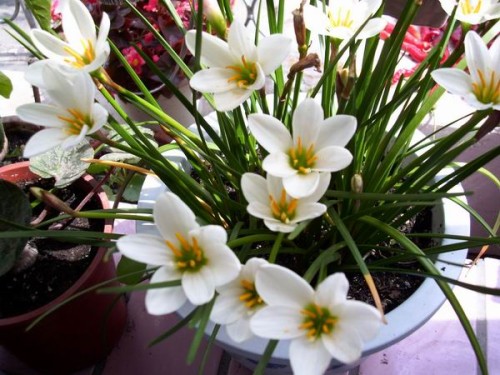
[Seed collection]
About 20 days after the rain lily blooms, the seeds mature and must be harvested promptly, because it is right in the rainy season at that time, and the seeds are extremely prone to germinating while still on the plant. Since it is fairly heat-sensitive throughout its growing period, and the optimum temperature for sowing is 15-20°C, autumn sowing is usually carried out after mid-to-late September.
[Sowing]
For tiny seeds that are hard to pick up with your hands or other tools, you can moisten one end of a toothpick with water and stick the seeds one by one onto the surface of the growing medium, then cover with 1 cm of medium. Then place the sown pot into water, with the water depth at 1/2 to 2/3 of the pot's height, and let the water slowly soak up from below (this method is called the “pot immersion method”). For larger seeds that can be picked up with your hands or other tools, place the seeds directly into the medium and sow them point by point at a spacing of 3×3 cm. After sowing, cover with medium to a depth 2-3 times the size of the seeds. After sowing, you can use a sprayer or a fine-holed watering can to moisten the sowing medium. Later, when the potting soil is slightly dry, water again, but still be careful not to water too forcefully, so as not to wash the seeds out.
[Management]
After autumn sowing, if a cold wave or low temperatures occur, you can wrap the pot in plastic film to help keep it warm and moist. After the seedlings emerge, uncover the film promptly, and let the seedlings receive sunlight before 9:30 every morning or after 3:30 in the afternoon; otherwise the seedlings will grow very weak and spindly. After most of the seeds have sprouted, appropriate thinning is needed: pull out the diseased and unhealthy seedlings so that the remaining seedlings have some space between them. When most of the seedlings have grown 3 or more leaves, they can be transplanted into pots.
When planting rain lilies in gardens, choose a sunny, warm, wind-sheltered location. Applying topdressing 3-4 times during the growing and flowering period will result in lush leaves and abundant flowers. For open-field cultivation in the middle and lower reaches of the Yangtze River, after heavy frost in deep winter, the old leaves wither, but the bulbs can remain in the ground to overwinter and will bloom as usual the next year. For potting soil, mix 2 parts loam, 1 part leaf mold and peat, plus a small amount of fine sand, and add a small amount of bone meal and decomposed compost. Rain lilies need plenty of sunlight and water during the growing period. After a batch of flowers fades, stop watering for 7-8 weeks before resuming watering. With such alternating dry and wet periods, it can bloom 2-3 times a year.
Organic fertilizer can be used, applied once every 2-3 months. Increasing phosphorus and potassium fertilizer proportionally can promote bulb enlargement and good flowering in rain lilies. When the plants become crowded in clumps, division must be forced. It is robust by nature, drought-tolerant and heat-resistant, and easy to cultivate. The optimum growing temperature is 22-30°C. When planting, set the depth so that the top of the bulb is slightly exposed, and divide the bulbs once every 2-3 years. After a batch of flowers fades, water should be withheld for 50-60 days, then normal watering resumed. Such alternating dry and wet conditions can promote repeated blooming in rain lilies, allowing 2-3 flowerings a year.