Detailed Explanation of Protea Planting Techniques and Care Management Methods
Protea flowers are large, unusual in shape, magnificently colorful and elegantly noble, with strong ornamental value as well as medicinal and edible value. Different climatic conditions and geographical environments lead to great variations in protea leaves, flower shapes, flower colors and flowering times. In commercial cultivation, even under the same growing conditions, proteas retain these characteristics. This enables proteas, when grown as cut flowers, to meet market demand worldwide for proteas in different seasons, and to be successfully grown as garden flowers or cut flowers under suitable soil types.
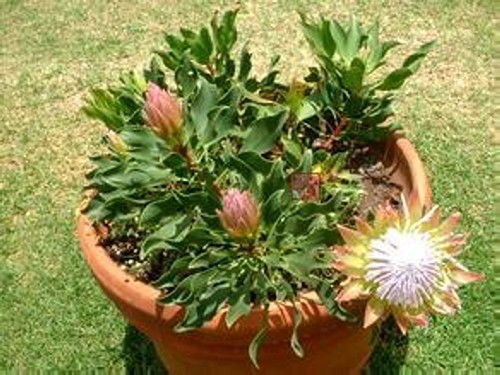
The protea is an evergreen shrub with luxuriant branches and leaves, large flowers, upright bracts and petals, exceptionally beautiful colors and a long ornamental period. It is suitable for potted display and is also an excellent material for cut flowers and dried flowers.
[Propagation Methods] Proteas are mainly propagated by sowing and cuttings.
1. Propagation by sowing
This is often carried out in autumn. Sow seeds mixed with New High-Fat Film (a seed-coating agent), keep them moist after sowing; after emergence they must not be too wet but kept slightly dry. When 1 pair of true leaves appears, transplant into pots and place in a ventilated spot with ample light for care.
2. Propagation by cuttings
Select branches above the semi-lignified position from a protea mother plant as cuttings, retaining 4-6 leaves. The substrate is a mix of peat and perlite at a volume ratio of 4:6, adjusted to pH 5.5-6.5, with an EC value less than 0.5. Soak the base of the cuttings in a 1000 ppm indole-3-butyric acid solution; after soaking for 15 minutes, air-dry them immediately. The insertion depth is 1/3-1/4 of the cutting length. After cutting, manage them according to conventional techniques, and transplant to the field after emergence.
[Cultivation Points]
1. The soil for protea seedlings needs good drainage. During the growing period, a cool, dry climate is needed in summer, with appropriate shading during strong sunlight. In winter, a warm environment with ample sunlight and slightly higher air humidity is required. During the flowering period and the peak growing period, water appropriately and apply fertilizer once each in spring and autumn.
2. During the growing period, spraying proteas with Flower Promoter No. 3 can convert the plant's vegetative growth function into reproductive function, inhibit excessive growth of the main shoot, promote flower bud differentiation, increase flowering and fruit set, and promote development. Then, at the young fruit stage, spray with Fruit-Strengthening Pedicel Agent to increase nutrient transport. This prevents flower drop, fruit drop, stiff fruit and deformed fruit. It makes the fruit brightly colored, attractive in shape and good in taste.