A Detailed Guide to Growing Variegated Spider Plant in Pots
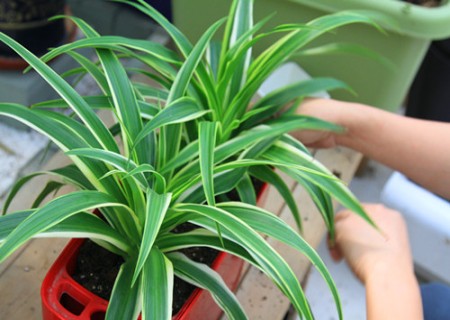
Variegated spider plant, of the Liliaceae family, is a perennial evergreen herbaceous plant and also a type of spider plant. Its leaves are broadly linear and tender green, growing on short stems; it has thick, cylindrical fleshy roots, and its raceme inflorescences are 30-60 cm long, curved and drooping, with small white flowers; it often produces several clusters of rooted small plantlets formed from plantlets on the flower stems, which is quite interesting.
Variegated spider plant grows fast and is easy to cultivate. It can be grown and enjoyed year-round in a relatively bright room, and is one of the most suitable species for hanging or placing on top of cabinets or on flower stands. Variegated spider plant is good at absorbing toxins. In a newly renovated house, placing a few pots can absorb harmful gases such as formaldehyde in one go; it is truly a green air purifier, able to absorb gases harmful to the human body such as formaldehyde and nicotine and purify the air. With greenery in the house, there is vitality, and people feel pleased and cheerful when they see it, making it one of the indispensable plants in life. Below we introduce the growing methods for variegated spider plant:
1. Soil requirements
Variegated spider plant is highly adaptable and not picky about soil, and is relatively drought-tolerant but not cold-tolerant. It is not demanding about soil, and generally grows best in well-drained, loose and fertile sandy soil. Generally, Dewoduo organic nutrient soil can be used. If the potting soil has poor air permeability and water permeability, and the potting soil retains water without drying for a long time, root respiration becomes difficult, causing the leaves to turn yellow; loosen the soil and control moisture in time.
2. Cutting propagation
Variegated spider plant can be propagated by cuttings, division, sowing and other methods, mainly by cutting propagation, which can be done at any time from spring to autumn. Cut off the clustered stems and leaves on the creeping stems of the spider plant (in fact, a young new plant with leaves above and aerial roots below), and directly plant it into a flower pot to cultivate; water thoroughly and place it in a cool, shady place for care. When taking cuttings, be careful not to bury them too deep, otherwise the heart is prone to rot.
3. Light requirements
Variegated spider plant prefers a semi-shady environment. In spring and autumn, avoid direct strong sunlight; in summer, when the sunlight is especially strong, it can only receive some oblique light in the morning and evening, and 50%-70% of the sunlight needs to be shaded during the day, otherwise the leaf tips will dry up. Variegated varieties are especially afraid of strong sunlight. Variegated spider plant grows more beautiful in weak light, and the yellow variegated edges are more obvious and the leaves more glossy. But in winter it should receive more sunlight to keep the leaves tender and fresh green.
4. Temperature control
Variegated spider plant prefers a warm and humid climate and is afraid of cold and high temperatures. It grows fastest at 25°C, stops growing above 30°C and below 0°C, and the leaves tend to turn yellow and dry at the tips. In winter, if the room temperature is kept above 12°C, the plant can grow normally and produce leaves and flowers; if the temperature is too low, growth slows or it goes dormant; below 5°C, it is prone to cold damage.
5. Watering method
Variegated spider plant likes a humid environment, and the potting soil should be kept moist frequently. In summer, watering should be sufficient; around noon and in the evening, water should also be sprayed on the branches and leaves to promptly wash off dust on the leaves and prevent the leaves from drying up. For specific methods, refer to Main Menu → Beginner Growing → Watering Methods → Teaching You the Correct Way to Water. However, the fleshy roots of variegated spider plant can store a large amount of water, so it has strong drought resistance and will not dry out and die even if not watered for several days. In winter, when the temperature is below 5°C, water less, and do not let the potting soil become too wet, otherwise the leaves will easily turn yellow.
6. Fertilizing method
Variegated spider plant is a foliage plant that is relatively tolerant of fertilizer. If fertilizer and water are insufficient, it easily becomes scorched and aged, and the leaves turn yellow, losing ornamental value. From late spring to early autumn, apply Dewoduo series liquid fertilizer at a ratio of 1:300 once every 7-10 days, but for variegated varieties such as variegated spider plant and golden-centered spider plant, less nitrogen fertilizer should be applied, so as not to fade or even disappear the variegation and affect the appearance. Dewoduo bio-organic fertilizer granules can be applied appropriately. Stop fertilizing when the ambient temperature is below 4°C. Pay attention to applying thin fertilizer frequently; if too much fertilizer is applied and exceeds the plant's needs, at first the leaves become shiny and uneven, then the root system rots and the leaves turn yellow. Fertilizing should be stopped, more clean water should be poured, or the pot should be repotted, the roots cleaned, and new soil replaced.
7. Repotting and soil changing
In managing potted variegated spider plant, to achieve lush stems and leaves, the soil and pot should be changed once every March. If the pot is relatively deep and the base fertilizer is sufficient, repotting can be done once every two years. When repotting, knock the plant out of the pot, cut off dead and rotten roots and excess roots, replace with new Dewoduo organic nutrient soil, and then apply Dewoduo bio-organic fertilizer as base fertilizer. After planting, place it in a semi-shady, warm place to recover.
8. Pruning method
Generally, the height should be such that it does not bump the head, and attention should be paid to ventilation. Dead and yellow leaves at the lower part should be removed at any time; when leaf tips turn yellow, use scissors to cut off the yellow tips at an angle. In early to mid-May, cut off some old leaves of the variegated spider plant, which will promote the sprouting of more new leaves and small variegated spider plantlets.
Tips:
Variegated spider plant is a perennial herbaceous plant of the Liliaceae family and the genus Chlorophytum. Its leaves are broadly linear, narrow and long yet flexible, and tender green, growing in clusters from the root crown; the leaves droop outward from the edge of the pot and flutter in the wind, like a fairy in the air, or like a crane spreading its wings and leaping, making it a hanging foliage plant deeply loved by people. Most interestingly, this spider plant blooms small white flowers in summer, and also produces several clusters of rooted small plantlets formed from plantlets on the flower stems.
There is a saying about variegated spider plant: "Grow spider plant at home, and evil spirits tremble with fear," and in European and American countries it is also called "spider grass." In flower beds on both sides of city roads, planted around the base of large trees, this orchid is commonly cultivated for beautification.