How to plant potted water lilies? Detailed planting methods
Growing a pot of water lilies on the balcony not only beautifies the environment but also elevates the spirit. Generally, water lilies grown on balconies are mostly small varieties, with petite and lovely flowers and leaves. Small potted plants can even be placed on a balcony or windowsill for cultivation. The unique water lily leaves and the exquisite, delicate water lily flowers float on the calm water surface, creating a distinctive charm.
For home cultivation of hardy water lilies, it is advisable to choose medium and small plant varieties, planted on balconies, terraces, courtyards and other places, together with potted terrestrial plants, creating a natural ecological landscape with an orderly, scattered arrangement and the charm of water. The selection criteria for varieties should be bright and brilliant flower colors, elegant flower forms that are pleasing to the eye; abundant blooming, long flowering period; and easy propagation and preservation.
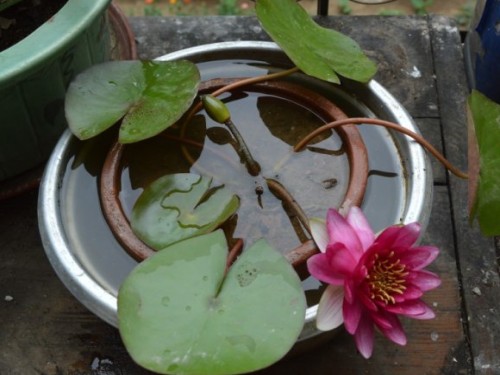
Potted water lilies are generally cultivated by hydroponics, but soil cultivation is also possible. They can be placed in offices, bedrooms, living rooms, balconies or courtyards. Because they love sunlight, as long as light, ventilation and fertilizer are ensured, basically not much effort is needed for management.
1. Choosing a pot
The flower pot is decided according to personal preference and the overall style of the home; it can be a transparent pot or a ceramic one. Try to choose a flower pot with an opening that flares outward, and the wider the pot opening, the larger the flowers. The deeper the pot, the longer the flowering period.
You can also prepare two pots, one large and one small. The large pot has a diameter of 40cm~50cm and a depth of 40cm~45cm; the small pot has a diameter of 25cm~35cm and a depth of 30cm. The small pot is used for planting, and the large pot is used for holding and cultivation. Plant the water lily tubers in the small pot; the planting method is the same as for pond planting. After planting, place it into the large pot and fill it with water. Place the pot in a sheltered, sunny spot for cultivation. The outer large pot is essentially equivalent to a small pond, and it can be moved to another location at any time as needed.
2. Preparing the soil
Potted water lilies are mostly grown hydroponically, but soil cultivation is also possible. When choosing soil, it is best to choose flower soil with relatively high viscosity.
3. Propagation
Propagation can be done by division or sowing. For the division method, generally in late March, dig up the rhizomes, cut them into small sections 10-15 cm long, and then plant them. For the sowing method, sow in pots in March-April, keep the temperature at 25-30 degrees, and germination will occur in about half a month. When the seedlings have 3-4 true leaves, transplant them separately into pots.
3. Fertilizing
Before planting water lilies, you can place a small amount of slow-release fertilizer at the bottom of the pot. During the growth period or flowering period, generally about 1.5-2.5 months, apply slow-release fertilizer or root fertilizer at a spot about 3-5cm away from the tuber. Note that no more fertilizer should be applied after the end of September, because autumn is gradually approaching and water lilies will also enter dormancy; adding fertilizer at that time will instead cause root rot.
4. Repotting
Potted water lilies should be divided and repotted once every spring. When repotting, it is best to choose a flower pot with an inner diameter of more than 30 cm, so that the plant can fully stretch out and grow and develop normally. This makes the leaves large and the flowers large. Use pond mud or vegetable garden soil for the potting soil. First put a small amount of hoof pieces or crushed bone pieces at the bottom of the pot as base fertilizer. After planting the rhizome, cover it with a layer of surface soil such as river sand or field mud, and water it thoroughly. After sprouts emerge, immerse the pot soil in water, with the water surface slightly higher than the soil surface, and place it in a well-ventilated, sunny place for care, keeping the water clean.
There are two most important elements for growing water lilies: light and temperature. Whether the light is sufficient determines whether the water lily can survive and grow well. The more sufficient the light and the warmer the climate, the better the water lily grows and the shorter the dormancy period. So if you want to grow water lilies, you must first assess whether you can provide a place with sufficient light. As the temperature rises and the leaves extend, water should be added gradually. In summer, growth is vigorous, so the water level should be slightly deeper, and it can be filled to a water depth of up to 20 cm, but the leaf surface must not be submerged. If you need to change the water, it should be done in the early morning.