How to cultivate wisteria bonsai? Mastering these methods is all you need
Wisteria is one of the four famous climbing plants. It grows rapidly, with lush branches and leaves, feathery green foliage, and purple flowers resembling butterflies. Clusters of blooms hang down like grapes, and the flowering period is long. In midsummer, its dense shade blocks the sun, offering a cool retreat beneath the trellis where you can admire the flowers and enjoy the fragrance, leaving you completely refreshed. Because wisteria has a very long lifespan and is a long-lived tree species, it is extremely popular for planting among the people. Mature wisteria stems and vines wind and twist, blooming profusely. Since ancient times, scholars have loved to use it as a subject for poetry and painting. Wisteria bonsai has a graceful form and posture; placed on a stand or atop a bookcase, with flowers covering the tree and the old trunk slanting horizontally, it has a distinctive charm.
Because wisteria has a very long lifespan and is a long-lived tree species, it is extremely popular for planting among the people. Mature wisteria stems and vines wind and twist, blooming profusely. Since ancient times, scholars have loved to use it as a subject for poetry and painting. “Wisteria hangs on cloud-reaching trees, its flowering vines suit the sunny spring; dense leaves conceal singing birds, fragrant breezes drift to beauties.” In Li Bai's writing, wisteria is a graceful beauty with an elegant posture and enchanting charm.
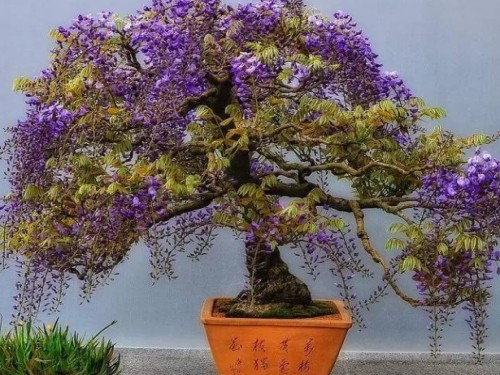
Wisteria has strong vitality; it is neither delicate nor lazy. As long as there is sufficient sunlight and proper water and fertilizer, it will bloom profusely and grow lush foliage. Wisteria is generous and selfless; she will not hold back. Sometimes, when the climate is suitable, in late summer and early autumn, she will even bloom a second time with youthful passion, giving her all.
Before wisteria sprouts in spring, it should be transplanted. First plant it in a clay pot to build up the rootstock, and prune before planting. Because wisteria is a vine with a relatively long trunk, you may keep only the main branches and trunk needed for the desired shape. Since wisteria has a very long taproot but few fibrous and lateral roots, you can shorten the taproot and retain the lateral roots. After planting, place it in a wind-sheltered spot, avoid direct sun exposure, and frequently spray water on the trunk to encourage adventitious buds on the old stump to sprout. After new branches grow, remove the tender buds and new shoots not needed for the design, and pay attention to developing transition branches so that the proportions of branches and trunk in the bonsai are harmonious.
The cultivation methods for wisteria bonsai are as follows:
I. Seedling sources
Propagation by sowing or cuttings is possible. The sowing time is in early spring, requiring a temperature of 10°C——13°C. Cutting propagation can be done in autumn. When taking cuttings, select current-year stem branches as cuttings, 8——10 cm long. Heel cuttings root relatively quickly. You can also dig up wild old root stumps from the mountains and fields; after building up the rootstock for 1 year, they can be potted and worked on.
II. Styling
1. Potting
In spring, February——March, it is better to plant before wisteria leafs out. The potting soil is made by mixing fertile, well-drained leaf mold with garden soil. For the pot, choose a relatively deep purple clay pot, available in square, rectangular, perfect circle, and oval shapes.
2. Styling
Wisteria bonsai styling relies mainly on pruning, with wiring as a supplement, aiming to fully express its simple natural form. Branches should alternate high and low, avoiding monotony, and the number of layers should be fewer rather than more. Wisteria bonsai forms include curved-trunk or slanting-trunk style, weeping-branch style, and cascade style; it can also be configured as a root-over-rock style.
3. Care
(1) Watering
Wisteria consumes a lot of water, but it should still be kept on the dry side rather than wet. If the potting soil is only wet and never dries, it is not conducive to flowering. Watering should follow the principle of not watering until dry, and watering thoroughly when you do. Especially in August during the flower bud differentiation period, water should be appropriately withheld. In September, normal watering can be resumed. After leaf drop in late autumn, water less.
(2) Fertilizing
Applying light fertilizer frequently is an important measure for making wisteria bloom profusely and grow lush foliage. During the growing season, along with watering, apply a thin cake fertilizer once every half month until July——August, when fertilizing stops. In September, continue fertilizing, but both frequency and concentration should be appropriately reduced. Before flowering, appropriately increase phosphorus and potassium fertilizer.
(3) Pruning
When wisteria sprouts tender buds in spring, appropriately remove dense buds. When new branches grow to more than 20 cm long, the excess length can be cut off. Ordinarily, pay attention to cutting off water sprouts, diseased branches, and weak branches at any time. During the dormant period, pruning should also be carried out. In September, old wisteria leaves tend to age and droop, affecting appearance. You can remove the old leaves to encourage new leaves to sprout. The newly sprouted leaves are tender green and delicate, which can delay leaf drop and extend the viewing period.
(4) Repotting
It is better to choose the time before budding in early spring. Repot once every 2——3 years.
(5) Pest and disease control
Wisteria has relatively few pests and diseases. Its pests include aphids and leaf moths. The control method is to spray with pesticide solutions such as trichlorfon and emulsified dimethoate.
For potted wisteria, in addition to choosing shorter species and varieties, you should strengthen pruning and pinching to control the plant and prevent it from becoming too large. If cultivated as a bonsai, shaping and pruning need to be strengthened even more; when necessary, you can also pot an old stump and graft superior varieties onto it.