Can you grow a peach tree on a balcony? Recommended peach bonsai suitable for balcony growing
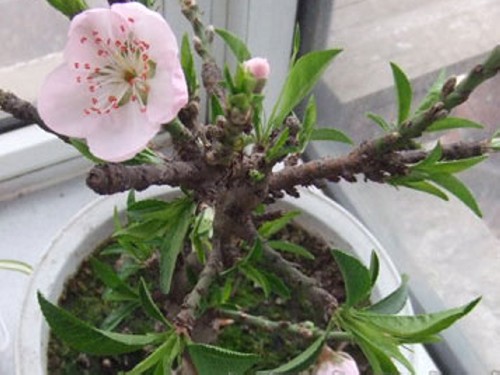
Peach blossom bonsai has very high ornamental value and is a common subject in literary creation. Every year from March to June is exactly the season when peach blossoms are in full bloom. At home we grow a pot of peach blossom bonsai, nearly twenty years old, with a graceful tree form, well-spaced branches, plump blossoms and brilliant colors that everyone admires.
Five years ago in summer I was eating a 'Piqiu' peach on the balcony, big, sweet and crisp. The original pot had held a yellow magnolia (Michelia alba) that later died, because when we planted it we did not know the nursery grower, to save trouble, had planted it straight in with the plastic bag still around it, so a very large pot was left empty. We had planned to buy a tree the following spring and plant it in, but after finishing the peach I couldn't resist digging a hole, adding a bit of soil and calling it done. Then in autumn a little sprout came up, I didn't notice it and didn't pull it out, and when spring came the sprout suddenly shot up, and only then did I realize it was a peach tree. It grew for a year, flowered the second year, and after another year it began to bear fruit. The first time it set 5 fruits, just a bit small, but the taste and peach fragrance were the same as the 'Piqiu' peach, unbelievably delicious.
This year strong wind blew many little fruits off, leaving 3, then another gale withered one, leaving only two. In June, seeing that a peach on the outer side of the terrace had split open, I thought I would get up in the morning and pick it to eat, but that night the wind blew hard again and it dropped. Still, I ate one. It proved the saying: plant a flower with care and it will not bloom; plant a willow without thinking and it will grow into shade.
As for the question of peach pits sprouting, I can only tell you my process; it may have no scientific basis. When eating a peach, I peel the flesh with a knife to eat it, and it is best not to get saliva on it.
As for grafting, there are no peach trees or orchards around where I live, so where would I get scion wood? And this peach tree sets 1 or 2 fruits on almost every spot that can bear fruit, but in the end the yield it produces is just something to amuse the family with; I never thought it could fill us up.
As for the pot, 47cm in diameter is roughly half a meter.
As for watering, peach trees need attention to watering; when the leaves droop it is time to water. In spring and autumn water every other day, in summer almost every day, and in winter after the leaves have all dropped, water once a week. When fruiting you can let it be a bit drier, so the fruit will be very sweet.
As for fertilizing, generally in winter use rotted oil cake; I have also applied it in spring. There is no fixed rule; if the soil is black, do not fertilize. Oil cake is the brown-black powder left after rapeseed is pressed for oil; scoop a big spoonful into a plastic bag, wet it with water and tie it tight. The longer it rots the less likely it is to burn the roots; 2 weeks or more is recommended. Note that when fertilizing it must not directly touch the roots.
Birds will certainly come to eat them; when the fruit starts to turn red you must wrap it in paper. If a fruit grows on the outermost branch, it may be sacrificed at any time. As for when to eat them, the birds know best. 'Piqiu' peaches are eaten late and only fully ripen in late June (a regional factor).
Peach bonsai suitable for balcony growing:
1. Zaolu flat peach
The tree posture is open, with many compound flower buds, and all types of fruiting branches can bear fruit. The fruit-setting rate is high, with a single fruit weight of 100 grams. The fruit is flat, with a sunken top and a shallow suture. The base color of the skin is creamy yellow, with a red blush on the sunny side. The fruit-viewing period is about 75 days. It is one of the excellent varieties for making peach bonsai for early marketing.
2. Late-ripening large flat peach
The tree vigor is moderate, with many compound flower buds, and all types of fruiting branches can bear fruit. The largest single fruit weighs 240 grams. The skin is greenish white with bright red patchy blush. The fruit-viewing period is about 110 days.
3. Chongyanghong
Young trees have strong bud-break rate and branching ability. After fruiting, the tree vigor is moderate, the tree posture is semi-open, and the fruit is extra large, with a single fruit weight of about 350 grams and a maximum weight of 700. Nearly round, bright red. The fruit-viewing period is about 180 days.
4. Zhonghua Shoutao
The fruit is nearly round, with an average single fruit weight of 350 grams, and when grown in a pot the largest single fruit reaches 1200 grams. The color is bright red. The fruit surface is smooth, ripening in early October. Around National Day is the best viewing period for bonsai of this variety.
5. Wanmi
The tree vigor is strong, the tree posture is semi-open, with rose-shaped flowers. All types of fruiting branches can bear fruit. The fruit is nearly round, with an average single fruit weight of 260 grams, and when grown in a pot the largest single fruit can reach 500 grams. After bagging, the fruit takes on bright red. Around National Day is the best viewing period.